The Wymerts Canal
Workum's main thoroughfare wasn't always a street.
Full story unlocks in the tour
 Michielverbeek / CC BY-SA 4.0, via Wikimedia Commons
Self-guided audio walking tour of Workum — GPS route, offline playback, story-driven narration in 32 languages.
“Where ancient waterways shaped a city, and everyday objects became art.”
Not the postcards. The stories even locals don't know — whispered in your ear, right where they happened.
Workum's main thoroughfare wasn't always a street.
The city's emblem tells a story that predates its current design.
Every October, traditional sailing ships compete in a race with a rather unusual cargo.
Discover every secret of Workum
Every address, every reveal in full — in your ear, right where it happened.
You pick your stops. You walk. The voice reveals what the others miss.

Your self-guided audio tour of Workum is ready — pick your landmarks, choose your language, and start the moment you arrive.
BuyLume has a built-in augmented-reality guide. Hold your phone up and its camera shows the street ahead of you, with a glowing arrow laid over the real view that always points to your next stop — no map to puzzle over, no wrong turns. Like everything in Lume, it works fully offline.
Workum, or Warkum in West Frisian, is a captivating city in the Dutch province of Friesland, one of the storied Eleven Cities. With a population of around 4,500, it offers a tranquil escape with a deep maritime and artistic heritage. The city's protected cityscape, established in 1988, features beautifully preserved facades, historic canals, and narrow alleys that invite leisurely exploration.
Once a significant trading center on the former Zuiderzee (now the IJsselmeer), Workum's past is deeply intertwined with water. Its strategic location connected the Zuiderzee with the Frisian inland lakes, fostering a thriving shipbuilding industry and trade. Today, this connection to water is still evident in its character, from the museum harbor filled with traditional fishing boats to the shallow waters of the IJsselmeer beach, ideal for children and kitesurfers.
Beyond its picturesque canals and historic buildings, Workum is a haven for art and culture enthusiasts, particularly known as the birthplace of the beloved self-taught painter Jopie Huisman. His museum offers a unique and moving insight into his life and work, celebrating the beauty found in the ordinary. Whether you're drawn to history, art, or the serene Frisian landscape, Workum presents a distinctive and memorable experience.
## From Salt Marsh to Seafaring Hub Workum's origins trace back to an agrarian settlement in the southwestern salt marsh, with early habitation suggested by low dwelling mounds (terpen) before 1000 CE. Its strategic development into an important maritime center in the late Middle Ages was largely due to its location along the Wymerts waterway, which linked the Zuiderzee with the Frisian inland lakes. This vital connection allowed the town to expand and densify along its banks, integrating agricultural cores into its urban fabric.
## Rise and Fall of a Trading Power Workum officially received its city rights in 1399. While the 15th century saw a decline in Frisian shipping due to the rise of Dutch and Zeelandic cities and the decline of the Hanseatic League, Workum maintained its economic standing through its burgeoning shipbuilding industry. However, the early 16th century brought turmoil, with foreign troops invading and plundering the city, even destroying the church in 1515 and 1523. Despite these setbacks, Workum's economy gradually recovered throughout the 16th century by supplying ships and sailors for the Dutch trade.
## A Shifting Landscape and Enduring Crafts The 17th century saw the emergence of new industries like pottery and tile manufacturing, alongside a continued reliance on shipping. A significant change to the city's landscape occurred in 1785 when the Wymerts waterway was filled in, creating the central Merk square and the main streets of Noard and Súd. The Anglo-Dutch War (1780–1784) and the French period, which halted maritime trade, marked the end of Workum's status as a major port city. In the 19th century, economic decline continued, with the ceramic industry largely disappearing due to the rise of enamel production and shipbuilding scaling down. Only the eel fishery remained active until around 1900.
## Preserving the Past Despite the economic shifts, Workum's spatial structure and size remained largely unchanged, though the cityscape underwent transformations. Today, Workum is recognized for its protected cityscape, showcasing beautifully preserved facades, old canals, and narrow alleys that offer a tangible link to its deep and complex past.
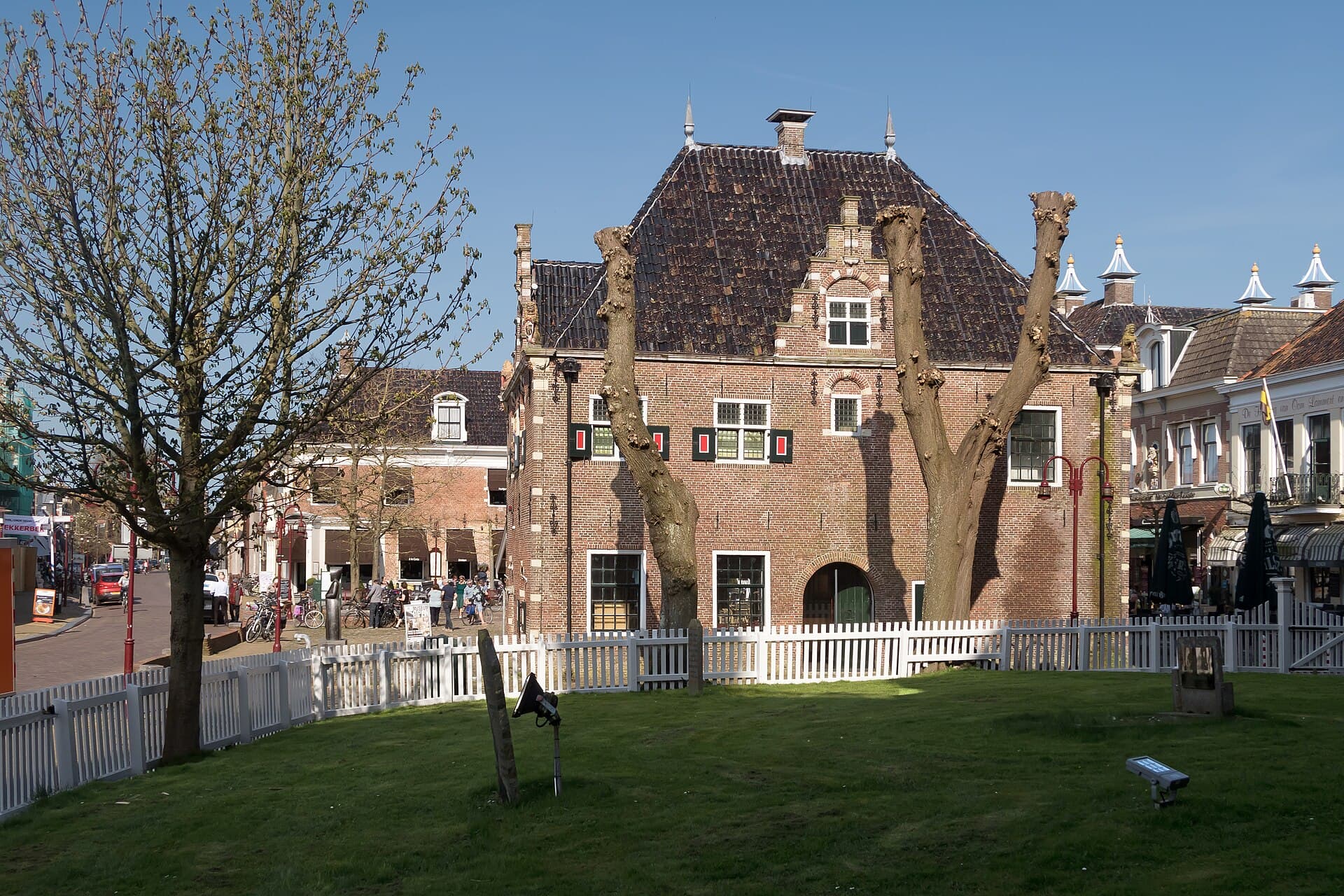
Begin your exploration at the Merk, Workum's central market square, where you'll find De Waag (the Weigh House), a beautiful 1650 building that once weighed goods like butter and cheese. Today, it houses Museum Warkums Erfskip, offering insights into Workum's maritime history and showcasing a collection of traditional Workum pottery.
Stroll along It Noard and It Súd, the main streets that were once the Wymerts canal, to admire the wealth of historic houses with their distinctive stepped, bell, and spout gables. Keep an eye out for the Sleeswijckhuis at Noard 5, a striking 17th-century merchant's house.
Immerse yourself in the world of the celebrated Frisian painter at the Jopie Huisman Museum. This modern museum, dedicated to the self-taught artist, presents his moving paintings and drawings of simple Frisian life and everyday objects.
Visit the imposing Grote of Sint-Gertrudiskerk (Great or St. Gertrude's Church), a late-Gothic cruciform basilica that dominates the skyline. Inside, you'll discover decorated tombstones and a unique collection of guild biers.
Explore the Blazerhaven, a museum harbor filled with original sailing fishing boats from the early 20th century, offering a picturesque and photogenic spot. For a touch of modern art, seek out The Wild Lions Fountain, part of the 11Fountains project, where water spouts from the lions that have graced Workum's coat of arms for centuries.
Workum is also home to four windmills: De Nijlânnermolen, De Snip, It Heidenskip, and Ybema's Molen, which are important parts of the Dutch landscape and history.
The best time to visit Workum, and the Netherlands in general, for warm-weather activities is from late June to early September. During these months, temperatures are comfortable, averaging around 67-69°F (19-21°C), and skies are clearest in July. This period is ideal for enjoying outdoor activities, exploring the city on foot or by bicycle, and experiencing lively events.
Spring (March to May) is also a lovely time, particularly April, if you wish to see the iconic tulip fields in bloom, though it can be more crowded. Fall (September to November) offers pleasant weather, beautiful foliage, and fewer tourists, with temperatures ranging from 48-66°F (9-19°C). Workum can be visited year-round, with winter offering a quieter experience and annual events like the Winter Fair.
Workum is easily accessible by train, with Workum station located on the Leeuwarden - Stavoren railway line. The town is also served by several bus lines connecting it to nearby towns like Bolsward, Sneek, Makkum, and Hindeloopen.
Once in Workum, the historic city center is best explored on foot, allowing you to appreciate the intricate facades and charming alleys. The town is a protected heritage area, making a simple walk an attraction in itself. For those interested in cycling, the surrounding Frisian landscape and IJsselmeer coast offer beautiful routes.
Workum offers a range of accommodations, from cozy bed and breakfasts to hotels. It's advisable to book in advance, especially during peak summer months. For tourist information, the VVV Workum can provide assistance with planning your trip and discovering local activities.
Workum in Korean, in Chinese or in Hebrew — and 29 more languages, every stop narrated by a native voice. The widest language range of any self-guided audio tour.
Available in: