Commercial Avenue
Anacortes' main thoroughfare wasn't always so prim and proper.
Full story unlocks in the tour
 JXthemeteorologist / CC0, via Wikimedia Commons
Self-guided audio walking tour of Anacortes — GPS route, offline playback, story-driven narration in 32 languages.
“Where island charm meets salty tales and grand ambitions.”
Not the postcards. The stories even locals don't know — whispered in your ear, right where they happened.
Anacortes' main thoroughfare wasn't always so prim and proper.
The historic Carnegie Library building holds more than just books.
Look closely at the sidewalks downtown, and you might see a glimpse into the past's innovative lighting.
Discover every secret of Anacortes
Every address, every reveal in full — in your ear, right where it happened.
You pick your stops. You walk. The voice reveals what the others miss.
Your self-guided audio tour of Anacortes is ready — pick your landmarks, choose your language, and start the moment you arrive.
BuyAnacortes, a city on Fidalgo Island in Washington State's Puget Sound, offers a captivating blend of maritime heritage, natural beauty, and small-town charm. Founded in 1879 by railroad surveyor Amos Bowman, who named it after his wife, Anne Curtis, Anacortes was initially envisioned as the 'New York of the West' and a major transcontinental railroad terminus. While that grand ambition never fully materialized, the city evolved into a vital hub for lumber, fishing, and later, oil refining.
Today, Anacortes serves as the primary gateway to the San Juan Islands, with the Washington State Ferries terminal providing connections to Lopez, Shaw, Orcas, and San Juan Islands. Beyond its role as a ferry departure point, the city itself is a destination, with a historic downtown, over 50 miles of hiking trails, and an active arts and culinary scene. Its moderate marine climate, tempered by the ocean, ensures mild temperatures year-round, making it an appealing spot for outdoor enthusiasts and those seeking a relaxed coastal experience.
For thousands of years before European settlement, Fidalgo Island was home to the Samish and Swinomish people, Coast Salish tribes who built a rich culture around the abundance of the sea. They lived in cedar longhouses, some over 1,000 feet long, and expertly harvested salmon and shellfish, crafting clothing and basketry from natural materials. Spanish and British explorers arrived in the late 1700s, mapping and naming the surrounding waterways and islands. White pioneers began settling on Fidalgo Island in the 1850s, drawn to the clear meadowlands of March's Point for farming.
Anacortes itself was established in 1879 by Amos Bowman, a railroad surveyor who named the budding town after his wife, Anne Curtis. Bowman, a former journalist for The New York Tribune, aggressively promoted Anacortes as the future western terminus of the transcontinental railroad, even establishing a newspaper, The Northwest Enterprise, to champion his vision of the 'New York of the West.' This speculation fueled a rapid boom in real estate in early 1890, and the town was officially incorporated in 1891. However, the promised major railroad terminus never fully materialized, leading to an economic bust in late 1891, which foreshadowed the nationwide Panic of 1893.
Despite the initial railroad disappointment, Anacortes found its footing as a center for lumber and fishing. The early waterfront was a bustling hub for the 'mosquito fleet' – steamships and gas launches that connected Puget Sound communities before reliable roads existed. In the 1920s, Anacortes was known as the 'City of Smokestacks' due to its timber mills and salmon canneries. The fishing tradition, including ventures to Alaskan waters, began in the 1890s. In the 1950s, oil companies established large refineries near Anacortes, and today, two of Washington's five refineries are located here, with oil refining remaining a significant industry alongside yacht and shipbuilding.
The mid-20th century saw Anacortes actively pursuing community development. In the 1950s, local newspaper publisher Wallie Funk, inspired by Dr. Richard Poston's book Democracy Is You, led a 'do-it-yourself' program involving over 1,200 citizens, contributing to the city's designation as an All-America City in 1962. Anacortes has successfully navigated economic shifts, preserving many of its traditions while embracing new focuses on technology, tourism, and the arts.
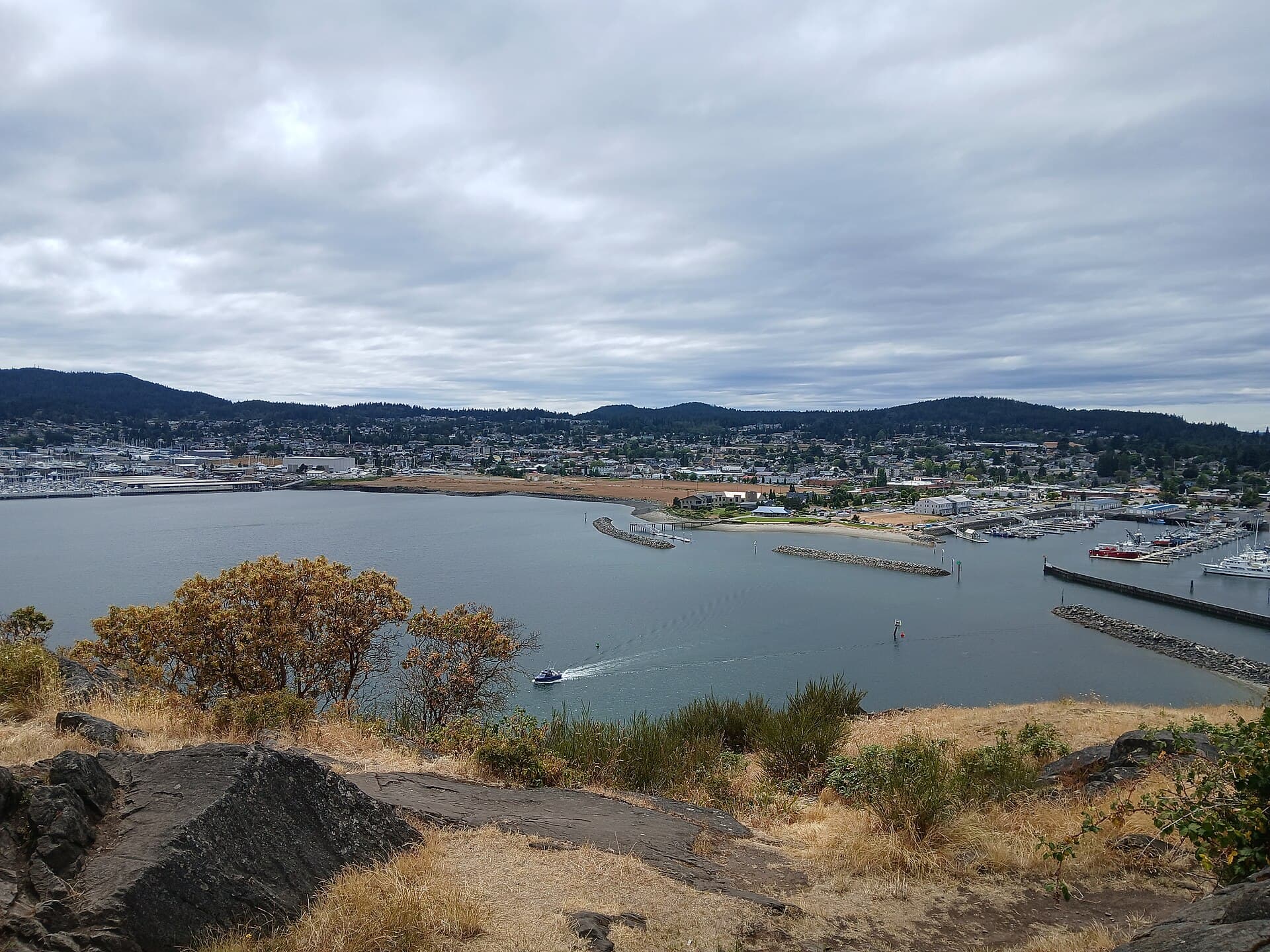
Anacortes offers a diverse array of sights and activities. Begin with a stroll through the Downtown Historic Mural Tour, where over 150 murals depict the town's history, many with QR codes for more information. For expansive views, head to Cap Sante Park overlook, offering vistas of the islands and waterways. Another elevated perspective can be found at Mount Erie, the highest point on Fidalgo Island.
Nature lovers will appreciate Washington Park, a 220-acre park on the westernmost point of the Anacortes peninsula. It features a scenic 2.2-mile loop trail that can be walked or driven, offering views of the San Juan Islands and Olympic Mountains. The park also has camping and picnic areas. Nearby, Deception Pass State Park, one of Washington's most visited parks, presents dramatic cliffs, swirling waters, numerous trails, beaches, and the iconic Deception Pass Bridge connecting Fidalgo and Whidbey Islands. You can even walk across the bridge, 180 feet above the sea.
For a unique historical experience, visit the W.T. Preston snagboat, a National Historic Landmark. This 1939-built vessel, one of only two surviving U.S. Army Corps of Engineers snagboats, is part of the Maritime Heritage Center and was used to remove debris from rivers. Another unusual sight is the La Merced Breakwater, an overgrown ship hulk that was once a four-masted schooner and floating Alaskan cannery, now serving as a striking breakwater. Do not miss Causland Memorial Park, the city's first park, redesigned in 1919 as a World War I memorial with intricate stone architecture and mosaics crafted from locally gathered stones.
Anacortes experiences a moderate marine climate, with mild temperatures year-round and no extreme heat or severe frosts. The most popular time to visit is during the spring and summer months, particularly from mid-May to September, when there are more days of sunshine and comfortable weather. July and August are the driest and sunniest, with average temperatures around 17-20°C, ideal for outdoor activities. While summers are pleasant, it's always wise to be prepared for some rain, as it is Washington State. For fewer crowds and potentially more budget-friendly travel, consider visiting in September and the first two weeks of October, which often offer excellent weather.
Anacortes is on Fidalgo Island and is accessible by car via Highway 20, the longest highway in Washington State. From Seattle, it's about a 1.5-hour drive, and ferries also connect Seattle to Anacortes. The city is also the departure point for Washington State Ferries to the San Juan Islands. While there are smaller regional airports nearby, the closest international airports are in Bellingham and Seattle-Tacoma (SEATAC).
Once in Anacortes, a car is recommended for exploring the wider area, though many downtown attractions are walkable. The city offers a variety of accommodations, from RV parks to hotels. Dining options are diverse, with farm-to-table menus and local specialties. For those planning outdoor activities, remember to wear a hat and SPF, especially near the water, even if temperatures aren't excessively hot. In winter, a waterproof jacket and warm layers are advisable due to increased precipitation and sea breezes.
Anacortes in Korean, in Chinese or in Hebrew — and 29 more languages, every stop narrated by a native voice. The widest language range of any self-guided audio tour.
Available in: