Spokane Falls
The Spokane Falls, a powerful natural landmark, possess a significance that extends beyond their visual impact.
Full story unlocks in the tour
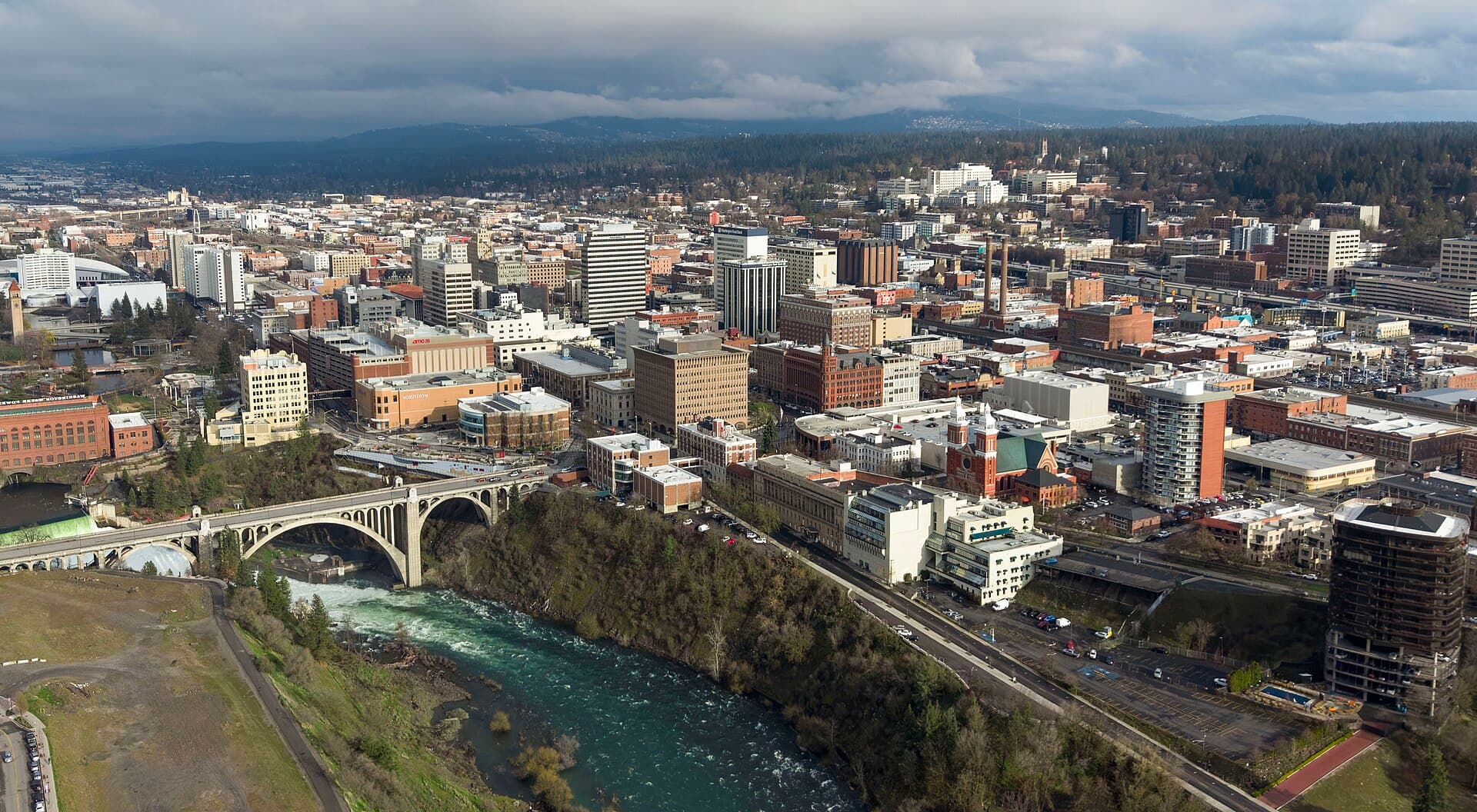 Quintin Soloviev / CC BY 4.0, via Wikimedia Commons
Self-guided audio walking tour of Spokane — GPS route, offline playback, story-driven narration in 32 languages.
“Where urban energy meets natural grandeur, Spokane invites you to explore its spirited confluence.”
Not the postcards. The stories even locals don't know — whispered in your ear, right where they happened.
The Spokane Falls, a powerful natural landmark, possess a significance that extends beyond their visual impact.
A walk through downtown Spokane reveals a remarkable collection of turn-of-the-century buildings.
Manito Park is celebrated for its beautiful gardens, yet one particular section maintains a quiet, international connection.
Discover every secret of Spokane
Every address, every reveal in full — in your ear, right where it happened.
You pick your stops. You walk. The voice reveals what the others miss.


Your self-guided audio tour of Spokane is ready — pick your landmarks, choose your language, and start the moment you arrive.
BuyLume has a built-in augmented-reality guide. Hold your phone up and its camera shows the street ahead of you, with a glowing arrow laid over the real view that always points to your next stop — no map to puzzle over, no wrong turns. Like everything in Lume, it works fully offline.
Spokane, Washington, often referred to as the "Lilac City" or "River City," stands as the second-largest city in Washington State and the metropolitan core of the Inland Northwest. Situated along the Spokane River, approximately 110 miles south of the Canadian border, the city rises to an elevation of 1,843 feet above sea level. Its name, derived from the Spokane Tribe of Indians, translates to "Children of the Sun" in Salish.
Spokane offers a distinctive blend of urban amenities and convenient access to the natural world, experiencing four distinct seasons. The city functions as a significant transportation and shipping hub, particularly for the agriculture and healthcare industries. Beyond its economic importance, Spokane is recognized as the largest city between Seattle and Minneapolis, establishing its role as a crucial regional center.
The Spokane Tribe of Indians, whose ancestors inhabited approximately 3 million acres of northeastern Washington, Idaho, and Montana, have called this region home for at least 9,000 years. Living a semi-nomadic existence, they primarily resided along the Spokane and Columbia rivers during winters, relying extensively on fish, especially salmon, for their sustenance. The first direct encounters between Spokane men and Europeans occurred on May 6, 1806, during the Corps of Discovery expedition led by Meriwether Lewis and William Clark.
European settlement commenced in 1810 with the establishment of Spokane House, a trading post at the confluence of the Spokane and Little Spokane rivers. This marked the first long-term, non-Indian settlement in what is now Washington State. The city of Spokane, initially known as Spokan Falls, was officially incorporated on November 29, 1881, with a population of 350 residents. The "e" was added to Spokane in 1883, and "Falls" was removed in 1891.
A pivotal moment in Spokane's past was the Great Fire of 1889, which devastated 32 blocks of downtown. However, the city rapidly rebuilt in a grander style, propelled by a flourishing economy from regional mining. This era saw the construction of many architecturally significant buildings, with Romanesque Revival and American Craftsman styles becoming particularly prominent.
In 1974, Spokane achieved international recognition by hosting Expo '74, a World's Fair centered on environmental preservation and sustainability. Notably, Spokane holds the distinction of being the smallest city to ever host a World's Fair. The enduring legacy of Expo '74 is Riverfront Park, a former rail yard transformed into an active urban green space. Spokane is also recognized as the birthplace of Father's Day, with the first celebration occurring on June 19, 1910, thanks to the efforts of local resident Sonora Smart Dodd.
Begin your exploration at Riverfront Park, the enduring legacy of Expo '74. This expansive urban park features walking paths, sculptures, and views of the Spokane River and its falls. You can ride the Numerica SkyRide for expansive views of the falls or explore the Looff Carrousel, a historic attraction.
For a deeper understanding of the region's past, visit the Northwest Museum of Arts & Culture (MAC). The MAC includes the historic Campbell House, a beautifully preserved Craftsman-style home designed by Kirtland Cutter, offering a glimpse into early 20th-century Spokane life.
Walk through downtown Spokane to appreciate its varied architectural heritage. Many buildings, particularly those constructed after the Great Fire of 1889, display Romanesque Revival, Art Deco, and Renaissance Revival styles. Seek out landmarks like the Fox Theater, an Art Deco masterwork, and the Davenport Hotel, a Renaissance Revival edifice.
Retreat to the tranquility of Manito Park, a sprawling urban oasis. The park features several distinct gardens, including the Nishinomiya Japanese Garden, the Rose Hill Garden, and the Gaiser Conservatory.
Spokane is also known for its active arts scene. Attend a performance at the Bing Crosby Theater, named after the celebrated singer who spent his childhood in Spokane.
The ideal time to visit Spokane for warm-weather activities is from early July to late August. Summers are typically warm, dry, and mostly clear, with average daily high temperatures above 78°F, reaching 86°F in July. Precipitation is lowest in August. Spring and autumn, particularly May and September, also offer pleasant, mild weather, avoiding the summer heat and winter cold. September still sees average temperatures around 70°F before cooling. Winters, from December to February, are cold and snowy, with average temperatures ranging from 25°F to 40°F and an average of 44-48 inches of snowfall annually.
Spokane International Airport (GEG) serves as the primary airport for the Inland Northwest, located approximately 7 miles west-southwest of Downtown Spokane. The airport code GEG is derived from its former name, Geiger Field. Public transportation within Spokane is managed by the Spokane Transit Authority (STA), offering bus services throughout the city and surrounding areas.
The local currency is the US Dollar (USD). Tipping customs align with standard practices for the United States, with 15-20% being customary for good service in restaurants and for other service industry professionals. Spokane experiences four distinct seasons, so pack appropriately. Summers can be hot, with temperatures occasionally exceeding 90°F, while winters bring significant snowfall and freezing temperatures. It is worth noting that the city's name is pronounced "Spo-CAN," not "Spo-CANE."
Spokane in Korean, in Chinese or in Hebrew — and 29 more languages, every stop narrated by a native voice. The widest language range of any self-guided audio tour.
Available in: