Fountain aux Dauphins
The village square's fountain features four bronze dolphins, a curious detail for a village far from the sea.
Full story unlocks in the tour
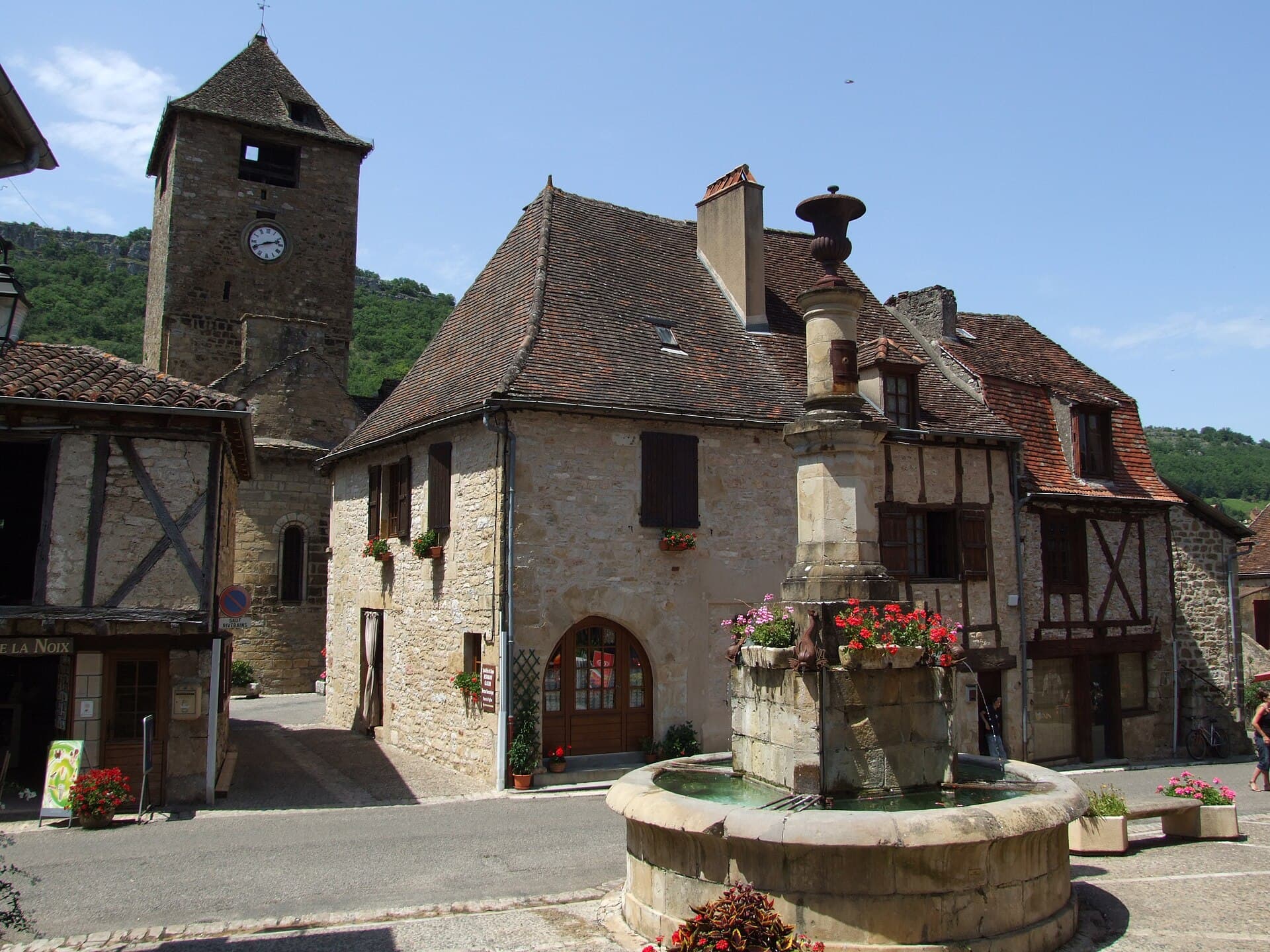 Christophe.Finot / CC BY-SA 2.5, via Wikimedia Commons
Self-guided audio walking tour of Autoire — GPS route, offline playback, story-driven narration in 32 languages.
“Where golden stone meets a dramatic cirque, and history breathes from every turret.”
Not the postcards. The stories even locals don't know — whispered in your ear, right where they happened.
The village square's fountain features four bronze dolphins, a curious detail for a village far from the sea.
Observe the exterior wall of the mairie and the interior of Auberge de la Fontaine for glimpses into Autoire's past.
One of Autoire's local sweet treats has a surprising connection to a major 19th-century battle.
Discover every secret of Autoire
Every address, every reveal in full — in your ear, right where it happened.
You pick your stops. You walk. The voice reveals what the others miss.


Your self-guided audio tour of Autoire is ready — pick your landmarks, choose your language, and start the moment you arrive.
BuyLume has a built-in augmented-reality guide. Hold your phone up and its camera shows the street ahead of you, with a glowing arrow laid over the real view that always points to your next stop — no map to puzzle over, no wrong turns. Like everything in Lume, it works fully offline.
Autoire, a designated 'Plus Beaux Villages de France' (Most Beautiful Villages of France), is a small village in the Lot department, close to the border with the Dordogne. It is often called the 'Petit Versailles of the Lot' due to its elegant manor houses, châteaux, and half-timbered buildings. The village is set within an impressive cirque of high limestone cliffs, some reaching 150 meters, which creates a dramatic backdrop.
The village's architecture, characterized by honey-colored stone, brown-tiled roofs, and narrow streets, exudes a tranquil atmosphere. Autoire's appeal extends beyond its buildings to its natural surroundings, including a 30-meter high waterfall accessible via a scenic trail. It's a place where medieval history and natural beauty converge, offering a serene escape.
The region where Autoire is situated was inhabited as early as the beginning of the Common Era. A small settlement eventually formed, where people lived together peacefully, retreating to nearby caves for safety during times of conflict. The village's first written mention dates back to 895 in the cartulary of the Beaulieu sur Dordogne monastery. By the 11th century, Autoire and its church were under the ownership of the bishop of Cahors. The village later became a property divided between the lord of Turenne and the Baron of Gramat.
During the 14th and 15th centuries, the Hundred Years' War brought significant conflict to the region, with ownership of Autoire alternating between England and France. The Château des Anglais, a fortified castle, was constructed during this period, set into the cliffs above the town. Despite the protection offered by the Viscount of Turenne, the village was besieged by the English. The 16th century saw further devastation when Calvinist forces attacked Autoire, burning the church and ransoming villagers, with the village being burnt in 1562. Peace was finally restored in 1588.
The 17th century brought a period of peace, leading to the construction of beautiful houses, such as Château de Busqueilles. Much of Autoire was built during the Renaissance, attracting nobility who resided in large country houses like Château de Laroque-Delprat and Limargue. The elite of Saint-Céré also established second homes here, contributing to the village's elegant architecture and its nickname, 'Petit Versailles of the Lot'. Autoire has preserved its historic setting, offering a glimpse into its past through its well-maintained buildings and tranquil atmosphere.
Begin your exploration in the village square, where the Romanesque Church of Saint-Pierre-et-Saint-Paul, dating from the 11th century, stands. Its entrance features the coat of arms of the lords of Banze, who built it. The Fountain aux Dauphins, adorned with four bronze dolphins, is another focal point of the square. Wander through the narrow streets to admire the characteristic half-timbered houses with their soft yellow natural stone and brown roofs, along with old mansions and numerous towers that speak to the village's past prosperity.
A visit to Autoire is incomplete without experiencing its natural surroundings. A footpath, Chemin du Paradou, leads from the church square to the Autoire waterfall, a 30-meter cascade falling from limestone cliffs. For a more challenging hike, follow the path up to the ruins of the Château des Anglais, a 12th-century castle set into the cliff above the village. This ascent rewards you with expansive views of the valley and the village below. Other notable manor houses to observe include Château de Limargue and Château de Busqueilles.
Autoire is particularly appealing in spring, when the streets and gardens are filled with blossoms. The weather in May is typically mild, with temperatures ranging from 8°C to 19°C (47-66°F). This season offers comfortable conditions for exploring the village and its surrounding trails. Late July brings the 'Embrasement des Falaises,' a large fireworks display against the backdrop of the high cliffs, an event known to draw visitors.
Autoire is a small village, best explored on foot. Wear comfortable shoes, especially if you plan to hike to the waterfall or the Château des Anglais, as some paths can be steep and rocky. While there isn't an official tourist office in Autoire, helpful staff can be found at the mairie (council) near the church. Dining options within the village are limited, with a couple of restaurants offering terraces with views. For those staying longer, nearby towns like Saint-Céré offer more amenities. Autoire is part of the 'Grand Site Midi-Pyrénées' and the 'Rocamadour-Vallée de la Dordogne', making it a good base for exploring other regional attractions like Gouffre de Padirac and Rocamadour.
Autoire in Korean, in Chinese or in Hebrew — and 29 more languages, every stop narrated by a native voice. The widest language range of any self-guided audio tour.
Available in: