The Clock Tower
This monumental gateway holds a secret about the village's past prosperity that goes beyond its visual charm.
Full story unlocks in the tour
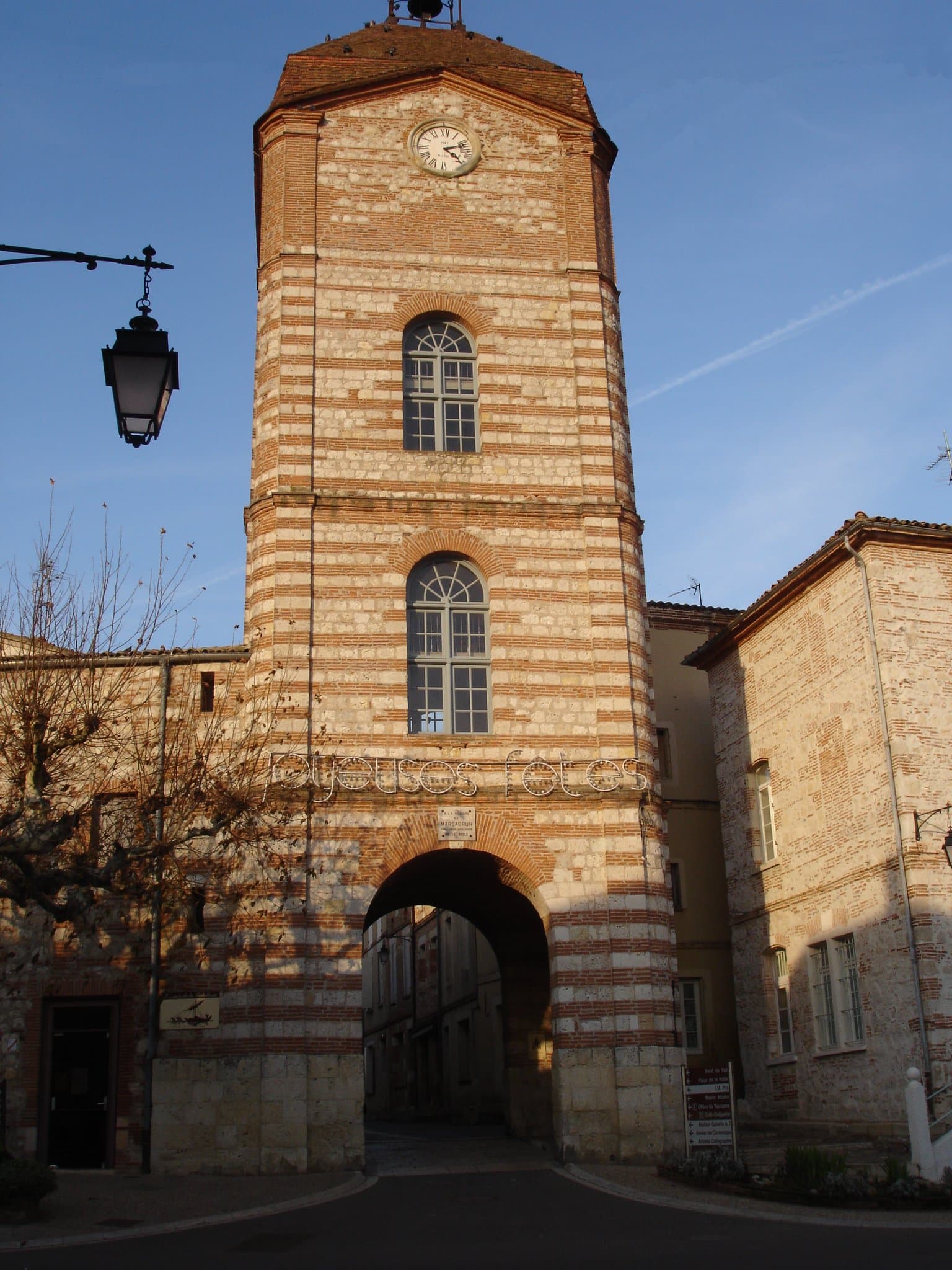 Unknown author / CC BY-SA 3.0, via Wikimedia Commons
Self-guided audio walking tour of Auvillar — GPS route, offline playback, story-driven narration in 32 languages.
“Where history echoes in red brick and river whispers.”
Not the postcards. The stories even locals don't know — whispered in your ear, right where they happened.
This monumental gateway holds a secret about the village's past prosperity that goes beyond its visual charm.
The unique circular market hall here isn't just a pretty face; it reveals a surprising historical function related to trade.
This seemingly peaceful building played a courageous role during a dark chapter of history, far beyond its religious origins.
Discover every secret of Auvillar
Every address, every reveal in full — in your ear, right where it happened.
You pick your stops. You walk. The voice reveals what the others miss.


Your self-guided audio tour of Auvillar is ready — pick your landmarks, choose your language, and start the moment you arrive.
BuyLume has a built-in augmented-reality guide. Hold your phone up and its camera shows the street ahead of you, with a glowing arrow laid over the real view that always points to your next stop — no map to puzzle over, no wrong turns. Like everything in Lume, it works fully offline.
Auvillar, a designated 'Most Beautiful Village in France,' ascends gracefully above the Garonne River in the Tarn-et-Garonne department of Occitanie. This village offers a journey back in time, with its distinctive red brick and white stone architecture, worn streets, and a tangible sense of history. It's a place where the past isn't merely preserved, but actively lives on in its structures and stories.
Beyond its visual appeal, Auvillar holds a significant place as a stop along the Way of St. James pilgrimage route, drawing both travelers and pilgrims. The village's strategic position on a rocky outcrop overlooking the Garonne Valley provided both defense and a vital connection to river trade, shaping its development over centuries.
Exploring Auvillar means stepping into a postcard-perfect setting, where every corner reveals a detail of its enduring heritage. From the iconic circular market hall to the expansive views of the Garonne, the village invites visitors to wander and discover its lasting allure.
Auvillar's history extends back to Gallo-Roman times, when it was known as Alta Villa, an oppidum strategically positioned on a rocky outcrop overlooking the Garonne River. This elevated vantage point offered clear views of approaching armies, making it a crucial defensive site.
Over the centuries, Auvillar faced numerous invasions, including those by the Normans until the 11th century. In response, formidable walls and a château were constructed to fortify the village. By the 12th century, it had become the capital and property of the Count of Armagnac. The village's early importance is further evidenced by the customs granted around 1120 by Viscount Saxet, which allowed for the levying of taxes on goods entering or passing through the port.
The fortress of Auvillar subjected the city to many conflicts, including the Crusade against the Albigensians, the Hundred Years' War, the Wars of Religion, and the Catholic League. These prolonged periods of conflict severely damaged many buildings, and the original château was destroyed. In the 16th century, the city became part of the Kingdom of Navarre, eventually attaching to the Crown of France in 1589 after Henri IV's coronation.
The 17th to 19th centuries marked a period of considerable prosperity for Auvillar, driven by two key industries: pottery and the preparation of goose quills for calligraphy. The pottery, with its distinctive fluted edges and striking colors, was so celebrated that it was exported to Bordeaux and even England. River navigation on the Garonne was vital for this trade, with boat traffic reaching an impressive 3,000 vessels per year at the beginning of the 19th century.
However, the late 19th century saw a decline in these industries, leading to a decrease in population as residents moved to larger cities like Toulouse and Montauban. Despite this, Auvillar has experienced a revival through tourism and local crafts, earning its classification as one of 'The Most Beautiful Villages in France' since 1994. Today, it continues to be a lively center for art and culture, hosting a large pottery market and various festivals throughout the year.
Begin your exploration at the Clock Tower, a 17th-century brick and white stone structure that once served as a fortified gate. Inside, the Museum of Earthenware and River Navigation details Auvillar's past as a center for pottery and goose quill production. Pass through to the Place de la Halle, a triangular square paved with stones and framed by 17th and 18th-century arcaded houses. The centerpiece is the singular circular market hall, rebuilt in 1825, which still hosts a lively farmers' market every Sunday morning.
Just off the main square, the Church of Saint-Pierre stands on the site of a 12th-century Benedictine priory, with only the small chapel behind the main church remaining from the original structure. Don't miss the panoramic viewpoint from Place du Château, the former site of the viscount's castle, offering expansive views over the Garonne Valley and the suspension bridge below. For a deeper dive into local traditions, the Museum of Old Auvillar showcases a remarkable collection of 18th and 19th-century local ceramics. A stroll along the waterfront promenade by the Garonne River provides a peaceful setting with scenic views.
The most pleasant time to visit Auvillar for warm-weather activities is from early June to late September. During these months, temperatures are comfortable, ranging from 19°C to 30°C (66°F to 86°F). July is particularly sunny, with an average of 8.4 hours of sunshine per day, and average temperatures between 16°C and 29°C (61°F and 85°F). May and October also offer enjoyable weather with moderate conditions. Rainfall is moderate throughout these periods, allowing for a good balance of sunny and rainy days.
Auvillar is approximately one hour from Toulouse and one and a half hours from Bordeaux by car. The village is a popular stop for pilgrims on the Way of St. James, and accommodations for pilgrims are available. For general visitors, Auvillar offers various accommodations, including bed and breakfasts, gîtes, and some hotels nearby. The village has essential amenities such as a bakery, grocer, newsagent, post office, chemist, and local produce gift shop. The Tourist Office, located in the former Ursuline convent, provides information on local activities and exhibitions. A farmers' market takes place every Sunday morning in the circular market hall, offering local produce. While Auvillar is relatively small and easily explored on foot, having a car allows for visits to nearby characterful villages and bastides such as Lauzerte, Moissac, and Montauban.
Auvillar in Korean, in Chinese or in Hebrew — and 29 more languages, every stop narrated by a native voice. The widest language range of any self-guided audio tour.
Available in: