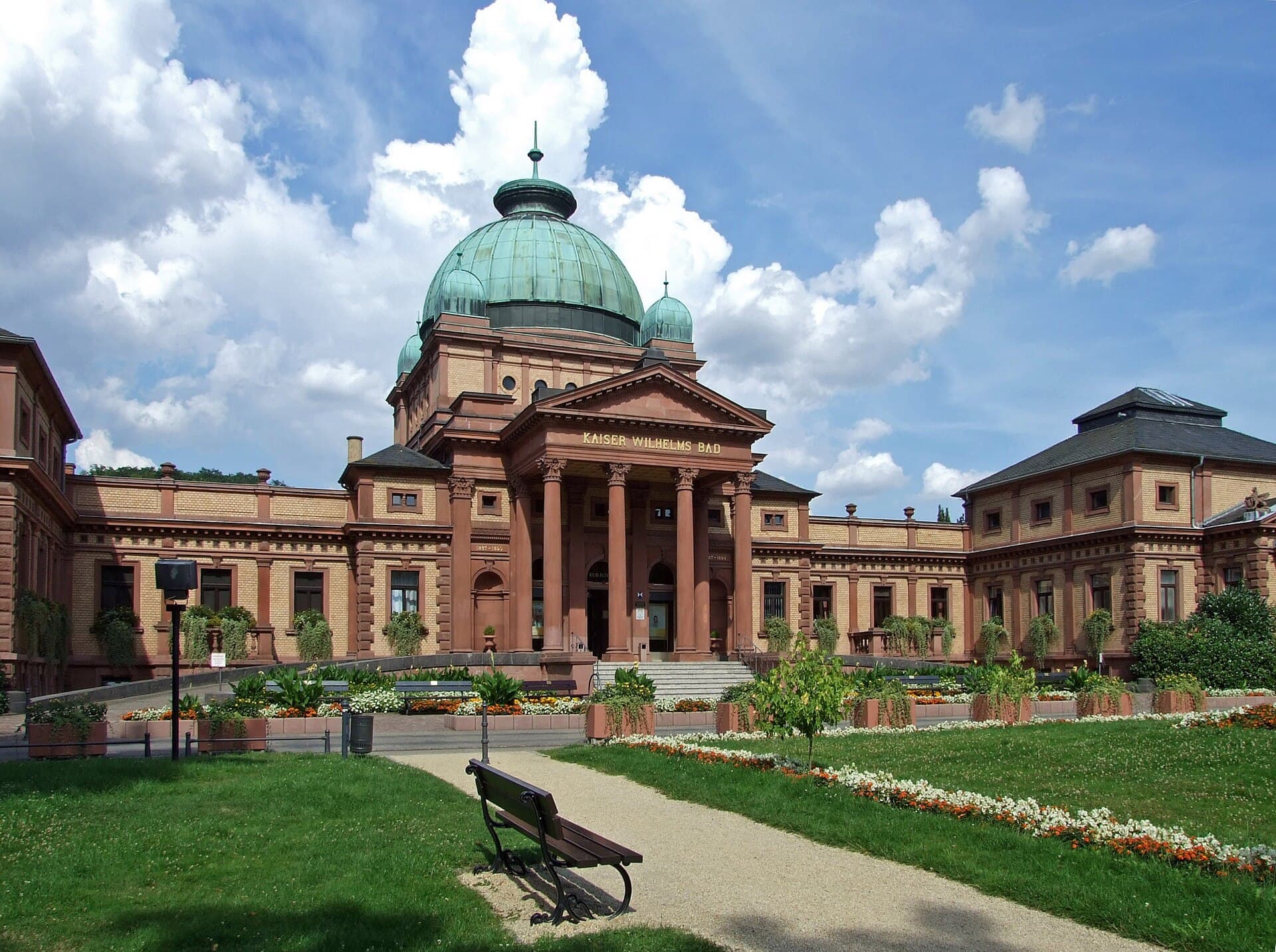
Bad Homburg, GermanyDontworry / CC BY-SA 3.0, via Wikimedia Commons
DE

Bad Homburg

Self-guided audio walking tour of Bad Homburg — GPS route, offline playback, story-driven narration in 32 languages.

Where imperial legacy meets the restorative power of 'Champagne air and tradition.'

The secrets of Bad Homburg

Bad Homburg, as no one tells it.

Not the postcards. The stories even locals don't know — whispered in your ear, right where they happened.

3 secrets below. Many more wait inside the tour.
Kurpark

Imagine a lavish 19th-century spa town, attracting European royalty and literary giants. What did one British king famously introduce to men's fashion after his visits?

Full story unlocks in the tour
Spielbank Bad Homburg

This elegant casino, one of Germany's oldest, holds a surprising connection to another world-renowned gambling mecca. What's its audacious nickname?

Full story unlocks in the tour
Elisabethenbrunnen (Princess Elizabeth's Spring)

Before Bad Homburg became a celebrated spa town, one of its most important mineral springs was 'rediscovered' in 1834. Who was the royal figure behind its name, and what was her surprising contribution to the town?

Full story unlocks in the tour
The full tour

Discover every secret of Bad Homburg

Every address, every reveal in full — in your ear, right where it happened.

Get the key to Bad Homburg

You pick your stops. You walk. The voice reveals what the others miss.

Bad Homburg — gray metal Herzberg signage
Photo: Larry Haubner / Unsplash
Bad Homburg — asphalt road scenery
Photo: Larry Haubner / Unsplash
Bad Homburg — person walking between trees during daytime
Photo: Larry Haubner / Unsplash
Choose your time

How long do you have in Bad Homburg?

Your self-guided audio tour of Bad Homburg is ready — pick your landmarks, choose your language, and start the moment you arrive.

Buy
About Bad Homburg

The story of Bad Homburg

Bad Homburg vor der Höhe, often simply called Bad Homburg, is a refined spa town situated at the southern edge of Germany's Taunus mountains, within the Frankfurt Rhein-Main urban area. Known for its mineral springs and elegant spa facilities, the town carries the motto 'Champagnerluft und Tradition' (Champagne air and tradition), reflecting its heritage as a destination for European nobility and its current status as one of Germany's wealthiest towns. It offers a blend of historical charm and modern wellness, providing a more subdued yet equally enriching experience compared to other German spa towns like Baden-Baden.

Visitors can explore a walkable town center featuring a medieval castle, upscale shopping streets, and expansive parks. Bad Homburg serves as an excellent base for exploring the region or as a day trip from nearby Frankfurt, easily accessible by public transport. The town's 'Bad' prefix, officially granted in 1912, signifies its recognition as an official spa town, a legacy that continues to shape its character today.

History

## From Medieval Settlement to Imperial Spa Bad Homburg's documented history is traditionally linked to a mention of the Villa Tidenheim in 782, though archaeological excavations suggest continuous settlement began later, around the 13th century. The town's name, 'Homburg,' is derived from the Hohenberg Castle, first mentioned around 1180. It acquired market rights around 1330.

In 1622, Homburg became the capital of the Landgraviate of Hesse-Homburg. Landgrave Friedrich II, known as the 'Prince of Homburg,' initiated the transformation of the old castle into a Baroque palace in 1680 and oversaw the establishment of the new town, fostering trade and commerce. The discovery of the first mineral spring in 1809 marked the beginning of Bad Homburg's journey as a spa town. The rediscovery of the Elisabethenbrunnen ('Princess Elizabeth's spring') in 1834, praised by chemist Justus von Liebig, further propelled its development.

The mid-19th century saw Homburg transform into an internationally renowned spa destination, particularly favored by Russian nobility. The Blanc brothers, François and Louis, built the first spa building and casino between 1841 and 1842, attracting wealthy Europeans and funding the development of luxury hotels and the Kurpark. A railway line connected the town to Frankfurt in 1860.

In 1866, Homburg became Prussian territory. A significant turning point arrived in 1888 when Kaiser Wilhelm II made Bad Homburg Castle his imperial summer residence, earning the town the nickname 'Kaiserstadt' (Emperor's City). He also financed the construction of the Church of the Redeemer. The official 'Bad' designation, recognizing its status as a spa town, was conferred in 1912. Bad Homburg also made sporting history by opening Germany's oldest golf club in 1899 (officially 1912). After World War II, General Eisenhower resided in the town, and the American presence significantly influenced local life and the economy. Today, Bad Homburg continues to balance its spa heritage with its role as a modern business center, while preserving its historic character.

What to see

Begin your exploration at the Kurpark, a sprawling 44-hectare landscaped park established in the 1800s. Here, you'll find several mineral springs, the historic Kaiser-Wilhelms-Bad building, and a Thai sala (pavilion) donated by the King of Thailand. The park offers walking paths, flower gardens, and a small lake. Make sure to visit the Schloss Bad Homburg (Castle), a medieval fortress with a distinctive 14th-century White Tower. The castle houses furnished royal apartments, a chapel, and a kitchen museum. Climb the 183 steps of the White Tower for expansive views.

Stroll along Louisenstrasse, the main shopping street, which features 19th-century architecture, upscale boutiques, and cafes. Experience the grandeur of Casino Bad Homburg, Germany's oldest casino, opened in 1841. Its elegant 19th-century interiors, complete with chandeliers, are open for tours during the day, with gaming available in the evenings (a dress code applies). The Russian Church (Church of All Saints), built in 1899 for Russian spa guests, stands out with its golden dome and traditional Orthodox architecture. For those seeking outdoor activity, the Taunus Mountains to the north offer hiking trails. Nearby, the reconstructed Saalburg Roman fort, a UNESCO World Heritage site, provides insight into the region's Roman past.

When to visit

The best time to visit Bad Homburg for warm-weather activities is from late June to early September. During these months, average daily high temperatures are above 68°F (20°C). July is typically the hottest month, with an average high of 74°F (23°C) and a low of 57°F (14°C), and also the sunniest, averaging 7.8 hours of sunshine per day. While July sees the most rainfall, the overall weather conditions are generally comfortable from May through September. Spring, when the flowers are in bloom, and autumn, for its changing colors, are also recommended for visiting the Kurpark.

Practical

Bad Homburg is easily accessible, located just north of Frankfurt and well-connected by the S5 line of the Rhein-Main S-Bahn from Frankfurt Hauptbahnhof, with regional trains taking approximately 16 minutes. The town center is walkable, and a decent bus system covers all main areas. Tickets for buses can be purchased on board. The Bad Homburg tourist information office is located in the Kurhaus, open Monday to Friday with shorter hours on Saturdays, and staff speak English. While the official tourism website is primarily in German, English brochures are available. For parking, the 'Parkhaus am Horexmuseum' offers 211 spaces across 13 levels, with a direct connection to some accommodations.

Good to know
What is the meaning of 'Bad' in Bad Homburg?
The prefix 'Bad' signifies that Bad Homburg is an official spa town, a designation granted in 1912, recognizing its mineral springs and therapeutic facilities.
Is Bad Homburg suitable for a day trip from Frankfurt?
Yes, Bad Homburg is an excellent choice for a day trip from Frankfurt, easily reachable by public transport (S-Bahn S5) in about 16 minutes.
What is the Homburg hat?
The Homburg hat is a type of felt hat popularized by King Edward VII of the United Kingdom, who was a frequent visitor to Bad Homburg.
Are there any Roman sites near Bad Homburg?
Yes, the reconstructed Saalburg Roman fort, part of the UNESCO World Heritage Site Limes Germanicus, is located near Bad Homburg and is accessible by local bus.
What kind of cultural events can I find in Bad Homburg?
Bad Homburg has a lively cultural scene, hosting events such as the poetry and literature festival, the FUGATO organ festival, and the Blickachsen art exhibition, along with various concerts, exhibitions, and theatrical performances throughout the year.
Is there a dress code for the Casino Bad Homburg?
Yes, a dress code applies for evening gaming at Casino Bad Homburg.
On the map
Bad Homburg
€9.90
No booking · activate anytime · 12h to walk it
Load on Wi-Fi, then walk offline — no roaming abroad
Get the key to Bad Homburg