The Weser River
Bad Karlshafen's founding involved a bold, yet ultimately unfinished, plan to reroute trade.
Full story unlocks in the tour
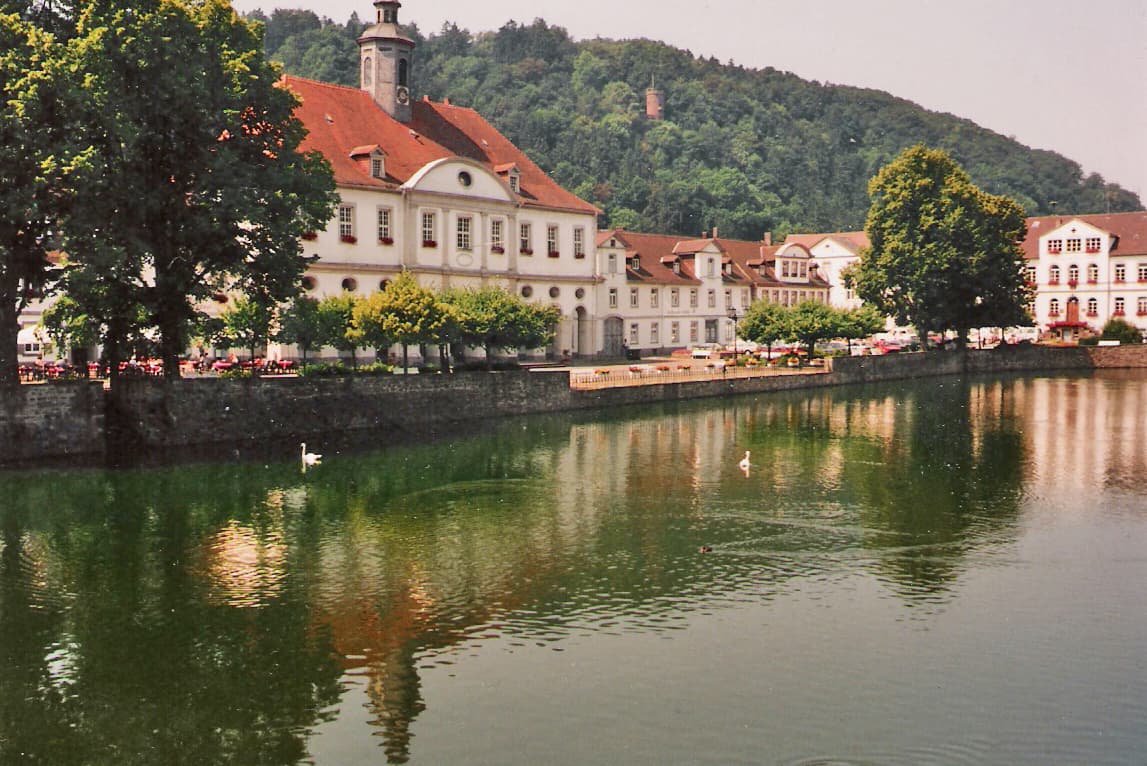 ERWEH / CC BY-SA 2.0 de, via Wikimedia Commons
Self-guided audio walking tour of Bad Karlshafen — GPS route, offline playback, story-driven narration in 32 languages.
“Where Baroque elegance meets the Weser's gentle flow, a spa town born of grand visions and enduring resilience.”
Not the postcards. The stories even locals don't know — whispered in your ear, right where they happened.
Bad Karlshafen's founding involved a bold, yet ultimately unfinished, plan to reroute trade.
This grand Baroque building, a central architectural feature, had a surprising initial purpose beyond its imposing facade.
Beyond its modern spa facilities, the healing waters of Bad Karlshafen have a specific, historical origin tied to a keen-eyed Huguenot.
Discover every secret of Bad Karlshafen
Every address, every reveal in full — in your ear, right where it happened.
You pick your stops. You walk. The voice reveals what the others miss.
Your self-guided audio tour of Bad Karlshafen is ready — pick your landmarks, choose your language, and start the moment you arrive.
BuyLume has a built-in augmented-reality guide. Hold your phone up and its camera shows the street ahead of you, with a glowing arrow laid over the real view that always points to your next stop — no map to puzzle over, no wrong turns. Like everything in Lume, it works fully offline.
Bad Karlshafen, a Baroque thermal salt spa town in Hesse, Germany, converges at the Diemel and Weser rivers. Founded in 1699 by Landgrave Carl of Hesse-Kassel as a refuge for French Huguenots fleeing religious persecution, the town was initially named Sieburg before being renamed Carlshaven in 1717 to honor its founder. Its distinct character is defined by elegant white Baroque houses arranged symmetrically around a central harbor basin.
The town's unique planned layout, with its rectangular street grid and uniform two-story stone buildings, reflects the ambitious vision of Landgrave Carl. While his grand plans for a canal connecting to Kassel to facilitate trade never fully materialized, the harbor became an important transshipment point for goods. Today, Bad Karlshafen offers a blend of historical charm and contemporary wellness, with its thermal salt spa, the Weser-Therme, drawing visitors seeking relaxation and health benefits from its saline springs.
Beyond its architectural and spa attractions, Bad Karlshafen is embraced by the natural beauty of the Reinhardswald fairy tale forest and offers numerous opportunities for outdoor activities along the Weser and Diemel rivers. The nearby medieval village of Helmarshausen, now part of Bad Karlshafen, adds another layer of history with its Romanesque castle ruins and former Benedictine monastery, once renowned for manuscript illumination and goldsmith workshops.
Bad Karlshafen's story begins in 1699 when Landgrave Carl of Hesse-Kassel founded the town, initially named Sieburg. His primary motivation was to provide sanctuary for French Huguenots, Protestants who had fled persecution in France following the Revocation of the Edict of Nantes in 1685. These 37 Huguenot families, including merchants, manufacturers, textile workers, and farmers, were seen as vital to the region's economic recovery after the Thirty Years' War.
Landgrave Carl had ambitious plans for his new settlement. He envisioned Bad Karlshafen as a significant trading center, strategically positioned at the confluence of the Diemel and Weser rivers. A key part of this vision was the construction of a canal to Kassel, intended to bypass the customs duties imposed in Hann. Münden. While the harbor was constructed, and the town's Baroque layout designed by architect Paul du Ry in 1717 was partially completed, the canal project never fully materialized beyond 17 kilometers. The town was renamed Carlshaven in 1717 in honor of its founder.
Despite the unfulfilled canal, Bad Karlshafen's harbor became an important transshipment point for goods. The town's economic trajectory shifted significantly in 1730 with the discovery of salt-laden springs by Huguenot apothecary Jacques Galland. A salt works was established in 1763, and from 1838, Karlshafen began to develop as a spa town, utilizing these therapeutic waters. This transformation was officially recognized in 1977 when the town received the designation "Bad," signifying its status as a spa.
Adjacent to Bad Karlshafen is the medieval village of Helmarshausen, which offers a glimpse into an even older history. The Romanesque Krukenburg, a castle ruin from the early 13th century, was originally built to protect the Benedictine monastery of Helmarshausen. This 10th-century monastery gained international renown for its school of manuscript illumination and goldsmith workshops, producing significant works like the Gospel Book of Henry the Lion. The area around Krukenburg is also believed to have been a site for Pagan worship. Today, visitors can explore the preserved sections of the abbey and learn about monastic life, while the castle tower offers expansive views of the Reinhardswald forest and the Diemel Valley.
Begin your exploration at the Harbor Basin, the architectural core of Bad Karlshafen, surrounded by elegant white Baroque buildings. The former Packhaus, dating from 1718, stands prominently at the center of the harbor front, now serving as the town hall.
Delve into the town's unique heritage at the German Huguenot Museum, housed in a former tobacco factory, which details the history and experiences of the Huguenot refugees who founded the town.
For relaxation, the Weser-Therme offers a modern health center with multiple indoor and outdoor pools, saunas, and massage services, all fed by the town's saline thermal spring. A highlight is the "Jacques Galland" boat sauna, situated directly on the Weser River.
Just a short distance away, explore the medieval village of Helmarshausen. Here, you will find the ruins of Krukenburg Castle, with its distinctive church built in 1107, offering expansive views. The Kloster Helmarshausen, a 10th-century former Benedictine monastery, is another significant historical site, once celebrated for its illuminated manuscripts and goldsmith work. Take time to wander through Helmarshausen's appealing half-timbered houses.
Outdoor enthusiasts can enjoy the Weser Skywalk for views of the valley, or explore the numerous hiking and cycling trails along the Diemel and Weser rivers, including connections to the Hessian Radfernweg R1 and R4.
The best time to visit Bad Karlshafen for warm-weather activities is from late June to late August. During these months, the average daily high temperature is above 66°F (19°C), with July being the warmest month, averaging 72°F (22°C). The skies are also clearest in July. The town hosts a City Culture Festival in August and a Salt Festival in September.
Winters are long, cold, and mostly cloudy, with the coldest month being January, averaging a low of 30°F (-1°C).
Bad Karlshafen is located in the district of Kassel, Hesse, Germany, at the confluence of the Diemel and Weser rivers. It is approximately 37 km north of Kassel and 15 km south of Höxter. The town is accessible by rail from Göttingen (heading west) or Ottbergen (heading east). Buses also connect from Hofgeismar, which is reachable from Kassel. If driving, Bundesstraße 83 runs north from Kassel and south from Höxter.
The Tourist Information Office is located at Hafenplatz 8. Many reasonably priced small hotels and a large campground on the riverbank are available for accommodation. English is spoken at the Weser Therme.
Bad Karlshafen in Korean, in Chinese or in Hebrew — and 29 more languages, every stop narrated by a native voice. The widest language range of any self-guided audio tour.
Available in: