The Limmat River
The Limmat River, a prominent feature of Baden, once served a surprising purpose beyond transport and scenery for the affluent.
Full story unlocks in the tour
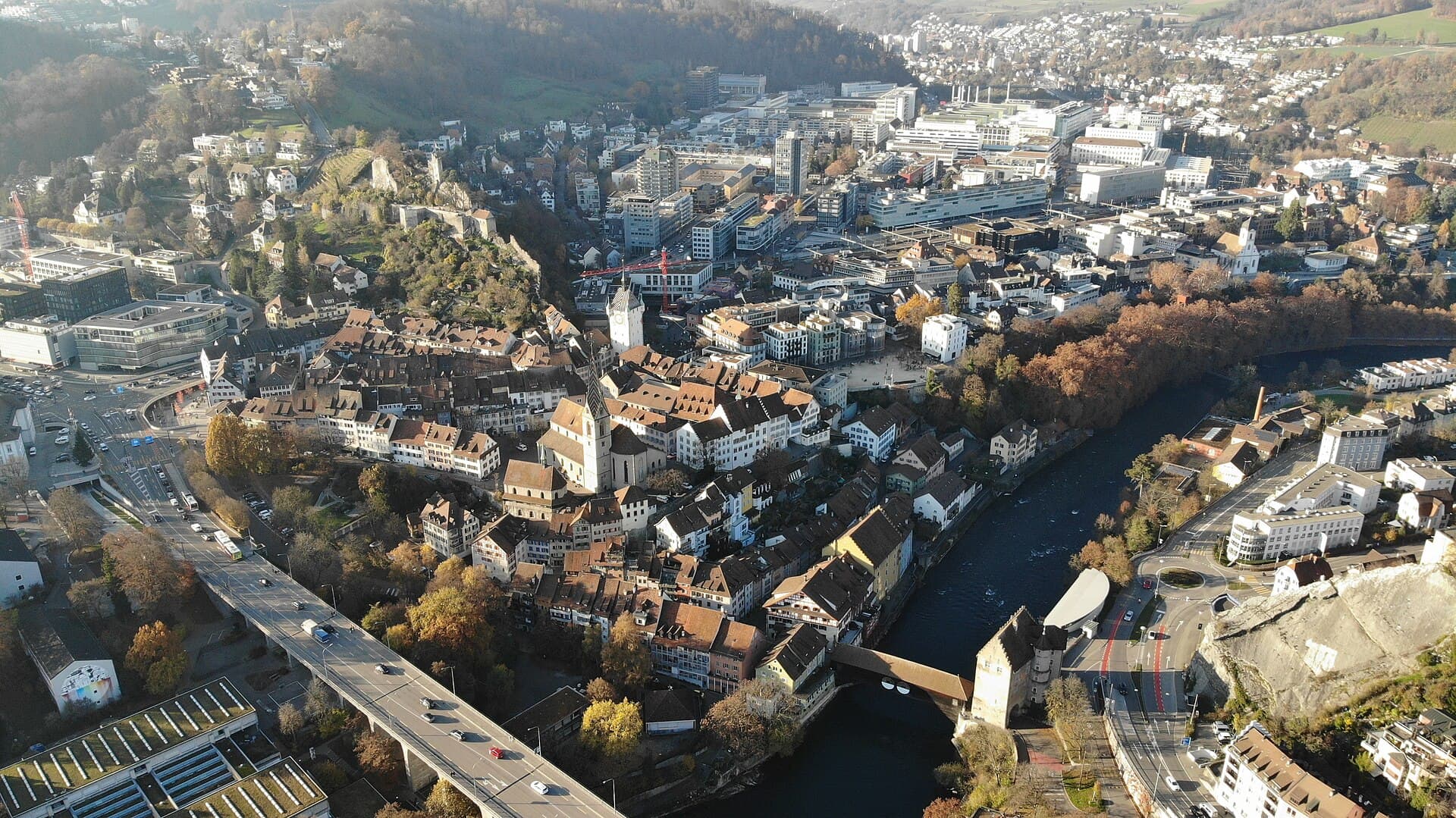 Lutz Fischer-Lamprecht / CC BY-SA 4.0, via Wikimedia Commons
Self-guided audio walking tour of Baden — GPS route, offline playback, story-driven narration in 32 languages.
“Where ancient thermal waters meet contemporary thought, Baden unfolds centuries of narratives.”
Not the postcards. The stories even locals don't know — whispered in your ear, right where they happened.
The Limmat River, a prominent feature of Baden, once served a surprising purpose beyond transport and scenery for the affluent.
Baden's striking City Tower, a medieval remnant, fulfilled a grimmer, more practical role for centuries.
The inaugural railway line in Switzerland carried a rather delightful, pastry-inspired designation.
Discover every secret of Baden
Every address, every reveal in full — in your ear, right where it happened.
You pick your stops. You walk. The voice reveals what the others miss.
Your self-guided audio tour of Baden is ready — pick your landmarks, choose your language, and start the moment you arrive.
BuyBaden, a captivating town in the canton of Aargau, Switzerland, is celebrated for its natural mineral hot springs and a history spanning millennia. Situated along the Limmat River, approximately 25 kilometers northwest of Zurich, Baden gracefully merges historical appeal with a contemporary way of life.
Visitors are drawn to its well-preserved Old Town, where car-free, cobbled streets meander past meticulously restored buildings housing boutiques and cafés. Beyond its scenic beauty, Baden is a center of culture, innovation, and well-being, offering a diverse array of experiences from ancient Roman bathing customs to modern art and technology.
The town's thermal springs, possessing the highest mineral concentration in Switzerland, have attracted visitors for over 2,000 years, giving Baden its very name, which translates to 'baths' in German.
## From Roman Aquae to Swiss Capital Baden's narrative commences around the 1st century AD, when Roman legionnaires, stationed at the nearby Vindonissa camp, discovered the restorative qualities of the local hot springs. They established a settlement called Aquae Helveticae, meaning 'Waters of the Helvetians,' and constructed an extensive bathing complex, transforming it into a popular health resort. The Roman historian Tacitus even mentioned the town, describing it as a place 'much used for its healthful waters.' While the Roman settlement was consumed by fire around 69 AD during a conflict, it was rebuilt with stone structures and continued to flourish through commerce.
In the Middle Ages, Baden attained official city status in the late 13th century under the Habsburg dynasty. The town's strategic position on a bend of the Limmat River, controlling important trade routes, and the formidable Stein Fortress (Schloss Stein) contributed to its escalating political importance. From 1426 to approximately 1712, Baden served as the recurring assembly point for the Federal Diet (Tagsatzung) of the Old Swiss Confederacy, effectively positioning it as a kind of capital for Switzerland.
## Industrial Revolution and Modern Era The 19th century brought considerable transformations. In 1847, Baden became the terminus of Switzerland's first railway line, the 'Spanisch-Brötli-Bahn,' connecting it to Zurich. This railway initially transported affluent individuals from Zurich to Baden's renowned baths. Later in the century, the establishment of Brown, Boveri & Cie (now ABB) in 1891 marked Baden's evolution from a spa town into a significant industrial center, particularly in electrical engineering. Although many industrial facilities have since relocated, Baden remains a hub for engineering services and technology.
Baden has consistently embraced its dual identity as a wellness destination and a center for innovation. In 2020, the city received the esteemed Wakker Prize for its meticulous preservation of historical heritage and the development of public spaces. Today, Baden is recognized for its varied cultural scene, encompassing numerous museums, theaters, and galleries, while still revering its 2,000-year-old bathing culture, now reinvigorated with modern thermal spas.
Baden's compact Old Town is a pleasure to explore on foot, with its car-free, cobbled streets and well-preserved medieval architecture. Begin at the Stadtturm (City Tower), a 15th-century landmark that once served as a prison, and pass beneath its archway to uncover the charming alleys.
Only a short walk leads to the ruins of Stein Castle, situated on a hill above the town. The ascent provides expansive views of Baden and the Limmat Valley, extending as far as Zurich and the Üetliberg mountain on a clear day. Be sure to visit the covered Wooden Bridge (Holzbrücke), one of Switzerland's oldest, with its current appearance dating from 1810.
For those interested in art, the Langmatt Museum, housed in a former industrialist's villa, displays an impressive collection of Impressionist art. The Swiss Children's Museum also offers a distinctive perspective on childhood through its exhibits. And, of course, no visit to Baden is complete without experiencing its thermal waters. You can unwind at the modern Wellness-Therme FORTYSEVEN or enjoy the public 'Heisse Brunnen' (hot fountains) and the Bagno Popolare for a complimentary soak.
Baden is a destination for all seasons, each offering a distinct appeal. For activities in warmer weather and exploring the city on foot, late June to early September is ideal, with average daily temperatures around 21°C (70°F) in July and August. These months also bring festivals and lively outdoor experiences.
Spring (March to May) offers mild weather, fewer crowds, and blossoming landscapes, perfect for tranquil river walks and enjoying the thermal baths. Autumn (September to November) brings golden foliage, culinary delights, and a comfortable atmosphere for spa visits. While winters are cold, Baden provides a slower pace, ideal for peaceful spa sessions and enjoying the festive Christmas markets.
Baden is conveniently located just 25 kilometers northwest of Zurich and is easily reached by train, with regular connections from major railway lines. The town center is designed for pedestrians, making it enjoyable to explore on foot. The local dialect is a variation of Alemannic Swiss German, though German is the primary spoken language.
For wellness, consider reserving a session at the Wellness-Therme FORTYSEVEN or exploring the public hot springs. The Old Town offers a variety of shops, from well-known brands to local boutiques, particularly along Weitegasse. A local farmer's market is held on Saturday mornings in the Old Town. Comfortable footwear is recommended for navigating the cobbled streets.
Baden in Korean, in Chinese or in Hebrew — and 29 more languages, every stop narrated by a native voice. The widest language range of any self-guided audio tour.
Available in: