The Circus
This circular arrangement of townhouses was conceived with a profound, ancient inspiration.
Full story unlocks in the tour
 Diliff / CC BY 2.5, via Wikimedia Commons
Self-guided audio walking tour of Bath — GPS route, offline playback, story-driven narration in 32 languages.
“Where ancient Roman legacy meets refined Georgian design, each edifice a chapter in stone.”
Not the postcards. The stories even locals don't know — whispered in your ear, right where they happened.
This circular arrangement of townhouses was conceived with a profound, ancient inspiration.
Observe this picturesque bridge closely, and you will discern an unusual architectural characteristic.
An unassuming address conceals the genesis of a monumental literary creation.
Discover every secret of Bath
Every address, every reveal in full — in your ear, right where it happened.
You pick your stops. You walk. The voice reveals what the others miss.


Your self-guided audio tour of Bath is ready — pick your landmarks, choose your language, and start the moment you arrive.
BuyLume has a built-in augmented-reality guide. Hold your phone up and its camera shows the street ahead of you, with a glowing arrow laid over the real view that always points to your next stop — no map to puzzle over, no wrong turns. Like everything in Lume, it works fully offline.
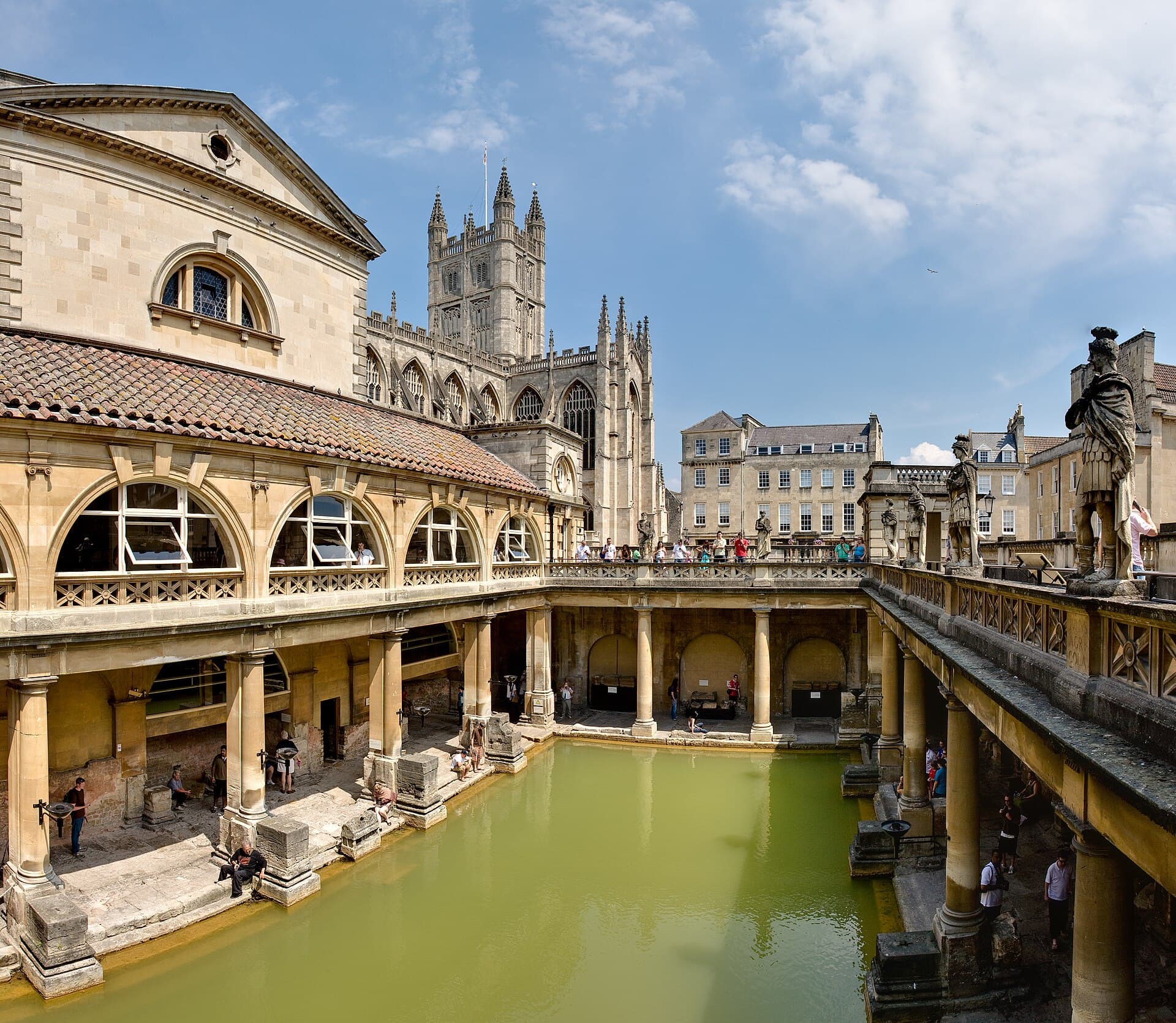
Bath, a city in Somerset, England, is celebrated for its Roman-constructed baths and its characteristic Georgian architecture. Situated in the valley of the River Avon, approximately 97 miles west of London, Bath presents a singular fusion of ancient history and the polished elegance of the 18th century. The entire city center holds UNESCO World Heritage status, a testament to its well-preserved Roman remnants, thermal springs, and architectural importance.
Travelers are drawn to Bath's natural thermal springs, which have attracted people for millennia. The Romans, arriving around 70 CE, established the foundation for the extensive bathing complex that evolved into a major religious spa of the ancient world. Beyond the Roman heritage, Bath flourished during the Georgian era, leading to the proliferation of the honey-colored limestone buildings that define its urban landscape today.
The story of Bath commences with its natural thermal springs, revered for thousands of years. Local Celtic tribes honored the goddess Sulis at these warm waters, believing in their restorative properties. Around 70 CE, the Romans arrived and began constructing an elaborate temple complex and public bathing facilities around the springs, establishing the settlement of Aquae Sulis. The Roman Baths, a significant religious spa of the ancient world, saw continuous use until the close of Roman rule in Britain in the 5th century AD.
After the Roman departure, the original baths fell into disrepair, yet the area around the springs underwent redevelopment multiple times throughout the Early and Late Middle Ages. Bath was granted city status by Queen Elizabeth I in 1590. However, it was during the 18th century, the Georgian era, that Bath truly transformed into the architectural marvel observed today. Affluent landowners and ambitious architects, such as John Wood the Elder and his son John Wood the Younger, conceived and constructed grand squares, crescents, and terraces, utilizing the distinctive local oolitic limestone. This period gave rise to structures like The Circus (built between 1754 and 1768) and the Royal Crescent (constructed between 1767 and 1774), considered pre-eminent examples of Georgian architecture.
Bath's prominence as a spa town and a fashionable resort persisted, drawing notable figures like Jane Austen, who resided in the city in the early 19th century. The city's historical importance, particularly its Roman remains and Georgian architecture, led to its designation as a UNESCO World Heritage site in 1987. Even during World War II, Bath faced challenges; in 1942, it was targeted during the Baedeker raids, which damaged several buildings, including the Assembly Rooms and parts of The Circus, though much of its Roman and Georgian heritage endured.
Commence your exploration at the Roman Baths, a remarkably preserved complex where you can walk on original Roman pavements and observe the natural thermal springs still flowing with warm water. Adjoining the baths, the impressive Bath Abbey stands as a testament to Gothic architecture, with a lineage extending back to the 7th century.
Walk to Pulteney Bridge, a distinctive 18th-century structure designed by Robert Adam, notable for being one of only four bridges globally with shops built across its entire span. From this vantage point, admire the horseshoe weir below. Continue your architectural journey to The Circus, a grand circular arrangement of Georgian townhouses designed by John Wood the Elder, and then to the sweeping Royal Crescent, a row of 30 terraced houses that embody Palladian style. Consider a visit to No. 1 Royal Crescent, now a museum, to experience what daily life entailed within a Georgian townhouse.
For a different perspective, visit the Herschel Museum of Astronomy, situated in the former home of William Herschel, who discovered Uranus from his garden in Bath in 1781. If you seek relaxation, the Thermae Bath Spa offers a contemporary method to experience the city's thermal waters, including a rooftop pool with city vistas.
The most favorable times to visit Bath are during the transitional months of May, June, September, and October. During these periods, you will encounter fewer visitors and more accessible accommodation rates compared to the busiest summer months of July and August. The weather is generally pleasant, with spring offering flourishing gardens and autumn displaying vivid fall colors. While summer brings festivals and warmer temperatures, it also signifies increased prices and a more crowded city. Winter provides a quieter, more intimate experience, with festive markets in December, but cooler temperatures and shorter days.
Bath is a compact and highly navigable city on foot, with most significant attractions readily accessible. For destinations further afield, an extensive bus network operates throughout the city and to surrounding areas; tickets can be purchased via the First Bus app or directly from the driver. Driving into Bath is not advised due to congestion and costly parking; instead, utilize the complimentary Park & Ride services situated on the city's periphery, offering regular bus connections into the center. Bath Spa railway station, centrally located, provides frequent train services to London, Bristol, and South Wales.
Regarding budget, Bath can be moderately expensive, comparable to cities like Oxford. However, many of its architectural wonders, such as the Royal Crescent and Pulteney Bridge, can be appreciated without cost. Free walking tours are also available, providing an economical way to learn about the city's past. Accommodation options range from hostel dorms starting around £15-25 per night to budget hotels at £80-120. Booking attractions and accommodation in advance, particularly outside of peak season, can assist in managing expenses.
Bath in Korean, in Chinese or in Hebrew — and 29 more languages, every stop narrated by a native voice. The widest language range of any self-guided audio tour.
Available in: