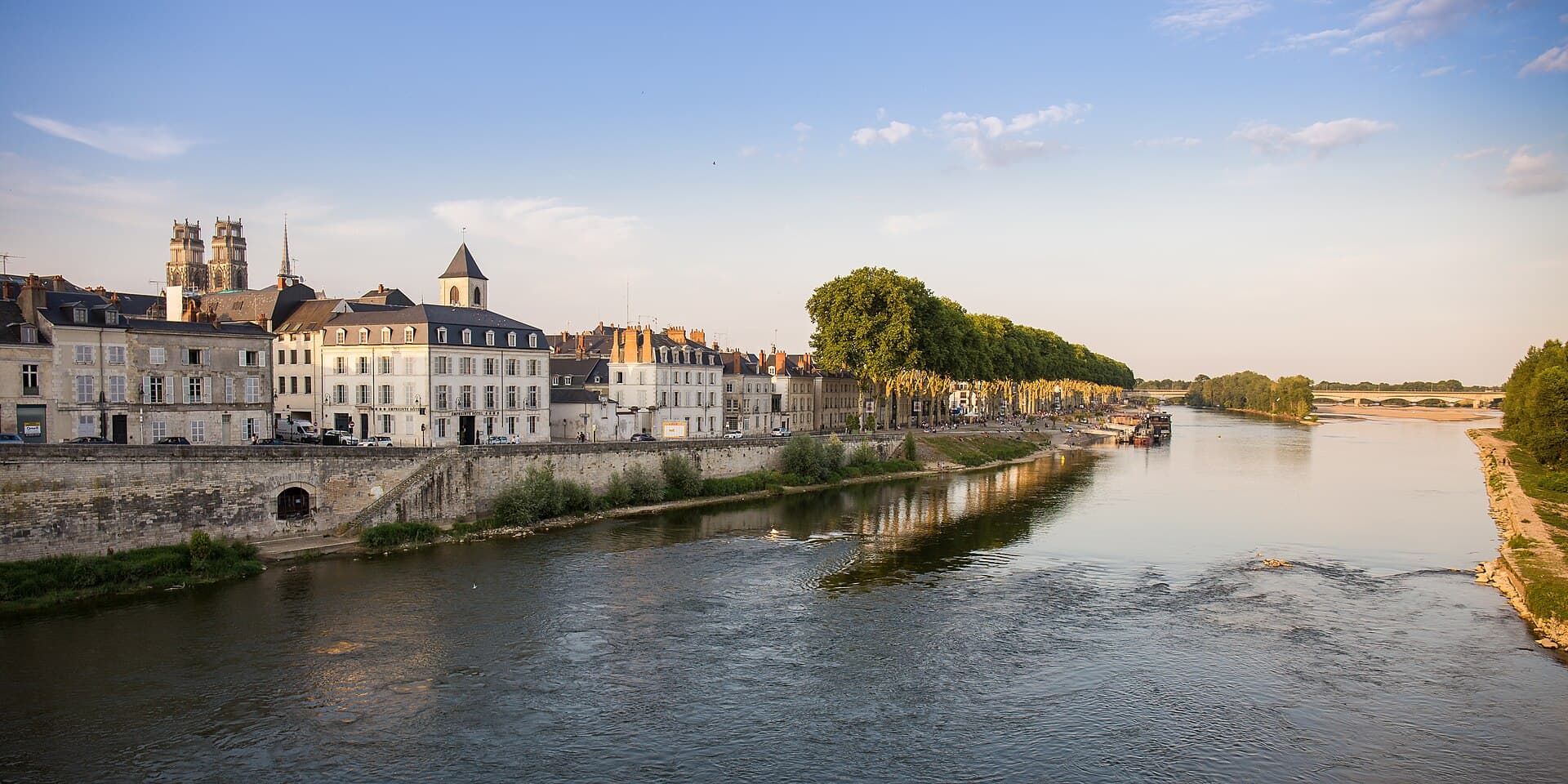
Pont de Beaugency
This ancient bridge spanning the Loire River conceals a secret about its making, a detail that lends a touch of the fantastical to its medieval masonry.
Full story unlocks in the tour
 Nono vlf / cc by-sa 4.0, via Wikimedia Commons
Self-guided audio walking tour of Beaugency — GPS route, offline playback, story-driven narration in 32 languages.
“Where ancient stones recount the sagas of Joan of Arc and monarchs, Beaugency invites you to discover its enduring allure.”
Not the postcards. The stories even locals don't know — whispered in your ear, right where they happened.
This ancient bridge spanning the Loire River conceals a secret about its making, a detail that lends a touch of the fantastical to its medieval masonry.
Beyond its formidable exterior, the Château de Beaugency presents a contemporary approach to exploring history.
The solitary bell tower of Saint-Firmin stands as a monument to a vanished church, yet its daily chime carries a melody older than many of the surrounding structures.
Discover every secret of Beaugency
Every address, every reveal in full — in your ear, right where it happened.
You pick your stops. You walk. The voice reveals what the others miss.


Your self-guided audio tour of Beaugency is ready — pick your landmarks, choose your language, and start the moment you arrive.
BuyLume has a built-in augmented-reality guide. Hold your phone up and its camera shows the street ahead of you, with a glowing arrow laid over the real view that always points to your next stop — no map to puzzle over, no wrong turns. Like everything in Lume, it works fully offline.
Beaugency, a medieval town in France's Centre-Val de Loire region, rests on the right bank of the Loire River, a UNESCO World Heritage site. It is a place where history feels palpable, with winding lanes and structures that span centuries. Recognized as one of the 'Most Beautiful Detours of France,' Beaugency offers a well-preserved historic center without the throngs often found in larger Loire Valley destinations.
This town, with an estimated population of around 7,876 in 2026, interweaves its deep past with a tranquil atmosphere, making it an ideal locale for those seeking an authentic French experience. From its ancient bridge crossing the Loire to its historic towers and abbey, Beaugency provides a glimpse into a bygone era while embracing contemporary cultural offerings.
Beaugency's narrative extends to prehistoric and Roman eras, evolving into a Carolingian fortress by the 10th century. The town's strategic position on the Loire River, particularly its bridge, established it as a vital location throughout history.
During the 11th to 13th centuries, the lords of Beaugency wielded considerable influence. The town played a part in pivotal moments of French royal history. The First Council of Beaugency in 1104 saw the excommunication of King Philip I. More notably, the Second Council in 1152 annulled the marriage of Louis VII and Eleanor of Aquitaine, a decision that profoundly altered the political landscape as Eleanor subsequently married Henry Plantagenet, who would become Henry II of England, thereby ceding much of southwestern France to the English crown.
Beaugency was a key battleground during the Hundred Years' War, falling to the English four times. In a significant triumph for the French, Joan of Arc liberated Beaugency from English forces in June 1429, a crucial step in her Loire Campaign. This campaign was the first sustained French offensive in a generation and led to the recapture of strategic bridges along the Loire.
The town endured further upheaval in 1567 when it was consumed by fire by Protestants during the Wars of Religion. The 17th and 18th centuries witnessed the development of canal links connecting the Loire navigation with the Seine, facilitating trade with Paris. In more recent history, German forces defeated the French Army of the Loire northwest of Beaugency in December 1870.
Today, Beaugency, once a possession of the Counts of Blois before returning to the French crown under Philip the Fair, continues to preserve its medieval character while serving as a tourist and service center with some light industry.
Begin your exploration at the Pont de Beaugency, a 14th-century stone bridge spanning the Loire. Its 23 arches, each subtly distinct due to centuries of repairs, offer a visual chronicle of medieval construction. The bridge connects Beaugency to Lailly-en-Val.
Ascend to the Château de Beaugency, an 11th-century fortress that now functions as a Digital Art Center. Here, immersive exhibitions, light installations, and digital art infuse new vitality into its historic spaces. Adjacent to the château, the formidable Tour César, an 11th-century square keep, stands as a testament to the town's defensive past. While once taller, its upper section was dismantled around 1750 due to structural concerns.
Discover the Abbatiale Notre-Dame, an 11th-century Romanesque abbey church with a sober yet substantial appearance. Though remodeled after the Wars of Religion and damaged during World War II, its 17th-century wooden paneled Gothic vault creates an illusion of stone. Do not overlook the Saint-Firmin bell tower, the solitary remnant of another 11th-century Romanesque church, known for its flamboyant portal and carillon. Wander through the town's medieval avenues, such as Rue du Change and Rue du Ravelin, to admire the historic architecture and absorb the atmosphere.
The most pleasant period to visit Beaugency is from May through September, when the weather is generally mild and suitable for outdoor pursuits. July and August are the warmest months, with average daily highs around 27°C (81°F). These months also offer the most sunshine and fewest rainy days. Summer also brings the "Estivales de Beaugency" from early July to late August, a multidisciplinary event with concerts, performances, open-air cinema, and workshops. A temporary beach is even established along the Loire banks between July 14 and August 15.
Spring and autumn can be enjoyable, though with a greater chance of rain, so an umbrella is advisable. Winter can bring snow and colder temperatures.
Beaugency is readily accessible by train. Direct trains from Paris-Austerlitz to Orléans take about an hour, followed by a 20-minute connection to Beaugency. From Blois, a direct train to Beaugency takes approximately 17 minutes. The Beaugency train station (Gare de Beaugency) is operated by SNCF.
Once in Beaugency, the town is traversable on foot, allowing you to explore its historic center. Parking is available, with free street parking options near some hotels. Several hotels offer comfortable stays, including Hostellerie de l'Écu de Bretagne, Grand Hôtel de l'Abbaye, and Le Beaugency. Some hotels, like Hostellerie de l'Écu de Bretagne, feature amenities such as heated outdoor swimming pools, open from June to September.
For dining, Beaugency offers a spectrum of options, from traditional French cuisine at establishments like Le P'tit Bateau and Chez Henri II to more casual cafes. The town also hosts markets on Tuesday, Wednesday, and Saturday mornings, with a full-day market on Saturdays, offering local produce and specialties.
Beaugency in Korean, in Chinese or in Hebrew — and 29 more languages, every stop narrated by a native voice. The widest language range of any self-guided audio tour.
Available in: