Radziwiłł Palace and Park Complex
Beyond the surviving gate and towers, an architectural detail reveals the Radziwiłł family's vision for their fortress.
Full story unlocks in the tour
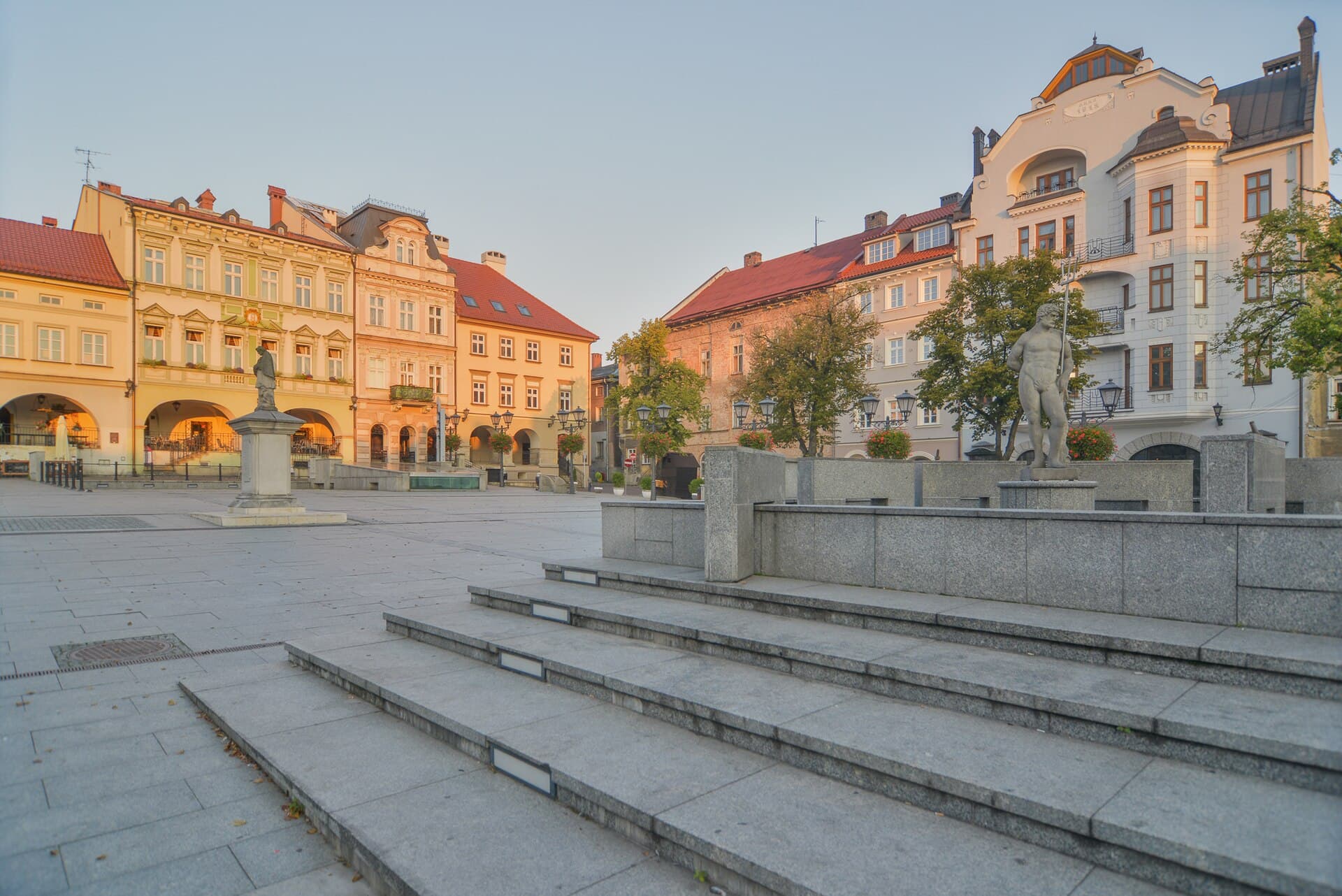 Bieniecki Piotr / CC BY-SA 4.0, via Wikimedia Commons
Self-guided audio walking tour of Biała — GPS route, offline playback, story-driven narration in 32 languages.
“Where enduring legacies meet the inventive spirit of Polish life.”
Not the postcards. The stories even locals don't know — whispered in your ear, right where they happened.
Beyond the surviving gate and towers, an architectural detail reveals the Radziwiłł family's vision for their fortress.
During WWII, the Jewish community of Biała Podlaska faced unimaginable hardship, including a forced relocation that created a distinct, confined area within the city.
Before WWII, Biała Podlaska was a center of innovation, home to an industry that soared to great heights, only to be tragically grounded.
Discover every secret of Biała
Every address, every reveal in full — in your ear, right where it happened.
You pick your stops. You walk. The voice reveals what the others miss.
Your self-guided audio tour of Biała is ready — pick your landmarks, choose your language, and start the moment you arrive.
BuyLume has a built-in augmented-reality guide. Hold your phone up and its camera shows the street ahead of you, with a glowing arrow laid over the real view that always points to your next stop — no map to puzzle over, no wrong turns. Like everything in Lume, it works fully offline.
Biała Podlaska, a city in eastern Poland's Lublin Voivodeship, offers a compelling blend of enduring history, local culture, and natural beauty. Situated along the Krzna River, near the Belarusian border, it has long served as a significant crossroads. The city's past is deeply intertwined with the powerful Radziwiłł family, whose influence shaped its development for over two centuries.
Today, Biała Podlaska serves as the capital of Biała County, though it functions as a separate city county. It is a place where historic architecture, such as the remnants of the Radziwiłł Palace complex and centuries-old churches, stands alongside modern developments. The city also maintains a lively cultural scene, with local traditions in pottery and folk music still flourishing.
Visitors to Biała Podlaska can explore its profound heritage, enjoy its green spaces, and experience the welcoming atmosphere of a city that has evolved significantly since its medieval origins. Its strategic location also makes it a gateway to exploring the broader Podlasie region and its unique landscapes.
The earliest records of Biała Podlaska date back to 1345, although mentions of the town appeared in the 15th century. It was initially part of the Brzeg Voivodeship within the Grand Duchy of Lithuania. The town's founder is believed to be Piotr Janowicz, nicknamed 'Biały' (Polish for 'white'), who was the hetman of the Grand Duchy of Lithuania. In the early 16th century, between 1508 and 1527, Jerzy Illinicz founded a private town called Biała under Magdeburg law, establishing a church by the marketplace.
The fortunes of Biała Podlaska dramatically changed in 1569 when it came under the ownership of the influential Radziwiłł family. Their rule, lasting two and a half centuries, ushered in a period of significant growth and prosperity, earning the city the moniker 'Duke's Biała' or 'Radziwiłł Biała.' Aleksander Ludwik Radziwiłł initiated the construction of a fortress and castle in 1622. The Radziwiłł period also saw the establishment of the Biała Academy in 1628, which became a branch of the Kraków Academy, and the granting of the city's coat of arms depicting Archangel Michael. Many churches and a hospital were also built during this time.
The city faced severe destruction during the Swedish invasion of 1655 and again in 1706. After the Third Partition of Poland in 1795, Biała Podlaska temporarily fell under Austrian Habsburg rule, then became part of the Polish Duchy of Warsaw in 1809, and finally Congress Poland under Russian rule in 1815. Despite these upheavals, the 19th century saw economic development, with industries like textiles and furniture emerging.
In the interwar period following Poland's regained independence in 1918, Biała Podlaska experienced rapid growth, becoming home to the Podlaska Wytwórnia Samolotów (PWS), an important aircraft factory. However, World War II brought immense devastation. The city was occupied by both Soviet and German forces, and its significant Jewish population, which constituted over 60% of the total population in 1841 and 1850, was tragically annihilated in the Holocaust. After the war, Biała Podlaska underwent substantial rebuilding and expansion. From 1975 to 1999, it served as the capital of the Biała Podlaska Voivodeship, a period that saw its population double and the city emerge as a dynamic center of science and culture.
Begin your exploration at the Radziwiłł Palace and Park Complex, the historical heart of Biała Podlaska. While much of the original fortress was destroyed, you can still observe the surviving gateway, two towers, and a chapel, offering a glimpse into its grand past. The surrounding park provides a pleasant setting for a stroll.
Religious architecture is well-represented by the Church of St. Anne, dating back to 1524, and the Church of the Basilians, constructed between 1747 and 1759, both significant historical buildings. The former Biała Academy, established in 1628 and now a high school, is another notable historical site.
For a deeper dive into the region's past, visit the Biała Podlaska Regional Museum (Muzeum Południowego Podlasia), which offers insights into local history and traditions. If you're seeking outdoor relaxation, the Krzna Riverside Beach and Picnic Area provides a tranquil spot with a sandy beach and amenities. Additionally, the John Paul II Memorial is a place of reflection in the city.
Consider a visit to the 19th-Century Manor House in Grabanów, a classicist building from the 1860s, now housing a hotel and educational facilities within a park.
The most pleasant times to visit Biała Podlaska, and Poland in general, are during the spring (March-May) and fall (September-November). These shoulder seasons offer moderate temperatures, agreeable weather, and fewer visitors compared to the peak summer months. Specifically, May, June, and September are considered excellent all-around months, with long days and everything open. September is often highlighted as a thoughtful choice, offering lingering summer warmth and vivid autumn foliage. While summer (July and August) is the warmest, it is also the busiest and most expensive. Winter (December-February) is cold and snowy, but can be atmospheric, particularly during the festive Christmas season.
Biała Podlaska is well-connected within Poland. The city is a significant transport hub, with two voivodeship roads (811 and 812) and the A2 motorway (Terespol-Świecko) passing through it. Public transportation within the city is served by 13 regular bus lines and two weekend lines, with some routes extending beyond the city limits. A bus terminal also offers private microbus services to major cities like Warsaw, Lublin, and Białystok.
For those arriving by air, the nearest international airports are in nearby cities like Katowice and Wrocław, though direct public transport to Biała Podlaska from these locations may require transfers. Accommodation options in Biała Podlaska include hotels and guesthouses, such as Gościniec Iwona. Basic services, including shops and restaurants, are readily available for visitors.
Biała in Korean, in Chinese or in Hebrew — and 29 more languages, every stop narrated by a native voice. The widest language range of any self-guided audio tour.
Available in: