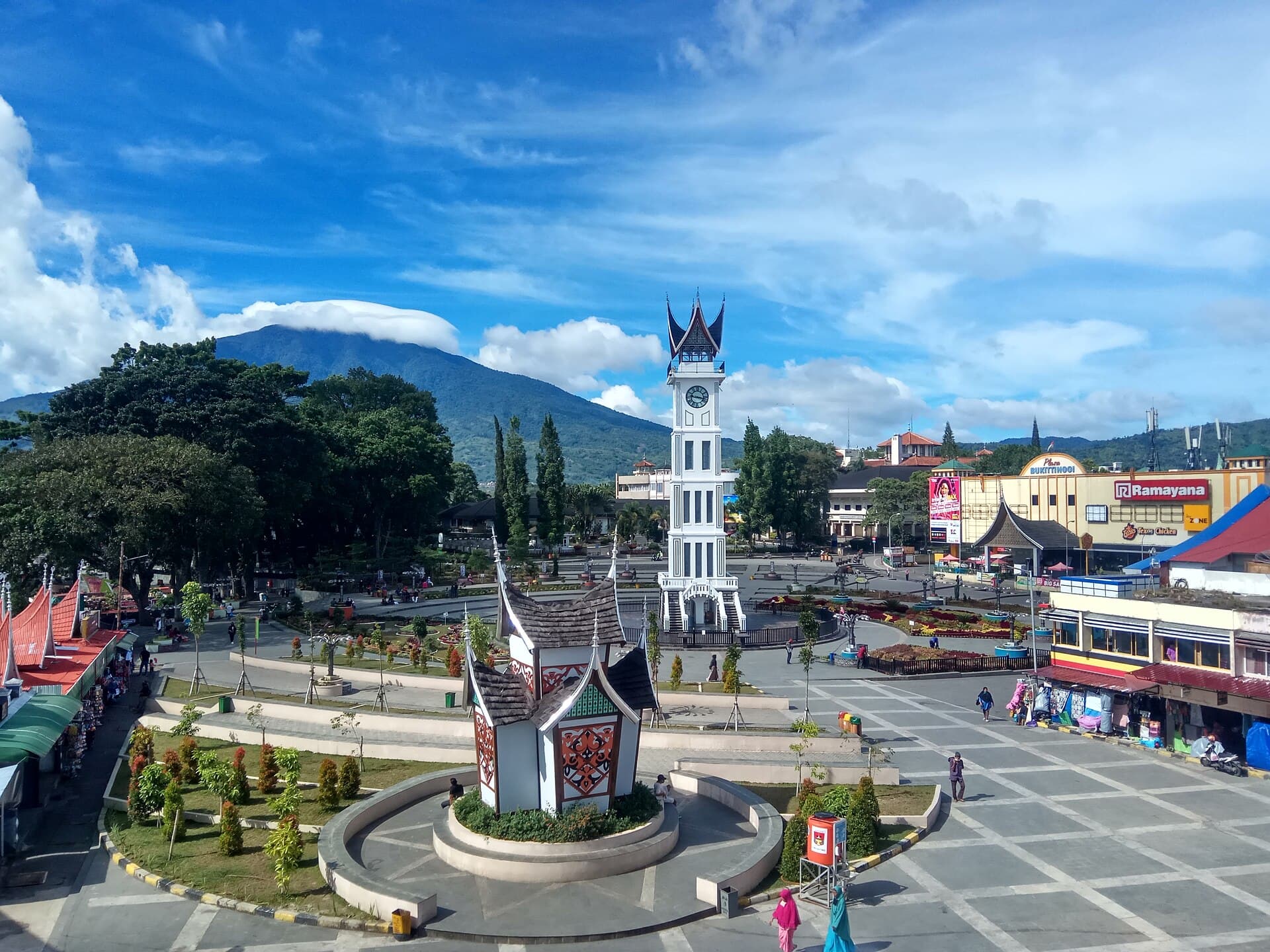
The prominent clock tower in Bukittinggi shares an unexpected connection with a world-famous landmark.
Rhmtdns / CC BY-SA 4.0, via Wikimedia CommonsBukittinggi
Self-guided audio walking tour of Bukittinggi — GPS route, offline playback, story-driven narration in 32 languages.
“Where Minangkabau tradition meets volcanic grandeur.”
Bukittinggi, as no one tells it.
Not the postcards. The stories even locals don't know — whispered in your ear, right where they happened.
Beneath the tranquil Panorama Park lies a network of tunnels with a somber past, and a unique method of concealing its secrets.
The distinctive buffalo-horn roofs seen throughout Bukittinggi are more than just a design choice.
Discover every secret of Bukittinggi
Every address, every reveal in full — in your ear, right where it happened.
You pick your stops. You walk. The voice reveals what the others miss.


How long do you have in Bukittinggi?
Your self-guided audio tour of Bukittinggi is ready — pick your landmarks, choose your language, and start the moment you arrive.
BuyThe story of Bukittinggi
Bukittinggi, meaning "high hill" in Indonesian, is a dynamic city at the core of West Sumatra's Minangkabau highlands. Resting at an elevation of about 930 meters above sea level, it offers a refreshingly cool climate, a welcome change from the tropical heat found elsewhere in Indonesia. The city is framed by the impressive Sianok Canyon on one side and the towering Mount Singgalang and Mount Marapi volcanoes on the other, creating a dramatic landscape. Bukittinggi is not only a significant cultural center for the Minangkabau people, known for their unique matrilineal society and distinctive buffalo-horn architecture, but also a bustling hub of markets and historical sites.
This city, once dubbed 'Parijs van Sumatera' during the Dutch colonial era, blends ancient traditions with a modern rhythm of life. Walking through its streets, you encounter lively markets, historical landmarks like the Jam Gadang clock tower, and the echoes of a pivotal past. Bukittinggi serves as an ideal base for exploring the natural beauty and cultural heritage of West Sumatra, inviting travelers to immerse themselves in its authenticity and grand panoramas.
From Dutch Outpost to Indonesian Capital
The origins of modern Bukittinggi trace back to the early 19th century, though the Agam plateau had long been inhabited by the Minangkabau people. The city began to take shape in 1825 when the Dutch established a strategic fortification called Fort de Kock during the Padri War. This fort, initially known as Sterrenschans due to its star shape, was built on Jirek Hill to protect five adat (traditional custom) villages from the Padri movement, an Islamic reformist group. The Dutch were granted permission by the adats to construct the fort, which later became a key military base and symbol of Dutch colonial control. Around this citadel, a settlement gradually grew, eventually becoming the city of Fort de Kock.
By the mid-19th century, the city transformed from a military outpost into an administrative center, and later, an elite garden city for the Dutch administration, earning it the nickname 'Parijs van Sumatera'. Infrastructure like roads and a rail line were developed, stimulating the agricultural economy. Bukittinggi also became an important intellectual center with the establishment of Sumatra's first teacher-training college in 1856.
During World War II, from 1942 to 1945, Bukittinggi served as the headquarters for the Japanese 25th Army, who constructed an extensive network of underground tunnels, known today as Lubang Jepang, for defense and storage. A pivotal moment in its history occurred from 1948 to 1949, when Bukittinggi briefly became the capital of the Emergency Government of the Republic of Indonesia (PDRI) during the Indonesian National Revolution, as Yogyakarta, the main capital, was occupied by Dutch forces. After Indonesia gained sovereignty, the city was officially renamed Bukittinggi in 1949. Today, it stands as a leading tourist and cultural center in West Sumatra.
Begin your exploration at Jam Gadang, the city's iconic clock tower. Built in 1926, this 26-meter tall landmark with its Minangkabau-style roof is a central meeting point and a symbol of Bukittinggi. From here, stroll to Panorama Park, which offers sweeping views of the dramatic Sianok Canyon (Ngarai Sianok), a 100-meter deep gorge stretching 15 kilometers. Within Panorama Park, you can also explore Lubang Jepang, a fascinating and somber network of underground tunnels built by the Japanese during World War II.
Cross the Limpapeh Bridge, adorned with Minangkabau motifs, to reach Fort de Kock. While the original buildings are gone, the fort's remnants, including old cannons and a concrete tower, offer historical insight and panoramic views of the city and surrounding volcanoes. Adjacent to the fort is the Kinantan Zoo and Cultural Park, where you can learn more about Minangkabau culture. Do not miss the bustling Pasar Atas (Upper Market) and Pasar Bawah (Lower Market) near Jam Gadang, where you can experience local life and find traditional crafts, textiles, and spices. For a unique hike, consider the Great Wall of Koto Gadang, a scenic stairway offering views of Sianok Canyon.
The best time to visit Bukittinggi is during the dry season, which typically runs from June to September. During these months, you can expect pleasant weather with clearer skies, ideal for outdoor activities and exploring the city's attractions. While Bukittinggi generally experiences consistent daytime temperatures around 23-24°C year-round, rainfall is significantly lower in the dry season, making for more comfortable touring. Even during the wet season, rain often comes in afternoon storms, leaving mornings clear for exploration. Be aware that July and August are peak tourist season, so planning in advance is advisable.
Getting to Bukittinggi typically involves flying into Minangkabau International Airport (PDG) in Padang, the capital of West Sumatra. From Padang, Bukittinggi is about an 89-kilometer, two to three-hour drive by shared taxi, bus, or minivan. Within Bukittinggi, the city center is walkable, and many attractions are easily reached on foot. For longer distances or exploring surrounding areas, consider renting a scooter or using local public transportation known as "Travel" minivans. Bukittinggi offers a range of accommodation, from budget-friendly guesthouses to more comfortable hotels, with many options concentrated in the central area. The local currency is the Indonesian Rupiah (IDR). While generally safe, it's wise to take standard precautions, especially after dark.
- What is Bukittinggi known for?
- Bukittinggi is known for its cool mountain climate, grand natural landscapes like Sianok Canyon, unique Minangkabau culture and architecture (especially the buffalo-horn roofs), and historical landmarks such as Jam Gadang and Fort de Kock.
- Is Bukittinggi safe for tourists?
- Bukittinggi is generally considered a safe city for tourists. Standard precautions, such as being aware of your belongings and avoiding poorly lit streets after dark, are advisable, as with any travel destination.
- What is the local cuisine like in Bukittinggi?
- The local cuisine in Bukittinggi is renowned for its flavorful Minangkabau dishes, with specialties like *rendang*, *nasi padang*, and *sate padang*. Bukittinggi is considered the birthplace of Padang food.
- How do I get around Bukittinggi?
- The city center of Bukittinggi is easily walkable. For longer distances, you can use local minivans (known as "Travel"), rent a scooter, or hire a taxi.
- What souvenirs can I buy in Bukittinggi?
- Popular souvenirs include traditional Minangkabau handicrafts such as woven textiles (*kain songket*), intricate wood carvings, silver jewelry (especially from nearby Kota Gadang), and embroidered garments.
- Was Bukittinggi ever the capital of Indonesia?
- Yes, Bukittinggi briefly served as the capital of the Emergency Government of the Republic of Indonesia (PDRI) from 1948 to 1949, during the Indonesian National Revolution when the main capital, Yogyakarta, was occupied by Dutch forces.
Bukittinggi in your own language — all 32· 32
Bukittinggi in Korean, in Chinese or in Hebrew — and 29 more languages, every stop narrated by a native voice. The widest language range of any self-guided audio tour.
Available in:
- English
- FrenchFrançais
- SpanishEspañol
- GermanDeutsch
- ItalianItaliano
- PortuguesePortuguês
- DutchNederlands
- PolishPolski
- SwedishSvenska
- DanishDansk
- NorwegianNorsk
- FinnishSuomi
- RussianРусский
- UkrainianУкраїнська
- TurkishTürkçe
- CzechČeština
- HungarianMagyar
- RomanianRomână
- BulgarianБългарски
- GreekΕλληνικά
- Japanese日本語
- Korean한국어
- Chinese中文
- Arabicالعربية
- Hebrewעברית
- Hindiहिन्दी
- Thaiไทย
- VietnameseTiếng Việt
- IndonesianBahasa Indonesia
- MalayBahasa Melayu
- CatalanCatalà
- BasqueEuskara