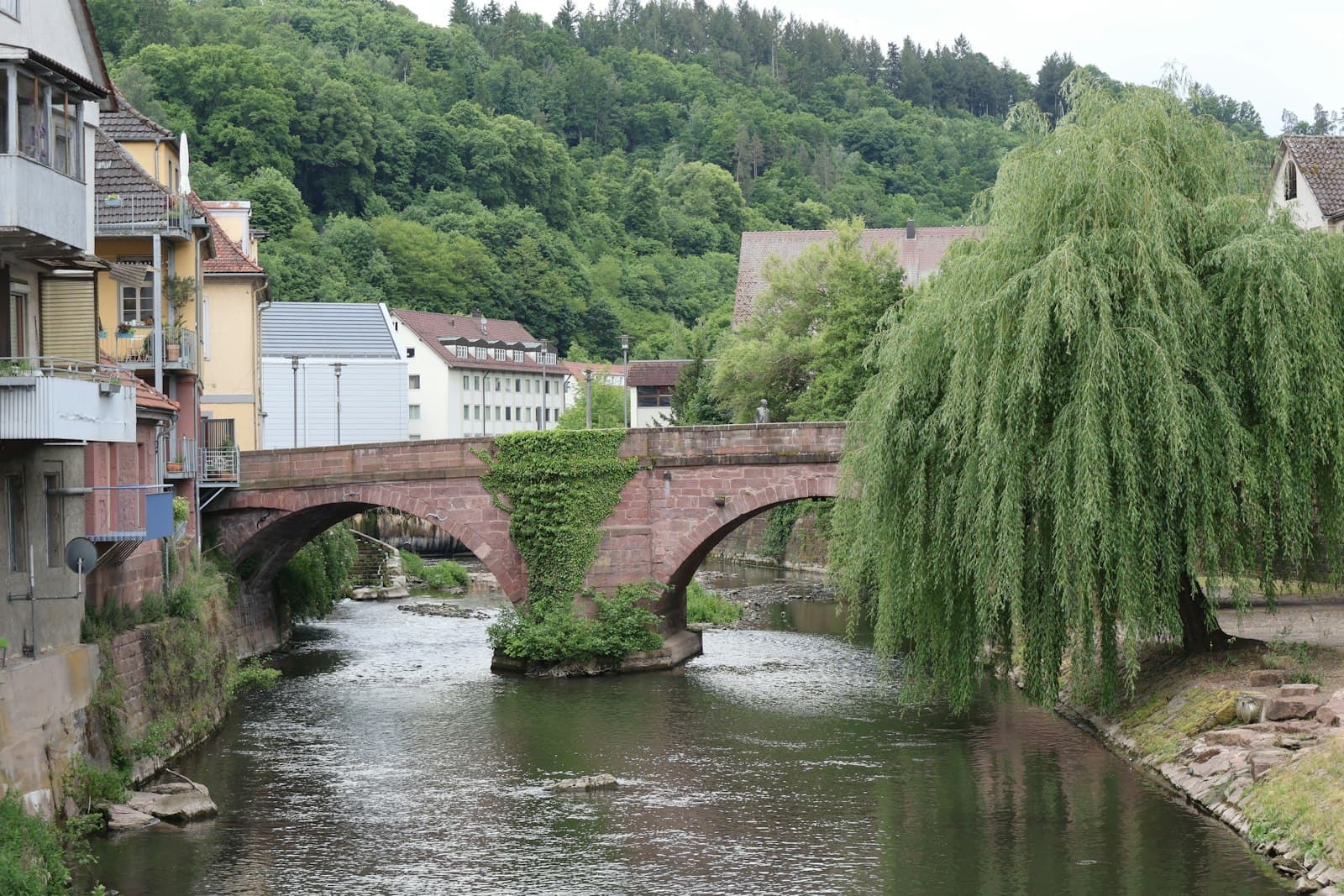
Nikolausbrücke
Hermann Hesse, Calw's most celebrated son, found a particular solace in one specific spot in his hometown.
Full story unlocks in the tour
 qwesy qwesy / CC BY 3.0, via Wikimedia Commons
Self-guided audio walking tour of Calw — GPS route, offline playback, story-driven narration in 32 languages.
“Where Black Forest allure meets literary echoes.”
Not the postcards. The stories even locals don't know — whispered in your ear, right where they happened.
Hermann Hesse, Calw's most celebrated son, found a particular solace in one specific spot in his hometown.
The ruins of Hirsau Abbey hold a secret that shaped monastic architecture across Germany.
Beneath the picturesque half-timbered facades of Calw's historic center lies a surprising connection to a common farm animal.
Discover every secret of Calw
Every address, every reveal in full — in your ear, right where it happened.
You pick your stops. You walk. The voice reveals what the others miss.


Your self-guided audio tour of Calw is ready — pick your landmarks, choose your language, and start the moment you arrive.
BuyLume has a built-in augmented-reality guide. Hold your phone up and its camera shows the street ahead of you, with a glowing arrow laid over the real view that always points to your next stop — no map to puzzle over, no wrong turns. Like everything in Lume, it works fully offline.
Calw, a town in the northern Black Forest of Germany, offers a captivating blend of history, culture, and natural beauty. Situated in the Nagold Valley, the town is characterized by its well-preserved historic center, where winding streets lead past late 17th and early 18th-century half-timbered houses. This idyllic setting, with its dense coniferous forests and rolling meadows, provides a tranquil escape and a base for exploring the wider Black Forest region.
Beyond its visual appeal, Calw holds a significant place in literary history as the birthplace of Nobel Prize-winning author Hermann Hesse. His early life in Calw and the Nagold Valley profoundly influenced his works, drawing many visitors who seek to trace his footsteps. The town has embraced its connection to Hesse, with a dedicated museum and themed walking paths that delve into his life and literary inspirations. Calw's elevation ranges between 330 and 630 meters (1,080–2,070 ft) above sea level.
Calw's origins can be traced back to the 11th century, growing around an older castle belonging to the Counts of Calw. During the Middle Ages, it flourished as an important commercial town, particularly known for its cloth and leather trades. In 1345, Calw became part of Württemberg, and by the 16th century, it served as a summer residence for the Dukes of Württemberg. The 18th century saw the town prosper from the lumber trade and timber rafting on the Nagold River.
Religious history also played a role in Calw's development. Originally part of the Roman Catholic Diocese of Speyer, the Reformation took hold in Calw in 1534, leading to the town becoming the seat of a deanery in 1555. Just a few kilometers north of Calw lie the ruins of the Benedictine monastery of St. Peter and St. Paul in Hirsau. Founded around 830, and later revitalized in the 11th century, Hirsau Abbey was once one of the most influential monasteries in Germany. It became a center of the Cluniac Reforms, which were implemented in German lands as the "Hirsau Reforms." The monastery's church, consecrated in 1091, was one of the largest Romanesque churches of the 11th century in Germany, and its architectural style influenced other abbey buildings. The complex was devastated during the War of the Palatine Succession in 1692 and was not rebuilt, with its ruins subsequently used as a quarry.
In the 20th century, Calw experienced further changes. In 1945, a subcamp of the Natzweiler-Struthof concentration camp was located here, where Jewish forced laborers assembled aircraft parts. After World War II, Calw became part of the French zone of occupation and later joined the state of Baden-Württemberg. The district reform of 1973 gave the district of Calw its current size, and in 1976, Calw was officially renamed after being combined with the communities of Altburg, Hirsau, and Stammheim. Today, Calw is the capital and largest town of the district of Calw, with a population estimated at 25,001 in 2024.
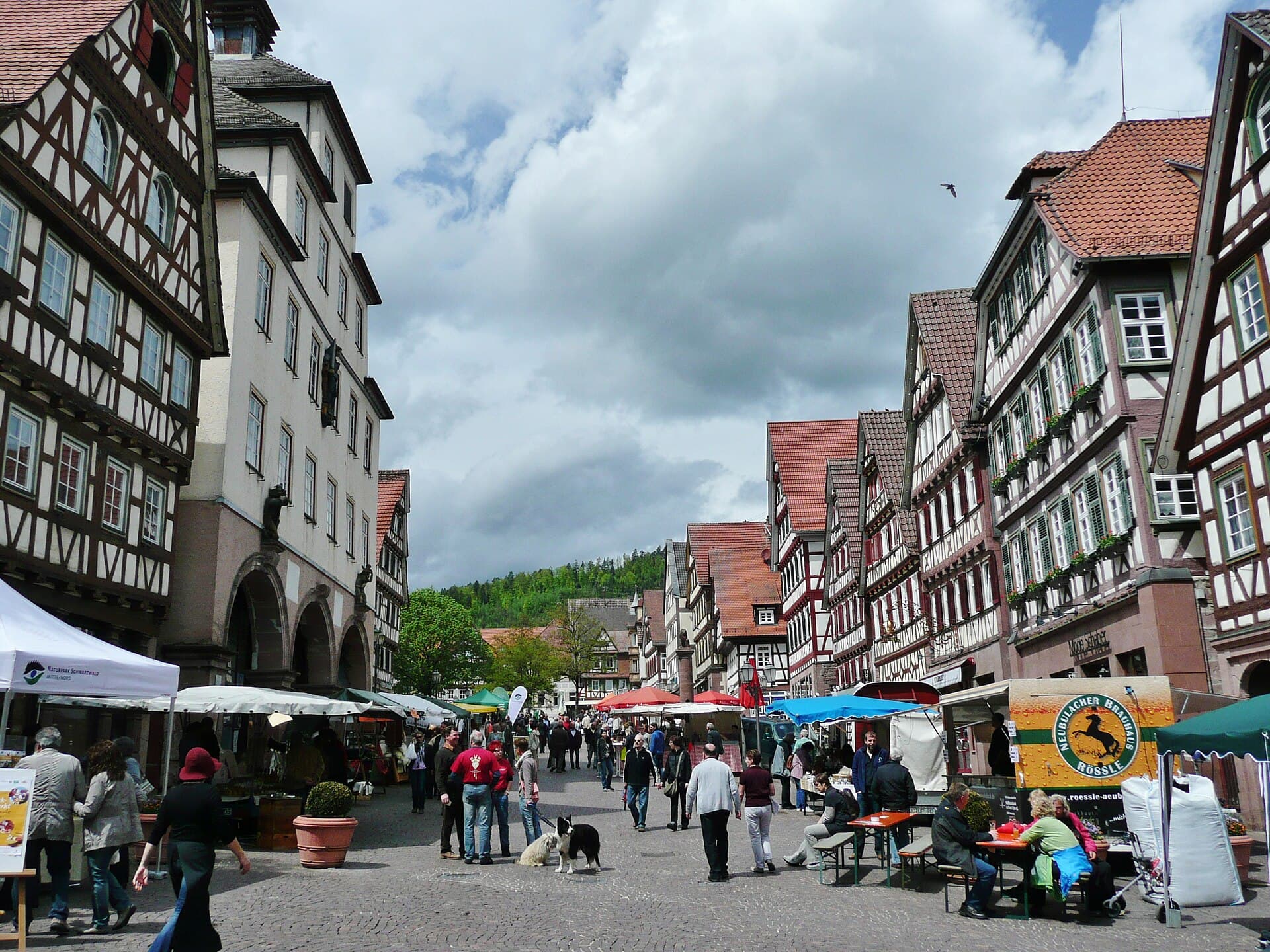
Calw's historic center is a pedestrian zone, ideal for leisurely exploration. The Marktplatz, or market square, is a focal point, adorned with two fountains and surrounded by well-preserved 18th-century half-timbered houses. A short stroll leads to the 14th-century Nikolausbrücke, a historic bridge over the Nagold River, notable for its masonry.
For literary enthusiasts, the Hermann Hesse Museum, located at Marktplatz 30, is a key attraction. It offers insights into the life and work of the Nobel laureate, displaying personal items, photographs, books, and even watercolors by the author. The town also features a statue of Hermann Hesse on the Nikolausbrücke.
Just two kilometers away, in the Hirsau district, are the extensive ruins of the Benedictine monastery of St. Peter and St. Paul. These ruins, once one of Germany's most important abbeys, include the remains of a large Romanesque basilica. A monastery museum in Hirsau further illuminates the site's history.
Beyond the town center, the surrounding Black Forest offers natural attractions such as the Monbachtal Gorge, known for hiking and water crossings, and the Rötelbach Valley. The hamlet of Zavelstein, about 5 kilometers (3 miles) south, is particularly scenic in late March and April when wild crocuses blossom. The Neubulach silver mine, which closed in the mid-1920s, now offers guided tours of its ancient shafts from April to November.
Calw experiences warm summers and cold, snowy winters. The average daytime high in July is 24°C (75°F), while January sees average daytime highs of 4°C (39°F) and nighttime lows around -2°C (28°F). The town receives around 1177 mm (46 inches) of rain/snowfall annually, with July typically being the wettest month.
The most comfortable weather for visiting Calw is generally in September. For warm-weather activities, late June to late August is considered the best time. Germany as a whole sees peak tourist numbers from June to August, during Oktoberfest in September, and around the Christmas period from mid-November to mid-December.
Calw is located in the northern Black Forest, approximately 18 km (11 miles) south of Pforzheim and 33 km (21 miles) west of Stuttgart. The town is easily accessible by rail and road. The Nagold Valley railway line serves Calw, connecting it to Pforzheim and leading south towards Nagold and Hochdorf. Major roads, including the B463, B295, and B296, converge in Calw, and the town is not far from the A81 and A8 motorways.
Calw's historic center is largely pedestrianized, making it pleasant for walking. The town has developed its tourist infrastructure, offering numerous shops, restaurants, bistros, and ice-cream parlours. The local currency is the Euro (€). While German is the official language, English may be understood in tourist-oriented establishments. The current population of Calw is estimated at 25,473.
Calw in Korean, in Chinese or in Hebrew — and 29 more languages, every stop narrated by a native voice. The widest language range of any self-guided audio tour.
Available in: