Parador de Cardona, Room 712
A specific room in the castle-turned-hotel holds a reputation for unexplained events.
Full story unlocks in the tour
 Paradores / cc by-sa 4.0, via Wikimedia Commons
Self-guided audio walking tour of Cardona — GPS route, offline playback, story-driven narration in 32 languages.
“Where salt runs deep and legends linger.”
Not the postcards. The stories even locals don't know — whispered in your ear, right where they happened.
A specific room in the castle-turned-hotel holds a reputation for unexplained events.
This singular geological formation is not merely ancient; it continues to reshape itself.
An incomplete bridge outside Cardona bears a name that suggests a dramatic origin.
Discover every secret of Cardona
Every address, every reveal in full — in your ear, right where it happened.
You pick your stops. You walk. The voice reveals what the others miss.


Your self-guided audio tour of Cardona is ready — pick your landmarks, choose your language, and start the moment you arrive.
BuyLume has a built-in augmented-reality guide. Hold your phone up and its camera shows the street ahead of you, with a glowing arrow laid over the real view that always points to your next stop — no map to puzzle over, no wrong turns. Like everything in Lume, it works fully offline.
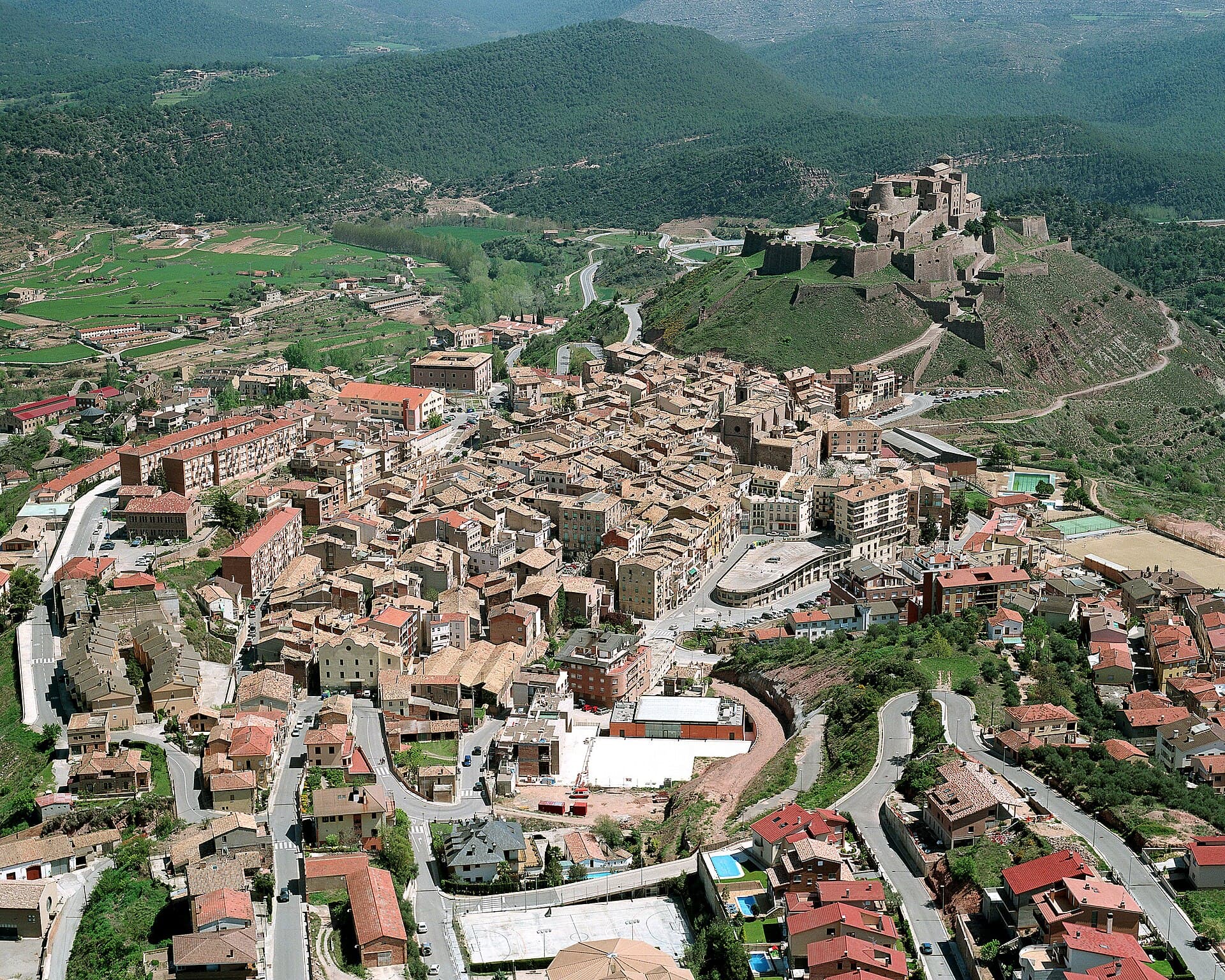
Cardona, a municipality in Catalonia, Spain, offers a passage through time, presenting its medieval legacy and remarkable natural formations. Situated upon a hill and nearly encircled by the Cardener River, Cardona lies approximately 90 kilometers northwest of Barcelona. The town's outline is dominated by its commanding 9th-century castle, a testament to its strategic significance across the centuries.
Beyond its formidable fortress, Cardona is recognized for its extraordinary Salt Mountain, a geological wonder that has shaped the town's economy and culture for millennia. This fusion of enduring history, striking architecture, and a terrain sculpted by salt renders Cardona a compelling destination for those seeking a glimpse into Catalonia's past and its persistent natural splendor.
Cardona's narrative is profoundly connected to its immense salt deposit, a resource utilized since Neolithic times and systematically mined by the Romans. This 'white gold' became a cornerstone of the local economy, contributing substantially to its prosperity throughout the Middle Ages.
The town's most recognizable structure, the Castle of Cardona, was initially erected in 886 by Wilfred the Hairy to safeguard the border between the Catholic Catalan Counties and Muslim territories. Over centuries, it developed into a formidable stronghold, incorporating Romanesque and Gothic architectural styles. From the 11th to the 15th centuries, the castle served as the dwelling for the influential Lords of Cardona. This noble lineage, second only to the royal house in the Kingdom of Aragón, accrued considerable wealth and authority, largely owing to their exclusive entitlements to the region's valuable salt mine.
The castle's strategic importance persisted through various conflicts. It sustained considerable damage during the War of the Spanish Succession (1701–1714), where it stood as one of the final fortresses to yield to Bourbon forces after the surrender of Barcelona in 1714. It also suffered damage during the Spanish Civil War (1936–1939). After losing much of its military relevance, the Cardona family eventually relocated their primary residence closer to the royal court in Barcelona.
The town itself experienced a decline after the 16th century, with its population primarily engaged in craftsmanship, agriculture, livestock farming, and salt exploitation. The 19th and 20th centuries brought a new wave of industrialization with textiles and the opening of potash mines in 1929. However, most textile industries closed in the 1970s, and the potash mine followed suit in 1990. Today, tourism has emerged as a vital activity, with the castle transformed into a Parador hotel in 1976 and the Salt Mountain becoming a cultural park, preserving and promoting Cardona's enduring heritage.
Begin your exploration at the Castle of Cardona, a medieval fortress offering expansive views of the town, the Salt Mountain, and the Cardener river valley. Within its walls, you will discover the Collegiate Church of Sant Vicenç, an exemplary instance of Catalan Romanesque architecture from the 11th century, featuring a central nave nearly 20 meters high. Be sure to visit the Torre de la Minyona (Maiden's Tower), a crucial element of the castle with its own compelling story.
Descend into the town's historic quarter to wander through its medieval pathways. The Plaça del Mercat (Market Square) is notable for its arcades, which display nine arches of varying styles. Visit the Church of Sant Miquel, a Gothic construction that houses a polyptych by Pere Vall and a 15th-century baptismal font. The Portal de Berga, a 14th-century gateway, is one of the remaining entrances to the old walled town.
Just beyond the town, explore the Cardona Salt Mountain Cultural Park. This distinctive location allows you to venture into old mining galleries, learn about the geology and history of salt extraction, and observe machinery from the 1920s. You can also visit the Josep Arnau salt museum, which exhibits handcrafted salt sculptures. Finally, seek out the Pont del Diable (Devil's Bridge), an unfinished 15th-century bridge spanning the Cardener River.
Cardona welcomes visitors throughout the year, though the transitional seasons of spring (April to June) and early autumn (September to October) provide the most balanced experience with comfortable temperatures and fewer crowds. July and August can be quite warm and busy. If you intend to visit the Salt Mountain or take a guided tour of the castle, be aware that these attractions are typically closed on Mondays. Autumn also brings harvest celebrations to the surrounding Bages region, recognized for its wine and olive oil.
Cardona is situated in central Catalonia, approximately 90 kilometers northwest of Barcelona. The most straightforward way to reach Cardona is by car, with the drive from Barcelona taking about an hour and a half. Alternatively, several buses depart daily from Barcelona's Sants station and Estació del Nord, with a journey time of around two hours. The town is compact and easily traversed on foot, particularly its medieval old quarter. For castle tours, consider reserving in advance, as guided tours are available from Tuesday to Sunday and on holidays. The Salt Mountain Cultural Park also offers guided visits, but remember its Monday closure. Cardona offers a range of local gastronomy, with numerous restaurants and bars serving traditional dishes from the Bages region.
Cardona in Korean, in Chinese or in Hebrew — and 29 more languages, every stop narrated by a native voice. The widest language range of any self-guided audio tour.
Available in: