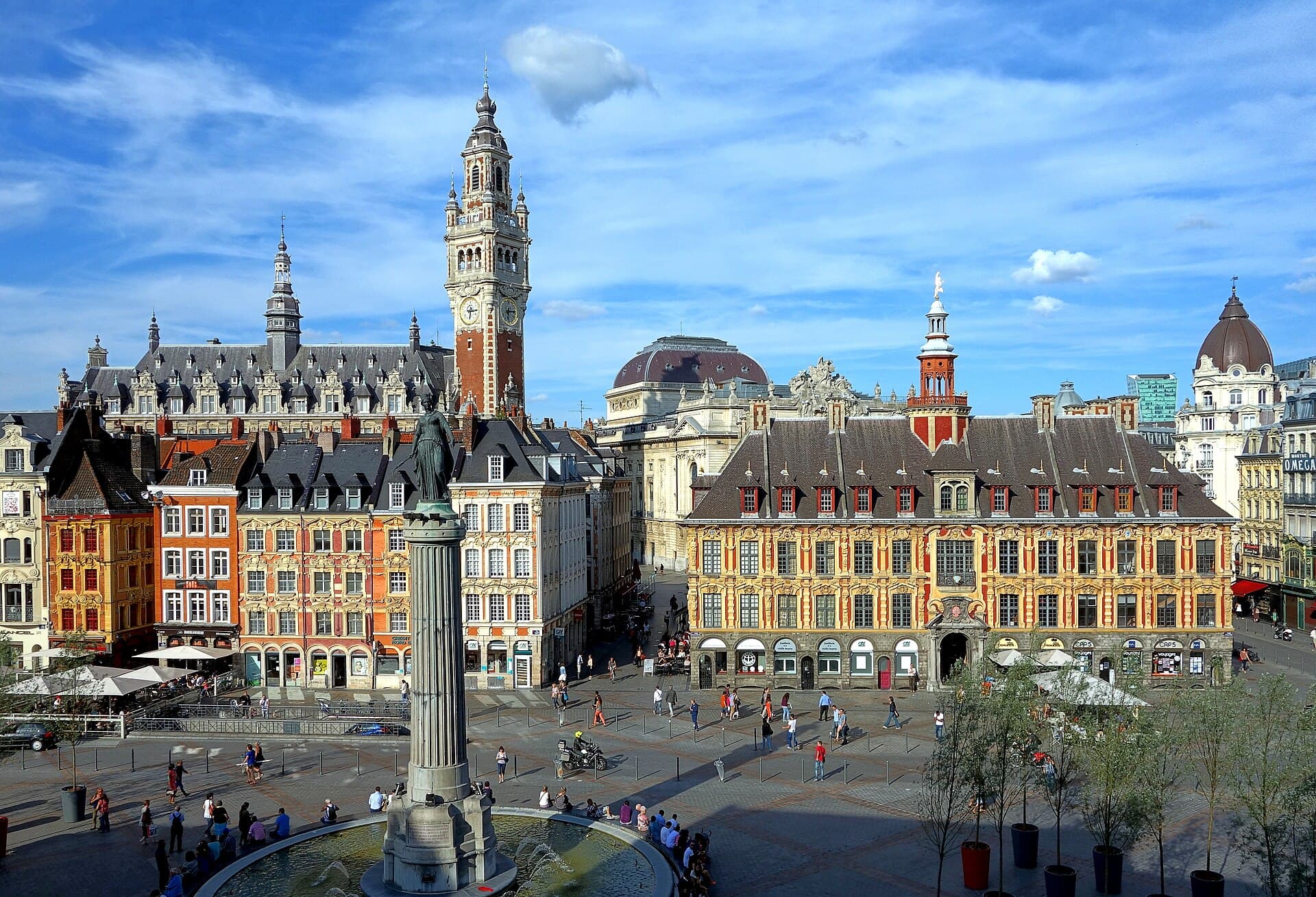
The Grand Place
Observe the architecture of Cassel's central square, and you might notice something distinctive for France.
Full story unlocks in the tour
 Velvet / cc by-sa 3.0, via Wikimedia Commons
Self-guided audio walking tour of Cassel — GPS route, offline playback, story-driven narration in 32 languages.
“Where Flemish character meets expansive views, high above the plains of French Flanders.”
Not the postcards. The stories even locals don't know — whispered in your ear, right where they happened.
Observe the architecture of Cassel's central square, and you might notice something distinctive for France.
From the highest point in French Flanders, the views extend far, but local lore suggests they stretch even further than one might imagine.
Beyond the Flemish art, the museum's 16th-century building holds a subtle architectural detail.
Discover every secret of Cassel
Every address, every reveal in full — in your ear, right where it happened.
You pick your stops. You walk. The voice reveals what the others miss.


Your self-guided audio tour of Cassel is ready — pick your landmarks, choose your language, and start the moment you arrive.
BuyLume has a built-in augmented-reality guide. Hold your phone up and its camera shows the street ahead of you, with a glowing arrow laid over the real view that always points to your next stop — no map to puzzle over, no wrong turns. Like everything in Lume, it works fully offline.
Cassel, a captivating hilltop town in the Nord department of northern France, offers a unique blend of French and Flemish heritage. Situated atop Mont Cassel, the highest point in French Flanders at 176 meters, the town provides sweeping panoramic views that stretch across the flat plains to the Belgian border, and on exceptionally clear days, even the North Sea. Its cobbled streets, distinctive Flemish architecture, and lively cultural traditions make it a rewarding destination for those seeking an authentic northern French experience.
Recognized as one of 'Les Plus Beaux Villages de France' and voted 'France's favorite village' in 2018, Cassel is a place where history feels tangible. From its Roman origins as a strategic hub to its role in significant historical battles, the town has continuously rebuilt itself while preserving its medieval character and Flemish essence. Cassel invites visitors to slow down, explore its deep past, and immerse themselves in a culture shaped by centuries of cross-border influence.
## From Roman Outpost to Flemish Stronghold Cassel's strategic importance dates to Roman times, with archaeological finds indicating habitation as early as the Iron Age. The Menapii Celts, who called the settlement 'Kasteel' (meaning fortress), ruled the region from here. The Romans occupied the town for nearly five centuries from 56 BC, recognizing its prime location. They developed it into a vital urban center, establishing a network of seven paved roads that converged on the hill, six of which are still in use today. These roads were ingeniously double-layered with cobblestones to ensure stability across the marshlands.
After the fall of the Roman Empire, Cassel evolved into an important fortified stronghold for the rulers of Flanders. Its elevated position made it a coveted prize, leading to numerous battles between the Flemish and the French. In 880, the town was destroyed by Vikings. It became a border town between France and the Spanish Netherlands by the end of the 16th century, repeatedly fought over by France, Spain, and later the independent Dutch Republic. Cassel was finally annexed to France in the 17th century, definitively becoming French in 1678. Despite the conflicts, the town consistently rebuilt itself, maintaining its distinctive medieval and Flemish character.
## Wartime Significance and Modern Recognition Cassel's strategic value continued into the 20th century. During World War I, it served as the headquarters for Marshal Ferdinand Foch from October 1914 to May 1915, and subsequently for the British Second Army under Sir Herbert Plumer from 1916 to 1918. Its elevated position made it a key observation post. In May 1940, during the German invasion of France, Cassel was the scene of a fierce three-day battle where British forces held a defensive line to protect the evacuation of Dunkirk, resulting in significant destruction to the town.
Today, Cassel is a peaceful, picturesque village, celebrated for its blend of Flemish and French influences evident in its architecture, cuisine, and traditions. In 2018, it earned national recognition by winning the popular 'Le village préféré des Français' (France's favorite village) contest, highlighting its charm and unique cultural offerings.
Cassel offers a compact yet full experience, easily explored on foot. Begin at the Grand Place, the town's central square, where historic buildings with gabled facades and colorful shutters showcase distinct Flemish architecture. Enjoy a drink at one of the traditional estaminets and absorb the atmosphere.
A short walk leads to the summit of Mont Cassel, the highest point in French Flanders. From here, the public garden offers a 360-degree panorama stretching across the Flemish plain, with views extending to the Belgian coast, Dunkirk, and potentially even the North Sea on a clear day. The Moulin de Cassel, a working 18th-century wooden windmill, stands at the summit and is open to visitors, offering a glimpse into traditional flour milling.
The Musée de Flandre, housed in the magnificent 16th-century Hôtel de la Noble Cour, is a cultural highlight. It presents Flemish art and heritage from the 15th century to contemporary works, with its unique French Renaissance façade adorned with grotesque carvings. Do not miss the Collégiale Notre-Dame de la Crypte, Cassel's main church, a 16th-century Gothic structure built in the distinctive 'hallekerk' style. For a tranquil escape, the Jardin du Mont des Récollets, a meticulously maintained Flemish-style garden, is a short drive from the center.
The best time to visit Cassel for pleasant weather and warm-weather activities is from late June to early September. During these months, temperatures are mildly cool and breezy, ranging from 13-22°C (56-71°F). Spring (April to June) and early autumn are also ideal, with mild weather, blooming flowers, and golden foliage. July and August see more tourists, especially on weekends, and the hilltop can be breezy. Visiting during one of Cassel's annual festivals, such as the Fête des Géants or the Easter Monday carnival, offers a lively cultural experience.
Cassel is easily accessible by car, with Lille about 45 minutes away and Paris approximately 2.5 hours by train and local connection. Driving offers the most flexibility for exploring the wider Flanders region. Several free car parks are available around the town center, including near the windmill and public gardens, and at Place du Général Vandamme (110 spaces) and the Chapter parking behind the collegiate church (36 spaces). Some areas, like the Grand Place, have regulated blue zones with free parking limited to 2 hours.
The Tourist Office of Cassel, located in the town, serves as a useful information point for visitors. Cassel is a small town with a population of less than 2,500, making it easy to navigate on foot, though some streets can be quite steep. The town offers a range of traditional estaminets for dining, serving hearty regional dishes and local beers.
Cassel in Korean, in Chinese or in Hebrew — and 29 more languages, every stop narrated by a native voice. The widest language range of any self-guided audio tour.
Available in: