Aragonese Castle
This imposing fortress holds a secret that links it directly to a legendary Trojan hero.
Full story unlocks in the tour
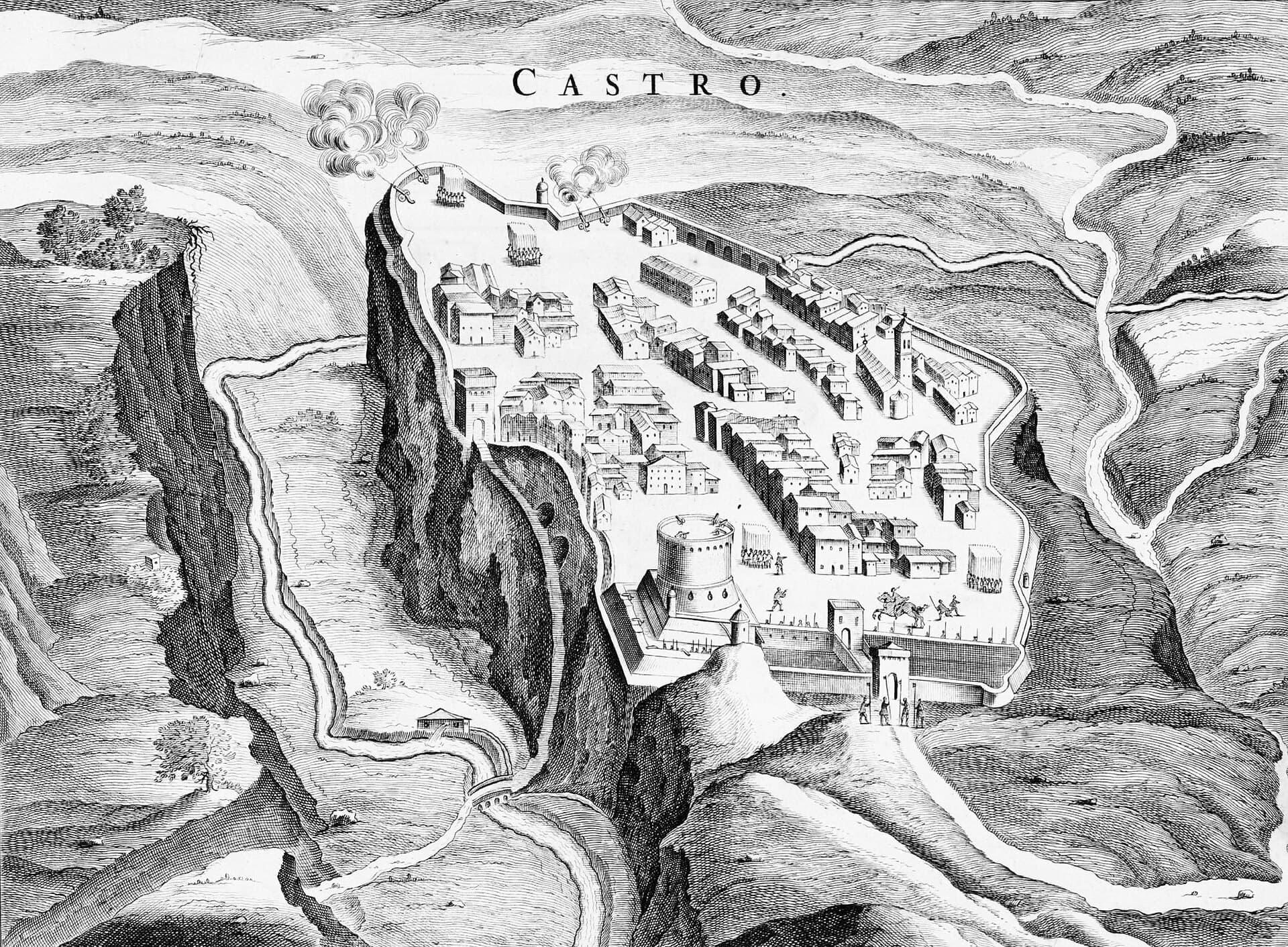 Joan Blaeu / Public domain, via Wikimedia Commons
Self-guided audio walking tour of Castro — GPS route, offline playback, story-driven narration in 32 languages.
“Where ancient myths meet the turquoise embrace of the Adriatic.”
Not the postcards. The stories even locals don't know — whispered in your ear, right where they happened.
This imposing fortress holds a secret that links it directly to a legendary Trojan hero.
The serene Romanesque cathedral conceals a much older, more pagan past beneath its foundations.
This renowned sea cave's name derives from a surprising local dialect word.
Discover every secret of Castro
Every address, every reveal in full — in your ear, right where it happened.
You pick your stops. You walk. The voice reveals what the others miss.


Your self-guided audio tour of Castro is ready — pick your landmarks, choose your language, and start the moment you arrive.
BuyCastro, a captivating town in Italy's Salento peninsula, rises dramatically on a cliff overlooking the Adriatic Sea. This destination is divided into two distinct parts: Castro Alta, the historic hilltop village with its ancient castle and narrow alleys, and Castro Marina, a lively harbor below.
Castro offers a compelling blend of history, natural beauty, and authentic southern Italian life. Its crystalline blue-green waters attract swimmers and sunbathers, while its medieval atmosphere and archaeological heritage invite exploration. Whether drawn to its legendary past, its coastline, or its local culture, Castro provides a memorable escape from the more crowded tourist hubs of Puglia.
Castro's roots stretch back to prehistoric times, with evidence of early settlements found in caves like Romanelli and Zinzulusa. The town's significance grew with the Messapians, an ancient Italic tribe, whose defensive walls are still visible today. Later, the Romans arrived, naming the town Castrum Minervae (Fortress of Minerva) around 120 BC.
Legend, famously recounted in Virgil's Aeneid, claims that Aeneas himself landed here after spotting a temple dedicated to Minerva on the cliffs. Archaeological excavations in the 'Capanne' area have lent credence to this myth, uncovering the remains of a sanctuary of Athena (the Greek equivalent of Minerva), including a monumental altar and a nearly three-meter-tall statue of the goddess. This discovery has cemented Castro's importance as an internationally significant archaeological site.
Throughout the Middle Ages, Castro maintained its strategic importance. The Normans took control in the 12th century, elevating it to a county and initiating the construction of a formidable fortress. This fortress, the Castello Aragonese, was later expanded in the 15th and 16th centuries by the Aragonese and Angevin rulers, serving as a crucial defense against coastal attacks. The 12th-century Cathedral of Santa Maria dell'Assunta, constructed on the foundations of an ancient Greek temple and incorporating elements of a 10th-century Byzantine church, further illustrates the town's layered history. Castro's past also saw it contested by the Byzantines and Normans before being passed to the Republic of Venice, each civilization leaving its indelible mark on the town's architecture and culture.
Begin your exploration in Castro Alta, the historic upper town. Wander through its narrow alleys, admiring the traditional stone houses and the defensive walls that still encircle the village. The Aragonese Castle, a 16th-century fortress built on Byzantine remains, dominates the skyline and houses the Antonio Lazzari Archaeological Museum. Here, you can delve into Castro's past, viewing artifacts from the Messapian era, remains linked to the Aeneas myth, and the impressive fragments of the Minerva statue.
Just a short walk from the castle is Piazza della Vittoria, a lovely square with wide sea views. Nearby, the Cathedral of Santa Maria dell'Assunta, a 12th-century Romanesque structure, stands on the site of an ancient Greek temple and features remnants of a 10th-century Byzantine church and frescoes in its crypt.
Descend to Castro Marina, the lively lower town and port. While there are no sandy beaches, the rocky coastline offers crystal-clear waters perfect for swimming and snorkeling. Consider a boat trip to explore the sea caves, including the renowned Grotta Zinzulusa with its unique stalactites, and the Grotta Azzurra known for its cobalt-blue hues. For a truly local experience, seek out the seaside fry shops in Castro Marina for freshly caught fried fish.
The ideal time to visit Castro is during the late spring (May-June) or early autumn (September-October). During these shoulder seasons, the weather is pleasantly warm, with temperatures ranging from 20°C to 28°C, making it perfect for exploring and enjoying outdoor activities without the intense heat and larger crowds of peak summer. The sea remains warm enough for swimming, and the sunsets over the Adriatic are particularly captivating. July and August offer lively atmospheres and festivals, but also bring higher temperatures (often exceeding 30°C) and more visitors.
Castro is best reached by car, offering the flexibility to explore the surrounding Salento region. The nearest airport is Brindisi (BDS), approximately a 1 hour and 15 minute drive away. While public transport is limited, especially off-season, summer bus routes connect Castro with Lecce and Otranto. The historic center of Castro Alta is largely pedestrianized, so comfortable shoes are a necessity for navigating its narrow alleys and stone staircases. Consider bringing water shoes for swimming, as the coastline is rocky. For convenience, especially in high season, it's advisable to reserve popular tours, like boat trips to the caves, in advance. Parking is available outside the walled old town.
Castro in Korean, in Chinese or in Hebrew — and 29 more languages, every stop narrated by a native voice. The widest language range of any self-guided audio tour.
Available in: