Diest's City Hall Cellars
Beneath the elegant 18th-century City Hall, a much older, more somber architecture waits.
Full story unlocks in the tour
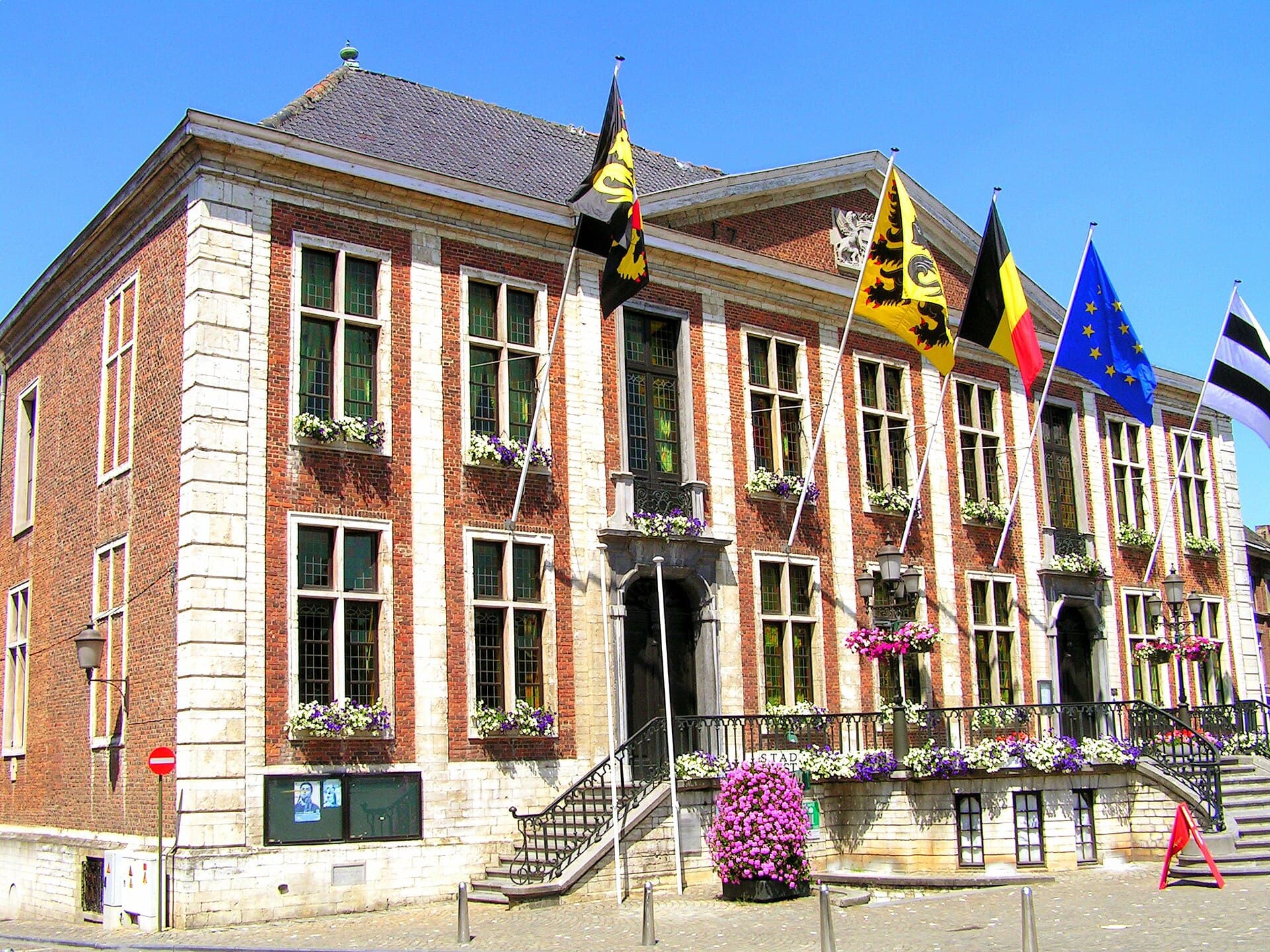 Unknown author / CC BY-SA 3.0, via Wikimedia Commons
Self-guided audio walking tour of Diest — GPS route, offline playback, story-driven narration in 32 languages.
“Where ancient stones recall medieval might, and quiet courtyards hold centuries of stories.”
Not the postcards. The stories even locals don't know — whispered in your ear, right where they happened.
Beneath the elegant 18th-century City Hall, a much older, more somber architecture waits.
Observe the Sint-Sulpitiuskerk, and its distinctive silhouette might bring a curious image to mind.
This UNESCO World Heritage site, now a picture of serenity, once teemed with a distinct community of women.
Discover every secret of Diest
Every address, every reveal in full — in your ear, right where it happened.
You pick your stops. You walk. The voice reveals what the others miss.
Your self-guided audio tour of Diest is ready — pick your landmarks, choose your language, and start the moment you arrive.
BuyLume has a built-in augmented-reality guide. Hold your phone up and its camera shows the street ahead of you, with a glowing arrow laid over the real view that always points to your next stop — no map to puzzle over, no wrong turns. Like everything in Lume, it works fully offline.
Diest, an engaging city in the Flemish Brabant province of Belgium, invites exploration through centuries of time, from its medieval beginnings to its strategic military past. Affectionately known as the 'Orange City' due to its long-standing connections with the House of Orange-Nassau, Diest is a place where every ancient brick and worn path recounts a narrative.
Beyond its historical importance, Diest captivates visitors with its tranquil beguinage, a UNESCO World Heritage site, and its impressive citadel, a singular example of 19th-century military architecture. The city's inviting Grote Markt, or Grand Place, serves as a lively heart, encircled by historic structures and inviting cafes. The surrounding natural reserves provide a peaceful escape into the Belgian countryside. Diest, though often quietly observed, reveals itself as a store of culture, nature, and unexpected stories for those who delve into its depths.
## From Medieval Trade to Orange Rule Diest's beginnings reach back to the medieval era, when it established itself as a significant trading hub. The city's prosperity was notably fueled by the woad trade, a valuable blue dye that brought considerable wealth to the region.
### The House of Orange-Nassau A crucial period in Diest's story commenced in 1499 when it came under the dominion of the House of Orange-Nassau, a powerful European dynasty. This association, which endured until 1794, bestowed upon Diest its lasting nickname, the 'Orange City'. The influence of this noble family remains visible throughout the city, including the burial place of Philip William, son of William the Silent, within the Sint-Sulpitiuskerk.
### A Fortified Stronghold Following Belgium's independence in 1830, Diest was transformed into a heavily fortified city, designed to defend against potential invasions from the Netherlands. Between 1837 and 1853, an extensive system of ramparts, city walls, and gates was constructed, partly upon older medieval defenses. The most prominent of these fortifications is the Citadel of Diest, a massive pentagonal brick structure built between 1845 and 1853 on the Allerheiligenberg. This self-sufficient fortress, conceived as a final refuge for troops, is unique in Europe for its perfectly preserved defense system. Another significant defensive structure from this period is Fort Leopold, an 'Artillery Fort' that reflects the evolving military architecture of the mid-19th century.
### A Legacy of Heritage Diest's extensive past is not solely contained within its military structures. The city is home to one of Europe's largest and best-preserved beguinages, a UNESCO World Heritage site established in the 13th century. This serene 'village within the city' offers a window into the lives of the beguines, lay religious women who lived communally. Today, Diest proudly holds the distinction of having the highest concentration of protected heritage sites per square meter in Flanders, a testament to its remarkably preserved story.
Begin your journey in the Grote Markt (Grand Place), Diest's central square, framed by houses from the 16th to 18th centuries and the neoclassical City Hall. Beneath the City Hall, explore the De Hofstadt Municipal Museum, housed in medieval cellars and displaying the city's history, including the armor of Philip of Orange.
Dominating the Grote Markt is the Sint-Sulpitiuskerk, a striking Gothic church recognized for its 'mustardpot' belfry and containing the tomb of Philip William of Orange. A short walk leads to the Diest Beguinage, a tranquil UNESCO World Heritage site with graceful baroque gates, worn paths, and houses from the 17th and 18th centuries.
Ascend to the Citadel of Diest, a monumental pentagonal brick fortress offering expansive views and a look into 19th-century military engineering. For a touch of nature, explore the Webbekoms Broek nature reserve, a vast wetland area perfect for walks along the historic ramparts. Do not miss the Lindenmolen Mill, a historic windmill standing on the city ramparts.
The most pleasant times to visit Diest are during the shoulder seasons of late spring (May, June) or early autumn (September). During these months, the weather is mild and comfortable, ideal for walking and exploring the city's outdoor attractions. Crowds are generally smaller than in the height of summer. Summers (July and August) offer warmer weather and numerous festivals, but also more tourists. While winters are colder and wetter, they provide a quieter experience and the charm of Christmas markets.
Diest is readily accessible by train, with direct connections from Brussels, Leuven, Antwerp, and Liège. The railway station is a short walk from the city center. If traveling by car, several free car parks are available on the city's perimeter, including at Halve Maan, Kluisberg, and the Citadel, all within a 3-10 minute walk to the center. The city center and its main attractions are easily explored on foot, with most sights within a 20-minute walk. Bicycles can also be rented to discover the nearby Flemish countryside. Many of Diest's museums, including the De Hofstadt Municipal Museum, offer free admission. For local delicacies, try the 'Diest Halve Maantjes' biscuits.
Diest in Korean, in Chinese or in Hebrew — and 29 more languages, every stop narrated by a native voice. The widest language range of any self-guided audio tour.
Available in: