The Church of Notre-Dame-de-l'Assomption
Within the Baroque interior of Fanjeaux's parish church, a wooden beam tells a story of divine intervention during a pivotal theological debate.
Full story unlocks in the tour
 Elizabeth Schwegler / CC BY-SA 3.0, via Wikimedia Commons
Self-guided audio walking tour of Fanjeaux — GPS route, offline playback, story-driven narration in 32 languages.
“Where Cathar echoes meet Dominican whispers in the Languedoc hills.”
Not the postcards. The stories even locals don't know — whispered in your ear, right where they happened.
Within the Baroque interior of Fanjeaux's parish church, a wooden beam tells a story of divine intervention during a pivotal theological debate.
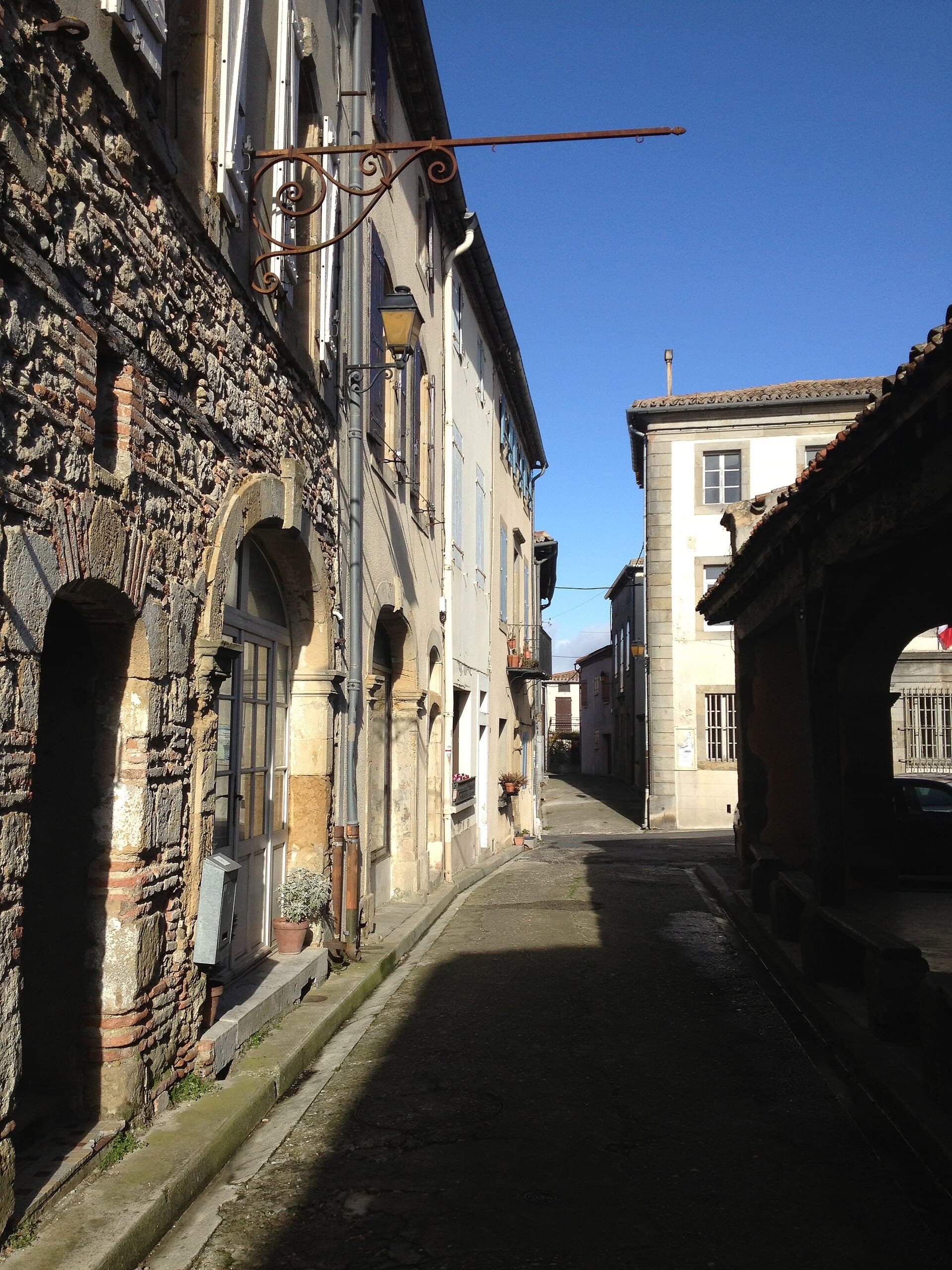
Keep an eye out for a peculiar carved head adorning a doorway on this street.
The communal washing place, fed by a spring, was more than just a site for chores.
Discover every secret of Fanjeaux
Every address, every reveal in full — in your ear, right where it happened.
You pick your stops. You walk. The voice reveals what the others miss.
Your self-guided audio tour of Fanjeaux is ready — pick your landmarks, choose your language, and start the moment you arrive.
BuyLume has a built-in augmented-reality guide. Hold your phone up and its camera shows the street ahead of you, with a glowing arrow laid over the real view that always points to your next stop — no map to puzzle over, no wrong turns. Like everything in Lume, it works fully offline.
Fanjeaux, a village in the Aude department of southwestern France, rests atop a hill, its silhouette a familiar landmark against the Lauragais plain. The name 'Fanjeaux' originates from 'Fanum Jovis,' a Gallo-Roman temple dedicated to Jupiter that once stood where the parish church is now located. This serene agricultural community, with around 900 inhabitants today, was a bustling center of 3,000 people during the time of Saint Dominic in the 13th century.
The village holds a strategic position, historically serving as a crossroads for traders, pilgrims, merchants, and armies moving across the region. It overlooks a network of valleys, connecting territories like the Carcassès, Razès, Lauragais, and Toulousain. Fanjeaux's enduring appeal lies in its winding medieval streets, stone facades, and expansive views that stretch across six departments from the Seignadou lookout.
## From Roman Temple to Cathar Center Fanjeaux's history begins with Roman origins, its name a direct link to a temple of Jupiter. In the medieval period, it evolved into a significant castrum, a fortified town with a specific city plan where houses were built in circles around central dwellings or a church. The town was once surrounded by a moat and defended by ramparts with fourteen towers, though little of these fortifications remain today.
## The Heart of Catharism and Saint Dominic's Mission By the 12th century, Fanjeaux became a lively cultural hub, known for its troubadours and as a welcoming place for Cathar preachers. More than fifty noble families resided here, many of whom adopted Cathar beliefs. Guilhabert de Castres, a Cathar bishop, even ran a 'House of Parfaits' within the fortified village. This made Fanjeaux a central point for the Cathar movement in the Lauragais region.
It was into this environment that Dominic de Guzman, the future Saint Dominic, arrived in 1206. He spent about eight years in Fanjeaux, attempting to convert the local nobility and populace back to Catholicism through itinerant preaching. His efforts led to the establishment of the first community of converted nuns at the nearby Monastery of Prouilhe in 1206, a precursor to the Dominican Order he would found in 1215.
## Crusades, Destruction, and Rebirth The proliferation of Catharism in Fanjeaux and the wider Languedoc region prompted Pope Innocent III to call for the Albigensian Crusade in 1209. Fanjeaux was taken over by crusaders, forcing many Cathar followers to flee. Simon de Montfort, a leader of the Crusade, even established his headquarters in Fanjeaux in 1209. After Dominic's death in 1221, the Dominicans were instrumental in the Inquisition, with records from 1246 detailing trials of Fanjeaux inhabitants.
In 1355, the village suffered destruction when it was burned by the armies of the Black Prince during the Hundred Years' War. However, Fanjeaux was quickly rebuilt and found new prosperity in the mid-15th century through the cultivation of woad, a plant used to produce blue dye. Today, Fanjeaux continues to embrace its enduring past, with five religious communities still active in the town.
Begin your exploration at the Church of Notre-Dame-de-l'Assomption, a Southern Gothic structure from the late 13th century built on the site of the ancient Roman temple to Jupiter. Its octagonal bell tower and stone spire are illuminated at night, offering a striking view. Inside, you'll find an 18th-century Baroque choir, 13th to 16th-century statues of the Virgin and Child, and the 'Miracle of Fire' beam. Nearby, the Dominican cloister features remains from the 14th and 15th centuries.
Walk to the House of Saint Dominic (Ostau de Sant Domenge), where legend states Dominic de Guzman resided. This building is notable for its carved wooden door and stained-glass windows by Jean Hugo, depicting six episodes from Dominic's life. A short distance away is the Monastery of Prouilhe, founded by Saint Dominic in 1206 as the first community for converted Cathar women. Do not miss the Seignadou lookout, which offers expansive views of the Lauragais plain, the Montagne Noire, and the Pyrenees. An artistic trail with ten sculptures by Loïc Tellier throughout the village gives tangible form to historical events and can be explored with an audio guide from the Tourist Office.
Fanjeaux is particularly pleasant to visit from late spring to early autumn. July and August offer warm temperatures averaging around 29°C (84°F) during the day, with about four rainy days a month. The village hosts a local farmers' market in July, and the Maison Gramont holds a contemporary art exhibition during July and August. Festi-Fanjeaux, a street festival, also takes place in July. For slightly cooler weather, March brings moderately chilly and breezy conditions, with temperatures ranging from 3°C to 13°C (37-55°F).
Fanjeaux is located in the Aude department, west of Carcassonne, and is accessible via the D119 road. The nearest train stations are in Castelnaudary, Bram, and Carcassonne, with Carcassonne Salvaza Airport approximately 25 km away. Free car parks are available in the village. The Tourist Office, located at 6 Place du Treil, offers information, maps, and audio guides for the artistic trail. They are open daily from 10 am to 1 pm and 2:30 pm to 6:30 pm in July and August, and Monday to Friday from 10 am to 12 pm and 2 pm to 5 pm from September to June, closing between December 22nd and January 2nd. Public toilets are available opposite the Tourist Office.
Fanjeaux in Korean, in Chinese or in Hebrew — and 29 more languages, every stop narrated by a native voice. The widest language range of any self-guided audio tour.
Available in: