Qasr al-Farafra
Before modern roads connected the oases, the residents of Farafra once faced a peculiar challenge in keeping track of time.
Full story unlocks in the tour
 Ahmedsalahemam / CC BY-SA 4.0, via Wikimedia Commons
Self-guided audio walking tour of Farafra — GPS route, offline playback, story-driven narration in 32 languages.
“Where the desert breathes white and history whispers from the chalk.”
Not the postcards. The stories even locals don't know — whispered in your ear, right where they happened.
Before modern roads connected the oases, the residents of Farafra once faced a peculiar challenge in keeping track of time.
A specific spring in the Farafra Oasis is rumored to be the last known point of contact for a legendary lost army.
One Farafra local recounts a chilling tale of a spring that demanded a strange offering.
Discover every secret of Farafra
Every address, every reveal in full — in your ear, right where it happened.
You pick your stops. You walk. The voice reveals what the others miss.


Your self-guided audio tour of Farafra is ready — pick your landmarks, choose your language, and start the moment you arrive.
BuyLume has a built-in augmented-reality guide. Hold your phone up and its camera shows the street ahead of you, with a glowing arrow laid over the real view that always points to your next stop — no map to puzzle over, no wrong turns. Like everything in Lume, it works fully offline.
Farafra Oasis, a captivating geological depression in Egypt's expansive Western Desert, offers a serene departure from the active Nile Valley. It claims the second largest area among Western Egyptian oases, yet sustains the smallest population, fostering an atmosphere of profound calm. Known in ancient times as 'the land of the cow' (Ana Akhet), a designation honoring the goddess Hathor and symbolizing fertility, Farafra has nurtured life for millennia with its natural springs and productive lands. This distant oasis serves as a portal to some of Egypt's most surreal natural landscapes, especially the White Desert National Park.
Life in Farafra unfolds at a gentle pace, preserving a traditional Bedouin way of life, characterized by its distinctive mud-brick architecture and enduring community bonds. Travelers are drawn to its quiet allure, the dramatic geological formations of the surrounding desert, and the therapeutic hot springs that dot the terrain. It is a destination that invites quiet thought, presenting a singular fusion of cultural immersion, natural splendor, and adventure beneath expansive desert skies.
The story of Farafra Oasis reaches back to prehistoric times, with archaeological evidence indicating human presence over 15,000 years ago. Eras of plentiful rainfall drew early Egyptians, cultivating an 'Oasis Culture' in the Western Desert, with Farafra safeguarding some of the most complete remnants. Neolithic villages like Hidden Valley and Sheikh el Obeiyid reveal semi-sedentary settlements, early goat-breeding, and sophisticated stone tool technology. These agro-pastoral activities in Farafra are thought to have influenced the evolution of pre-Dynastic Neolithic cultures in the Nile Valley during arid phases.
Farafra's importance continued into the Pharaonic era. Ancient texts from the 21st century BC, during the reign of the 10th dynasty, refer to Farafra as "Ana Akhet" or "The Land of the Cow," symbolizing fertility and connecting it to the goddess Hathor. Its remoteness earned it the title 'city of conquest and invasion'. Ramses II (1279-1213 BC) reportedly brought stones from Farafra for his temples in Luxor, and inscriptions from his son Merenptah at Karnak Temple mention the occupation of Farafra by Libyan troops.
During the Roman period (1st to 3rd centuries AD), Farafra functioned as a vital agricultural center, recognized as a 'land of grains'. Remains of Roman temples, tombs, and palaces can still be found, including the ancient granary of Qasr El-Farafra, which operated as a fortress guarding caravan routes. The oasis also offered sanctuary for Copts escaping Roman persecution. Following the Arab conquest in 641 AD, Farafra prospered as a trade nexus, exchanging dates, olives, cloth, and tea with the Nile Valley via camel caravans. Throughout the 19th and 20th centuries, Farafra continued to be a place of worship and, more recently, has experienced agricultural revitalization efforts, drawing workers from the Nile Valley and increasing its population.
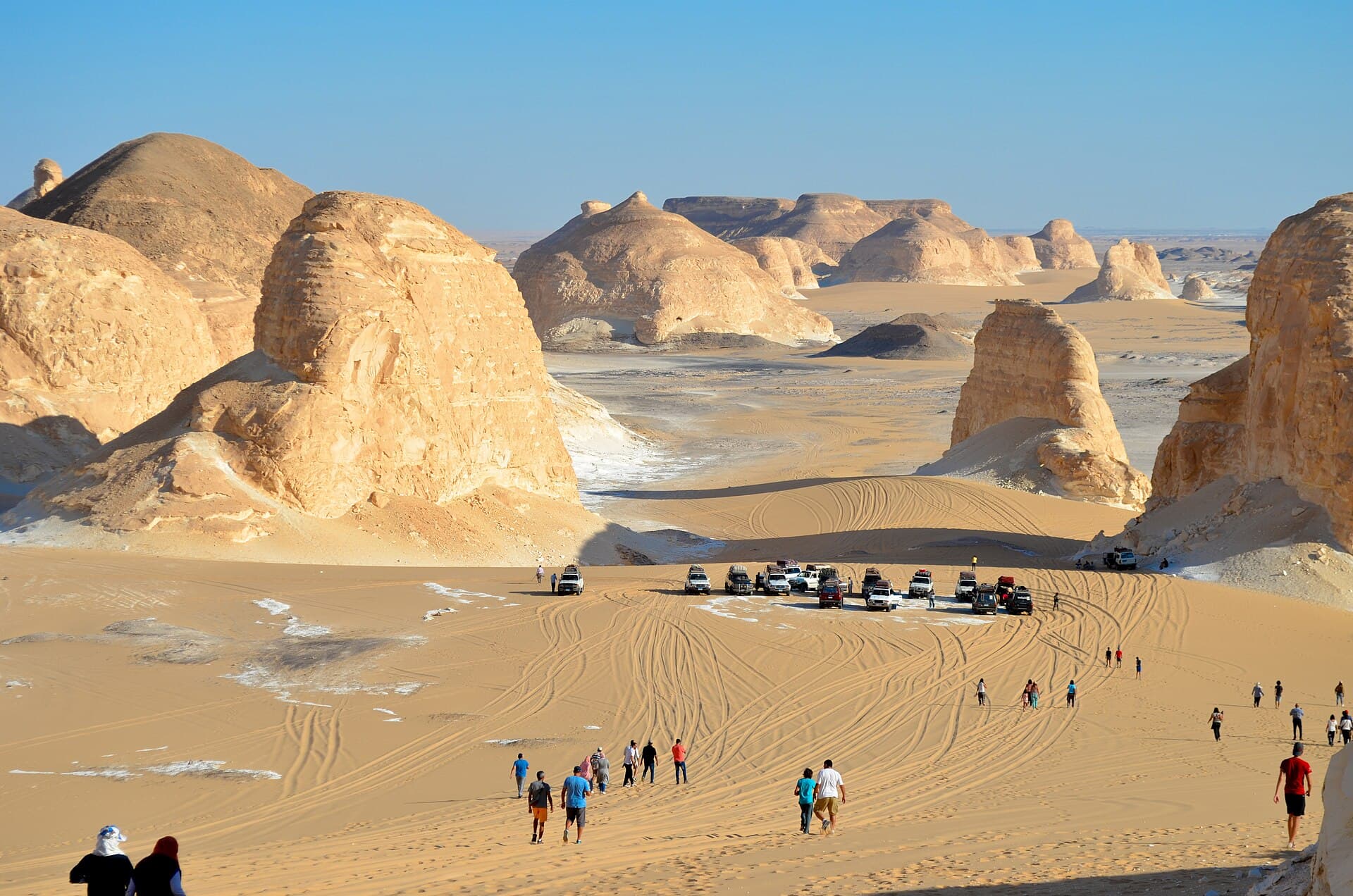
The primary draw of Farafra is the White Desert National Park (Sahara el Beyda), situated 45 km north of the town. This protected expanse is known for its surreal, brilliant-white chalk rock formations, sculpted by wind and sand into otherworldly shapes that resemble mushrooms and alien figures. It offers an excellent setting for camping and stargazing.
Within Farafra itself, explore Qasr al-Farafra, the main settlement, which preserves sections of traditional mud-brick architecture, providing a look into authentic Bedouin existence. The Badr Museum, the workshop-museum of local artist Badr Abdel Moghny, displays sculptures and paintings that reflect the oasis's culture and desert life. Farafra is also recognized for its many hot springs, with over 100 wells spread across the oasis. Popular options for a soothing soak include Bir Sitta (Well Number Six), known for its warm, therapeutic waters (around 32°C / 90°F) and amenities, and Ain Bishay, a Roman-era spring. For adventurous travelers, 4x4 safaris can be arranged to explore the Black Desert with its volcanic remnants, the Crystal Mountain (Gebel al-Izaz), a massive quartz crystal rock formation, and the Agabat Valley, noted for its pale rock formations.
The best time to visit Farafra Oasis is during the cooler months, from October to April. In this period, daytime temperatures are agreeable, ranging from 15°C to 30°C (59°F to 86°F), making outdoor activities and desert exploration comfortable. Winter months (December to February) provide particularly ideal weather for camping, with cooler nights. Spring (March-April) can bring occasional sandstorms but also offers the chance to see wildflowers after rare rainfall. Summers (June-August) are exceedingly hot, with temperatures often surpassing 40°C (104°F), making midday outdoor activities challenging.
Reaching Farafra Oasis, located deep in the Western Desert, primarily involves road travel. There are no nearby airports or train stations. Most travelers arrive by bus from Bahariya Oasis (approximately 3 hours) or Dakhla Oasis (around 3 hours). Regular bus services from Cairo to Farafra, passing through Bahariya, are available, though the journey can be lengthy (8-10 hours). Many visitors opt for organized Western Desert oasis circuit tours or White Desert safari tours from Cairo or Bahariya, which often include 4x4 transportation.
When visiting, pack ample water, sunscreen, and warm layers for surprisingly cool desert nights. Carrying cash is advisable as ATMs are scarce. While Farafra is generally secure, traveling with a local guide is recommended, especially for desert excursions, to ensure safety and enhance the experience. Respecting the fragile chalk formations in the White Desert by not touching or leaning on them is important.
Farafra in Korean, in Chinese or in Hebrew — and 29 more languages, every stop narrated by a native voice. The widest language range of any self-guided audio tour.
Available in: