Domberg (Cathedral Hill)
The bear on Freising's coat of arms isn't just a symbol; it's a testament to a miraculous journey.
Full story unlocks in the tour
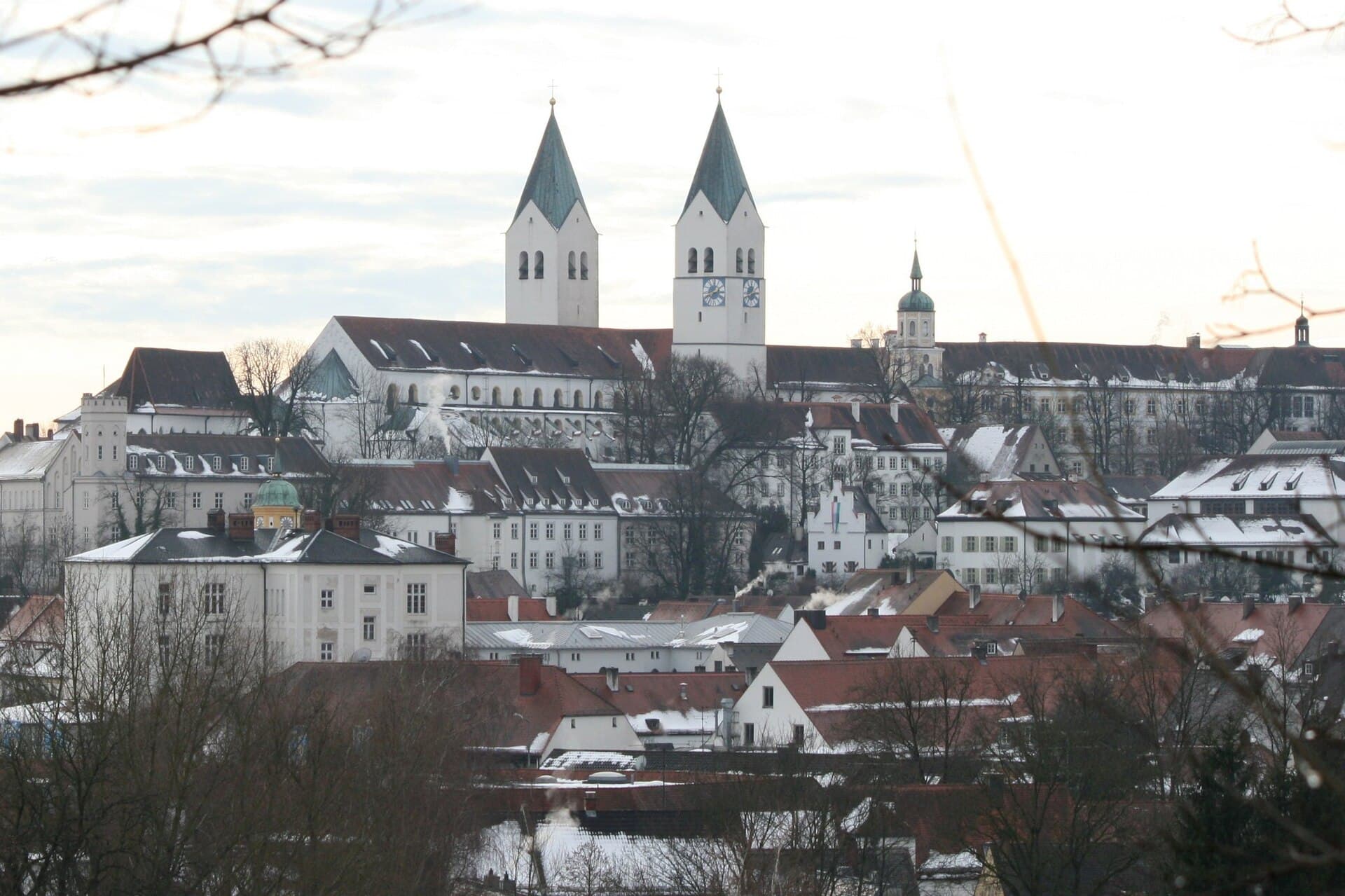 Doktor Oli / CC BY-SA 4.0, via Wikimedia Commons
Self-guided audio walking tour of Freising — GPS route, offline playback, story-driven narration in 32 languages.
“Where ancient faith meets the world's oldest brew.”
Not the postcards. The stories even locals don't know — whispered in your ear, right where they happened.
The bear on Freising's coat of arms isn't just a symbol; it's a testament to a miraculous journey.
The world's oldest continuously operating brewery started not with a business plan, but with Benedictine monks.
Beneath the Baroque splendor of the cathedral lies a much older, more mysterious secret.
Discover every secret of Freising
Every address, every reveal in full — in your ear, right where it happened.
You pick your stops. You walk. The voice reveals what the others miss.


Your self-guided audio tour of Freising is ready — pick your landmarks, choose your language, and start the moment you arrive.
BuyLume has a built-in augmented-reality guide. Hold your phone up and its camera shows the street ahead of you, with a glowing arrow laid over the real view that always points to your next stop — no map to puzzle over, no wrong turns. Like everything in Lume, it works fully offline.
Freising, cradled between two prominent elevations—Domberg (Cathedral Hill) and Weihenstephan Hill—is a city where ancient history and contemporary life intertwine. As the oldest town in Upper Bavaria, founded in 739 A.D., Freising carries a profound sense of heritage, evident in its Romanesque cathedral and picturesque old town.
Beyond its ecclesiastical significance, Freising is a lively university town, home to institutes of the Technical University of Munich focused on nutrition, land usage, and the environment. It also contains the world's oldest continuously operating brewery, Weihenstephan, a testament to centuries of brewing tradition. With its close proximity to Munich Airport, Freising offers a compelling stop for travelers seeking a blend of historical charm, academic energy, and authentic Bavarian culture.
## From Romanesque Roots to Prince-Bishopric Power Freising's story begins long before its official founding, with archaeological evidence suggesting settlements as far back as the Bronze Age on Cathedral Hill. The current settlement is generally considered to have begun in the 8th century, with the arrival of Saint Corbinian, a Frankish missionary bishop who established a Benedictine monastery and school around 724 A.D. This marked the beginning of Freising's enduring role as a significant religious and cultural center in Bavaria.
In 739 A.D., Saint Boniface formally established the bishopric, solidifying Freising's ecclesiastical importance. The town quickly grew, and in 996, Emperor Otto III granted Freising city rights. For over a millennium, the prince-bishops of Freising ruled from Domberg, wielding considerable influence. This era saw Freising flourish as a center of scholarship, with notable figures like Otto of Freising, a renowned medieval philosopher and historian, contributing to its intellectual legacy.
However, Freising's prominence faced a challenge in 1158 when Duke Henry the Lion, seeking to monopolize the lucrative salt trade, destroyed Freising's bridge over the Isar River. He then built a new bridge closer to his own settlement, an event that led to the first documented mention of Munich and is often considered Munich's birth date. Despite this, the Prince-Bishopric of Freising maintained its independence as a religious center until the early 19th century. In 1802/1803, under the influence of Napoleonic France, the bishopric was secularized, and its territory was annexed to Bavaria. The seat of the diocese was eventually transferred to Munich in 1821, though Freising continues to house diocesan administration and the Diocesan Museum.
Freising experienced an economic resurgence with the planning and construction of Munich Airport, which opened in 1992 on the city's borders. Today, Freising is economically healthy, with a high residency growth rate and low unemployment, thriving as a modern university city while preserving its deep historical roots.
Begin your exploration on Domberg (Cathedral Hill), home to the magnificent Freising Cathedral (Mariendom). This Romanesque basilica, with its distinctive towers, features a lavish Baroque interior by the Asam brothers and a fascinating 12th-century crypt containing the 'Bestiensäule' (Pillar of Beasts). Adjacent to the cathedral is the Diözesanmuseum (Diocesan Museum), showcasing an extensive collection of religious art.
Descend to the Historic Old City, where imposing burgher residences and craftsmen's houses line the streets. The central Marienplatz is a bustling hub, marked by the Marian Column from 1674 and the imposing Town Hall. Don't miss the bronze miniature model of the city center near the fountain on Untere Hauptstraße, offering a unique tactile overview. Explore the charming lanes and discover places like the Zierer-Haus, known for its Rococo stucco façade.
Across the city, on Weihenstephan Hill, you'll find the Bavarian State Brewery Weihenstephan, recognized as the world's oldest continuously operating brewery. Take a tour or enjoy a traditional Bavarian meal at the Bräustüberl. The hill is also home to the Weihenstephaner Perennial Gardens and the show gardens of the Weihenstephan-Triesdorf University of Applied Sciences, offering diverse botanical experiences.
For outdoor enthusiasts, the Isar Cycle Path provides scenic views along the river, and the World Forest Arboretum in Kranzberg Forest showcases trees from various continents. The Amtsgerichtsgarten offers an idyllic garden setting in the old town, and Freising's status as a 'City of Roses' means you'll find fragrant rose gardens throughout its historic quarter.
The best time to visit Freising for general outdoor tourist activities is from late June to late August, when temperatures are pleasant, averaging highs of 23-25°C (73-77°F) and lows of 13-14°C (55-57°F). July is often the warmest and sunniest month. Spring and autumn also offer agreeable weather, with September being particularly optimal. The Weihenstephaner Perennial Gardens are especially beautiful when in bloom during these seasons. While winters are cold with average highs around 4°C (39°F) and lows around -2°C (28°F), Freising's historical sites and brewing culture can be enjoyed year-round.
Freising is conveniently located just 5 kilometers (3 miles) from Munich International Airport (MUC). The city is well-connected to Munich by regional trains and the S1 S-Bahn line, with a journey time of approximately 20-45 minutes. Be mindful that the S1 train splits at Neufahrn, so ensure you are in the correct section heading to Freising. Local bus line 635 connects Freising railway station directly to the airport terminals.
Once in Freising, the city is easily navigable on foot due to its compact size. Public buses are also available and are part of Munich's MVV public transportation network, meaning tickets are integrated. Parking in the city center can be scarce, so walking or using public transport is recommended. Taxis are also an option, especially for those with heavy luggage, with an estimated cost of 25-30 Euros from the airport.
Freising in Korean, in Chinese or in Hebrew — and 29 more languages, every stop narrated by a native voice. The widest language range of any self-guided audio tour.
Available in: