Ludwigstraße de Partenkirchen
La rue principale de Partenkirchen, Ludwigstraße, suit un chemin ancien, mais ses façades colorées cachent un secret sur ses origines romaines.
L'histoire complète se débloque dans le tour
 Octagon / CC BY 3.0, via Wikimedia Commons
Visite audio autoguidée de Garmisch-Partenkirchen — parcours GPS à pied, lecture hors ligne, narration en 32 langues.
“Là où les sommets imposants rencontrent la grâce bavaroise.”
Pas les cartes postales. Les histoires que même les habitants ignorent — soufflées à l'oreille, là où elles se sont passées.
La rue principale de Partenkirchen, Ludwigstraße, suit un chemin ancien, mais ses façades colorées cachent un secret sur ses origines romaines.
Haut au-dessus de la vallée de la Loisach, les vestiges du château de Werdenfels témoignent d'une période sombre où la région a été confrontée à une épreuve glaçante.
La spectaculaire gorge de Partnach, un monument naturel sculpté par l'eau de fonte, n'a pas toujours été une attraction touristique ; elle a jadis servi à un but plus utilitaire, quoique dangereux.
Découvrez tous les secrets de Garmisch-Partenkirchen
Chaque adresse, chaque révélation en entier — dans ton oreille, là où elle s'est passée.
Tu choisis tes lieux. Tu marches. La voix te révèle ce que les autres ignorent.


Votre visite audioguidée de Garmisch-Partenkirchen vous attend — choisissez vos lieux, votre langue, et lancez-vous dès votre arrivée.
AcheterLume intègre un guide en réalité augmentée. Levez votre téléphone : sa caméra montre la rue devant vous, avec une flèche lumineuse posée sur l'image réelle qui pointe toujours vers votre prochain arrêt — aucune carte à déchiffrer, aucun mauvais virage. Comme tout dans Lume, ça fonctionne entièrement hors-ligne.
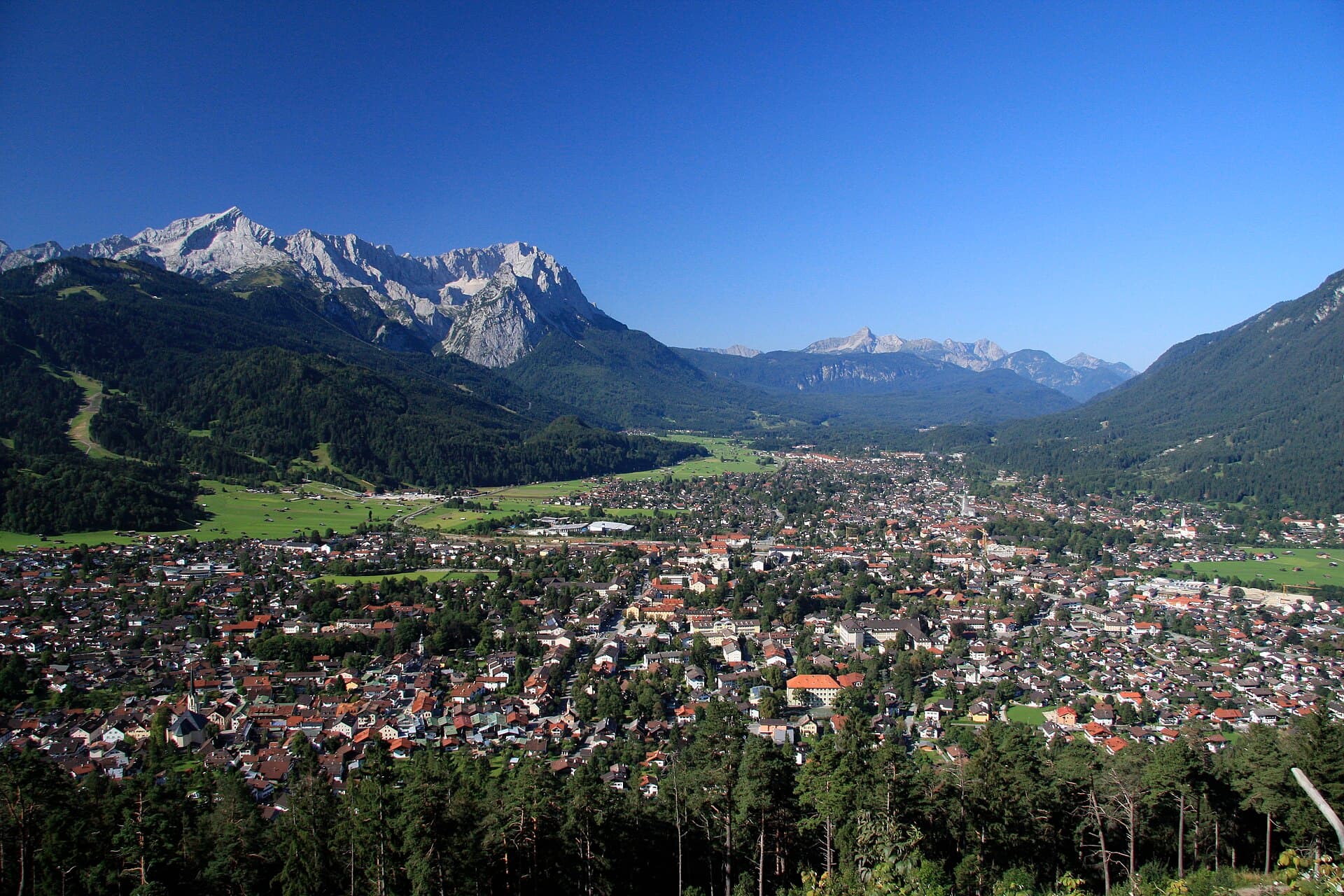
Garmisch-Partenkirchen, souvent simplement appelée GaPa, est une ville bavaroise typique nichée au milieu des pics spectaculaires des Alpes allemandes. Cette double municipalité, formée par la fusion de deux villes distinctes, Garmisch et Partenkirchen, offre un mélange captivant d'aventure alpine et de culture allemande traditionnelle. Entourée par les montagnes du Wetterstein, y compris le plus haut sommet d'Allemagne, la Zugspitze, la région est un havre pour les amateurs de plein air en toute saison.
Les visiteurs peuvent explorer des rues charmantes ornées de 'Lüftlmalerei' (peintures murales traditionnelles bavaroises), découvrir le long passé de la région et s'immerger dans un paysage défini par des montagnes imposantes, des gorges profondes et des lacs sereins. Que ce soit pour des sports d'hiver exaltants ou des randonnées estivales tranquilles, Garmisch-Partenkirchen offre une porte d'entrée vers la splendeur naturelle des Alpes bavaroises.
L'histoire de Garmisch-Partenkirchen est unique, car elle a commencé comme deux colonies distinctes : Garmisch à l'ouest et Partenkirchen à l'est. Les origines de Partenkirchen remontent à la ville romaine de Partanum, établie vers 15 après J.-C. sur la route commerciale reliant Venise et Augsbourg. Sa principale artère, la Ludwigstraße, suit toujours cet ancien chemin romain. Garmisch, mentionnée pour la première fois environ 800 ans plus tard sous le nom de 'Germareskauue', signifiant 'gau de Germar', s'est développée comme une colonie germanique.
À la fin du XIIIe siècle, la vallée, connue sous le nom de comté de Werdenfels, passa sous la domination des princes-évêques de Freising. Cette période vit Partenkirchen prospérer en tant que poste de traite, ce qui lui valut le surnom de 'Golden Landl' entre le XIIIe et le XVIe siècle. Cependant, l'arrivée des Européens en Amérique au XVIe siècle entraîna un déclin du commerce terrestre, plongeant la région dans une longue dépression économique. L'adversité, y compris les maladies et les mauvaises récoltes, conduisit parfois à des périodes plus sombres, comme les tristement célèbres procès et exécutions de sorcières entre 1589 et 1596, où 63 personnes furent mises à mort au château de Werdenfels.
Les deux villes sont restées distinctes jusqu'en 1935, lorsque Adolf Hitler a contraint leur fusion en Garmisch-Partenkirchen en prévision des Jeux olympiques d'hiver de 1936. Ces jeux, les premiers à inclure le ski alpin, ont apporté une reconnaissance internationale à la région. Bien qu'officiellement unifiées, les deux parties de la ville conservent toujours leur caractère individuel, Partenkirchen étant souvent perçue comme plus historique en raison de ses rues ornées de fresques, et Garmisch ayant une atmosphère plus moderne.
Commencez votre exploration à Partenkirchen en vous promenant le long de la Ludwigstraße, où de nombreux bâtiments affichent des fresques traditionnelles 'Lüftlmalerei'. Le musée de Werdenfels, installé dans une maison de marchand des XVIIe/XVIIIe siècles, offre un aperçu complet de l'histoire et de la culture de la région sur cinq étages, y compris des costumes traditionnels et de l'artisanat local. Pour un spectacle naturel, visitez la gorge de Partnach (Partnachklamm), un canyon de 700 mètres de long avec des parois atteignant 80 mètres de haut, sculpté par la rivière Partnach. Des sentiers et des tunnels permettent d'admirer de près ses cascades et ses rapides, et elle est accessible toute l'année.
Un voyage à la Zugspitze, la plus haute montagne d'Allemagne à 2 962 mètres, est un incontournable pour des vues panoramiques qui peuvent s'étendre jusqu'en Italie et en Suisse par temps clair. Vous pouvez atteindre le sommet via un nouveau téléphérique ou un chemin de fer à crémaillère. Une autre montagne accessible en téléphérique est l'Alpspitze, offrant des vues différentes mais tout aussi impressionnantes et la passerelle AlpspiX. Pour une expérience montagnarde moins fréquentée avec de belles vues, pensez au Mont Wank. Ne manquez pas le tremplin olympique de ski, héritage des Jeux olympiques d'hiver de 1936, qui accueille toujours le concours annuel de saut à ski du Nouvel An.
Garmisch-Partenkirchen est une destination toute l'année, chaque saison offrant des expériences distinctes. Pour les activités par temps chaud comme la randonnée et l'exploration des lacs, la meilleure période est de début juillet à fin août, lorsque les températures sont douces (19-22°C) et que les heures d'ensoleillement sont longues. Cependant, préparez-vous à une forte probabilité de précipitations pendant ces mois. L'hiver transforme la région en un paysage enneigé idéal pour le ski et les sports d'hiver, janvier étant le mois le plus froid. Le printemps et l'automne offrent moins de foule et des conditions agréables, bien que les altitudes plus élevées puissent encore avoir de la neige en mai.
Garmisch-Partenkirchen est facilement accessible. De Munich, un trajet en train dure environ 1h30, ou c'est 1h30 de route via l'autoroute A95. L'aéroport de Munich (MUC) est la principale porte d'entrée pour les visiteurs internationaux. Bien que des options de transport en commun comme les bus et les trains soient disponibles pour les attractions locales, explorer la région en voiture de location offre une plus grande flexibilité.
Dans la ville, le centre de Garmisch-Partenkirchen est piétonnier. Lors de la visite de la gorge de Partnach, prévoyez environ 20 minutes de marche depuis le parking, ou envisagez une promenade en calèche. Portez des chaussures imperméables et antidérapantes pour la gorge, car l'eau s'écoule même sans pluie récente, et les parapluies ne sont pas recommandés dans les tunnels étroits. De nombreux habitants, en particulier les jeunes, parlent anglais et sont généralement heureux d'aider les visiteurs.
Garmisch-Partenkirchen en coréen, en chinois ou en hébreu — et dans 29 autres langues, chaque étape narrée par une voix native. La plus large gamme de langues de tous les audioguides autoguidés.
Disponible en :