Faïencerie de Gien
The distinctive 'rice grain' pattern, a hallmark of Gien faience, holds an unexpected culinary reference.
Full story unlocks in the tour
 B kerr / CC BY-SA 3.0, via Wikimedia Commons
Self-guided audio walking tour of Gien — GPS route, offline playback, story-driven narration in 32 languages.
“Where the Loire's gentle currents meet centuries of artistry.”
Not the postcards. The stories even locals don't know — whispered in your ear, right where they happened.
The distinctive 'rice grain' pattern, a hallmark of Gien faience, holds an unexpected culinary reference.
This Renaissance castle, now a museum, once served a very different, less grand purpose.
This impressive navigable aqueduct, a marvel of 19th-century engineering, was not the first effort to cross the Loire at this point.
Discover every secret of Gien
Every address, every reveal in full — in your ear, right where it happened.
You pick your stops. You walk. The voice reveals what the others miss.


Your self-guided audio tour of Gien is ready — pick your landmarks, choose your language, and start the moment you arrive.
BuyLume has a built-in augmented-reality guide. Hold your phone up and its camera shows the street ahead of you, with a glowing arrow laid over the real view that always points to your next stop — no map to puzzle over, no wrong turns. Like everything in Lume, it works fully offline.
Gien, a town in north-central France, rests on the banks of the Loire River, marking the eastern boundary of the traditional Loire Valley. It is a place where the river's steady movement converges with centuries of French craftsmanship and the weight of history.
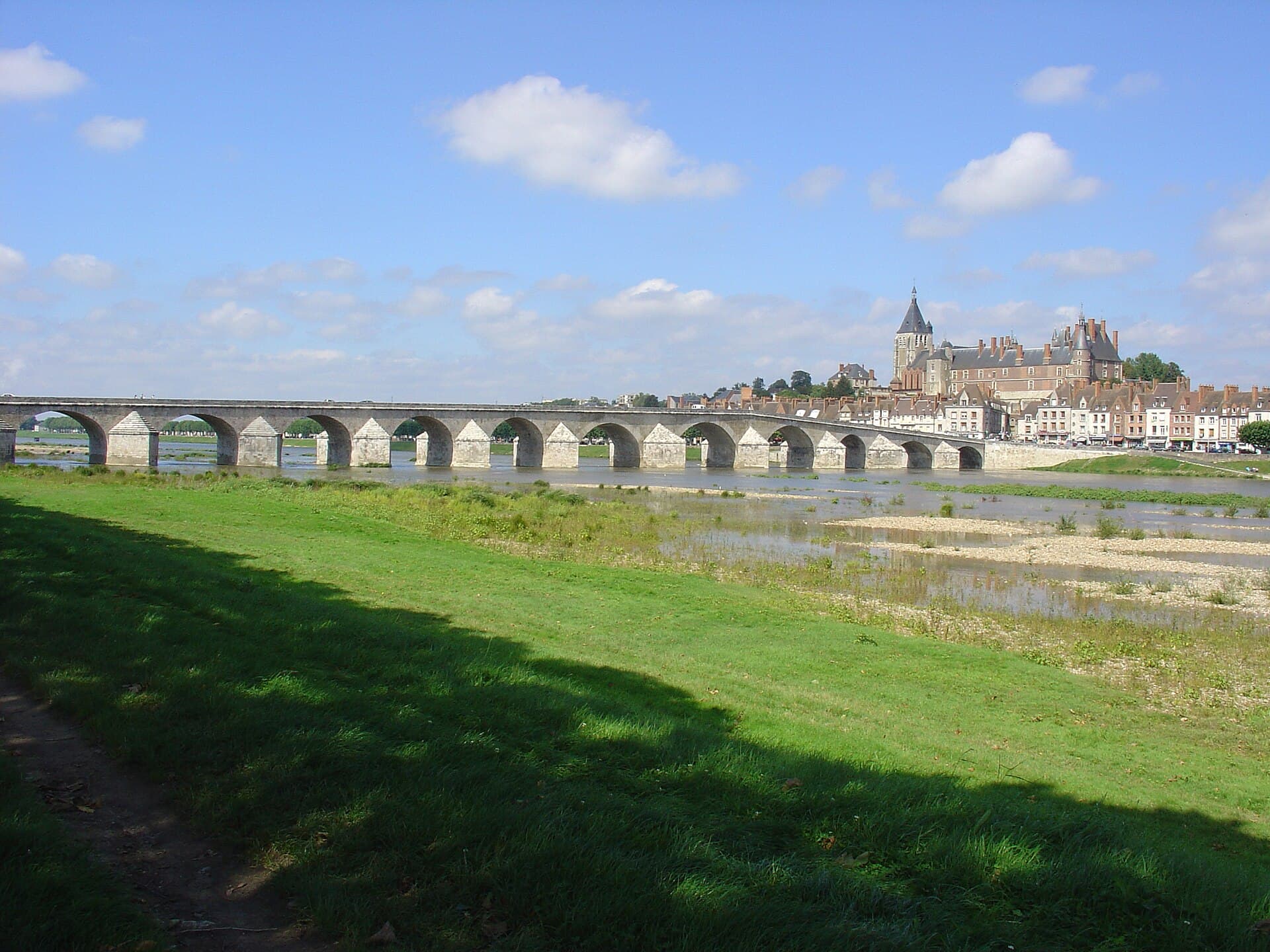
The town is particularly celebrated for its exquisite faience pottery and its commanding château, which gazes out over the river. A visit to Gien offers a blend of cultural immersion and scenic splendor. From walking across its historic stone bridge, which provides evocative views of the town and castle, to exploring its lively markets, Gien unveils a slice of authentic French regional life. The town serves as an ideal interlude for those exploring the Loiret region, offering connections to other significant sites in the Loire Valley.
The history of the Château de Gien reaches back to the 8th century, when Charlemagne erected a fortress to safeguard the land. This initial structure was destroyed in 1178 during internal conflicts. Philip Augustus restored the castle in 1199, incorporating it into the royal domain. The current Château de Gien, with its distinctive red and black brickwork and stone, stands as an early example of French Renaissance architecture. Its construction began in 1482 for Anne de France (Anne de Beaujeu), the eldest daughter of King Louis XI and regent of France, and her husband Pierre II de Beaujeu.
The castle was a favored secondary residence for royalty, including François I, Catherine de' Medici, Charles IX, and even Louis XIV and his court. Its strategic placement, between the game-rich Sologne region and the Orléans forest, made it an ideal royal hunting lodge. After the French Revolution, the château's purpose shifted dramatically. In 1823, it was acquired by the Department of Loiret and subsequently housed the sub-prefecture, a court, and a prison. The building sustained considerable damage during World War II, undergoing extensive restoration from 2012 to 2017. Since 1952, it has been home to the International Museum of Hunting.
The narrative of Gien's world-renowned faience began in 1821 with its establishment by Englishman Thomas Hall. Hall thoughtfully selected Gien for his factory due to its plentiful raw materials—clays, sands, and siliceous pebbles from the Loire—and the availability of wood from the Orléans forests to fuel the kilns. The 19th century marked a 'Golden Age' for the Faïencerie de Gien, as it earned a reputation for crafting elaborate tableware for aristocratic families across Europe. The factory also produced tiles for the Paris Metro and tableware for the Orient Express, further cementing its prestige.
Gien faience is characterized by its white, lustrous, and opaque glaze, which provides an ideal surface for lively, colorful designs. The manufacturing process, from sourcing raw materials to the finished product, is meticulously overseen within the factory. Each piece is fired at high temperatures and passes through the hands of numerous skilled craftspeople, carrying forward two centuries of expertise. Today, the Faïencerie de Gien continues to produce high-quality earthenware, blending traditional craftsmanship with contemporary designs, and is a member of the prestigious Comité Colbert, which represents French luxury brands.
Begin your exploration at the Château de Gien, a striking Renaissance castle with its polychrome brick and stone architecture. Inside, the Musée International de la Chasse et de la Faune Sauvage (International Museum of Hunting and Wildlife) holds an extensive collection of art and artifacts related to hunting techniques and animal art, spanning centuries.
A visit to Gien would feel incomplete without experiencing the Faïencerie de Gien, the historic earthenware factory. You can explore its museum, which illuminates the history and craftsmanship behind its renowned pottery, including magnificent china collections and temporary exhibitions. The factory's boutique offers an exclusive selection of pieces.
Just a short drive from Gien is the impressive Pont-canal de Briare, a navigable aqueduct that carries the Canal Latéral à la Loire over the Loire River. This 19th-century engineering achievement, constructed between 1890 and 1894, is a registered historic monument and offers scenic views. Back in Gien, take a deliberate stroll across the stone bridge spanning the Loire for some of the finest photographic views of the town and its castle. The town also reveals vestiges of ancient ramparts and a portion of a medieval hospital.
The most agreeable weather in Gien typically arrives from May to September, with average daytime temperatures ranging from 21°C to 27°C (70°F to 81°F). These months are perfect for exploring and outdoor pursuits, with July being the sunniest month. While May experiences the most rainfall, August is generally the driest. For warm-weather activities, the period from mid-June to early September is considered the most opportune time to visit.
Gien is situated in the Loiret department in north-central France, approximately 80 km from Orléans. The town is easily navigable on foot, and a helpful guide with a suggested route can be obtained from the Gien Tourist Office at Place Jean Jaurès. Markets enliven the town on Wednesday mornings in Place Jean-Jaurès and Saturday mornings in Place de la Victoire, offering local produce and a lively atmosphere.
For those interested in visiting the Faïencerie de Gien Museum or the manufactory, it is wise to contact them directly for information on opening hours and tours. The Château-Musée de Gien also provides guided visits and is accessible to groups. Payment methods at the Château-Musée de Gien include debit cards, cheques, holiday vouchers, and cash.
Gien in Korean, in Chinese or in Hebrew — and 29 more languages, every stop narrated by a native voice. The widest language range of any self-guided audio tour.
Available in: