Iglesia de Nuestra Señora de las Mercedes
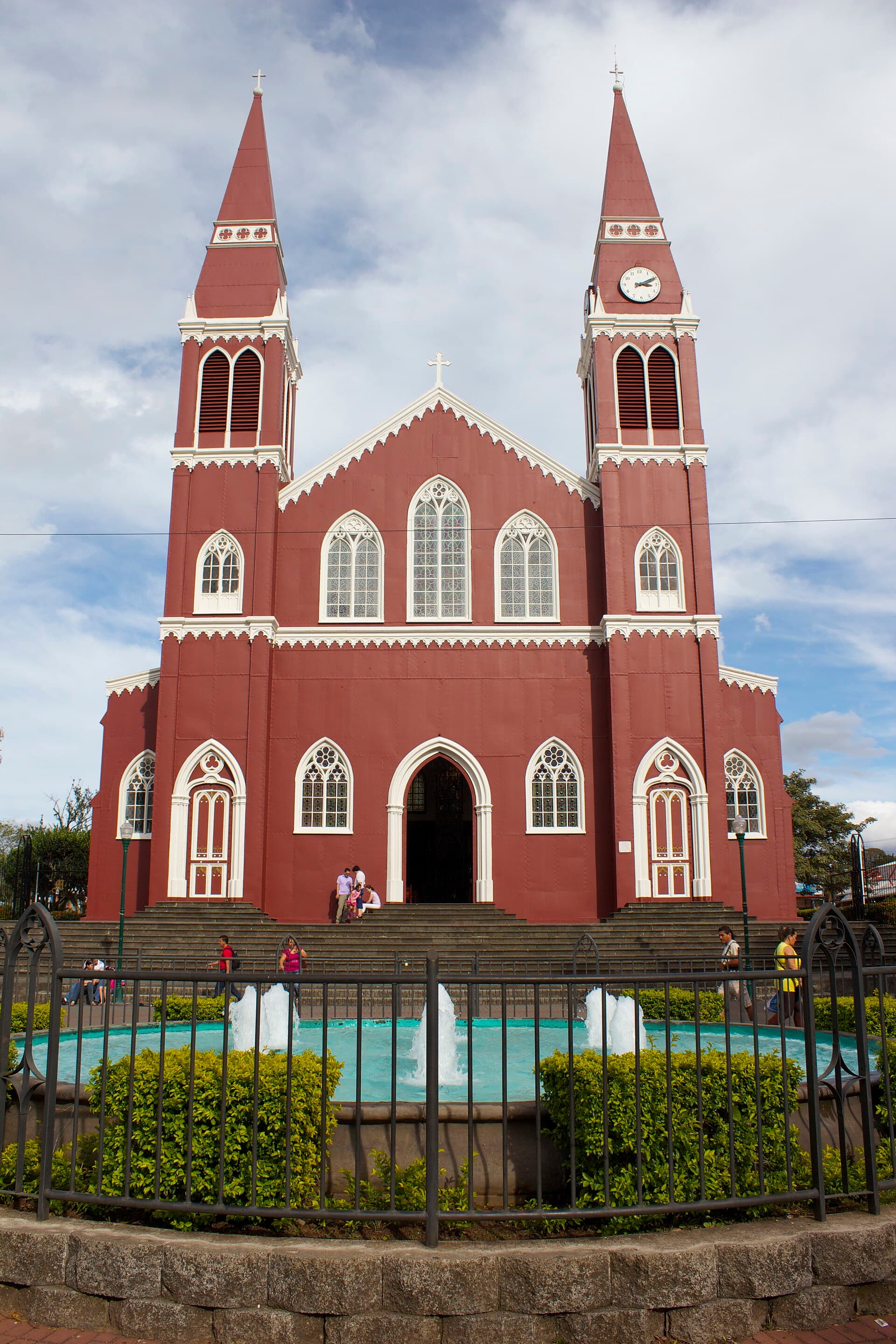
The iconic red metal church in Grecia is famous for its unique construction, but the story behind its arrival is often misremembered.
Full story unlocks in the tour
 The LEAF Project / CC BY-SA 2.0, via Wikimedia Commons
Self-guided audio walking tour of Grecia — GPS route, offline playback, story-driven narration in 32 languages.
“Where a Red Steel Church Meets Green Mountains”
Not the postcards. The stories even locals don't know — whispered in your ear, right where they happened.
The iconic red metal church in Grecia is famous for its unique construction, but the story behind its arrival is often misremembered.
Grecia prides itself on being one of the cleanest cities in Latin America.
Beyond the main attractions, the true flavor of Grecia can be found in its unassuming local restaurants.
Discover every secret of Grecia
Every address, every reveal in full — in your ear, right where it happened.
You pick your stops. You walk. The voice reveals what the others miss.


Your self-guided audio tour of Grecia is ready — pick your landmarks, choose your language, and start the moment you arrive.
BuyLume has a built-in augmented-reality guide. Hold your phone up and its camera shows the street ahead of you, with a glowing arrow laid over the real view that always points to your next stop — no map to puzzle over, no wrong turns. Like everything in Lume, it works fully offline.
Grecia, a captivating town in Costa Rica's Central Valley, offers a refreshing journey into authentic Tico culture. At an elevation of approximately 999 meters (3,278 feet), it maintains a consistently mild, spring-like climate, a welcome change from the warmer coastal regions. This area, marked by verdant mountain scenery and fertile agricultural lands, is a vital center for cultivating sugarcane, organic coffee, and pineapples.
Frequently recognized as one of the cleanest cities in Latin America, Grecia extends a peaceful and inviting atmosphere. Its central park, a lively gathering spot for local residents, frames the town's most distinctive landmark: a striking red metal church. This town provides a window into daily Costa Rican life, away from the more heavily touristed areas, making it a cherished spot for both residents and expatriates seeking a balanced existence.
Grecia is located in the Alajuela province, about 29 kilometers (18 miles) from Juan Santamaría International Airport (SJO) and 45 kilometers (28 miles) from San José, the capital city. Its strategic position in the Central Valley makes it an accessible yet distinct destination for travelers eager to experience the core of Costa Rica.
## Early Inhabitants and Founding Before the arrival of Europeans, the region that is now Grecia was settled by indigenous peoples belonging to the Western Huetar Kingdom, during the reign of King Garabito. The aspiration to establish a formal town in this productive area arose as early as 1828. With government encouragement for northern exploration, more settlers were drawn to the northwest Central Valley, seeking land for farming and homes. As the community grew, residents formally requested to establish their town, a request that was approved on April 27, 1838. The town was officially declared a city on August 6, 1903.
## The Mystery of the Name The name "Grecia," which means "Greece" in Spanish, has a few theories surrounding its origin. One widely held theory suggests that the region's prefect and future president, José Rafael de Gallegos Alvarado, a known philhellene, named the town Grecia, influenced by the Greek Revolution. Another account states that in 1826, during a meeting to decide on a name, a resident named Juan Lara Zamora proposed "Grecia" to honor Greece's independence from the Ottoman Empire in 1821, symbolizing a new beginning. A third theory links the name to a well-known farm in the area owned by Juan Lara Zamora, also called Grecia.
## The Iconic Red Church Grecia's most recognizable landmark, the Iglesia de Nuestra Señora de las Mercedes (Our Lady of Mercy), has a compelling narrative. The current all-steel, red church is not the first on the site. Earlier structures, including an adobe chapel, a wooden church (damaged by fire), and a brick church (destroyed by an earthquake), succumbed to natural disasters. To address this, in 1890, the local community, with the counsel of Bishop Thiel, decided to construct an earthquake-proof church using "new technology"—prefabricated metal. A contract was signed with a Belgian firm, Dresse Aux Ateliers de la Societe de Couvillet, in 1891. The steel plates arrived at the Port of Limón in 1892 and were transported by train to Alajuela. From there, the heavy plates were hauled 21 kilometers over the mountains to Grecia by oxcarts, a journey that could take up to two weeks. The church was finally assembled and completed in 1897, becoming a national monument and a testament to the community's resolve.
The central feature of Grecia is the Iglesia de Nuestra Señora de las Mercedes, a striking red metal church with white trim. This Gothic Revival-style church, prefabricated in Belgium and assembled in Grecia between 1894 and 1897, stands as a unique architectural marvel and a national monument. Adjacent to the church is Grecia Central Park, a verdant space where locals gather, relax, and observe daily life. The park offers excellent views of the church's exterior.
For those interested in local agriculture, Grecia is surrounded by fields of sugarcane, coffee, and pineapples. While specific tours are not always highlighted, the landscape itself speaks to the region's agricultural importance. Nearby, you can explore Los Chorros, a regional park featuring a pair of natural waterfalls, an easy walk from the parking area. Other attractions include the World of Snakes, a collection of over 50 species, and the Grecia Regional Museum, which showcases local artifacts and traditions. The artisan town of Sarchí, known for its vibrantly painted oxcarts, is also a short drive away.
Grecia enjoys a mild, spring-like climate year-round, with daytime temperatures typically in the upper 70s Fahrenheit (around 26°C) and cooler nights in the lower 60s Fahrenheit. The dry season runs from December through April, offering sunny days ideal for exploration. The rainy season extends from May through November, with heavier rains generally occurring in September and October. During the rainy season, mornings are often sunny, with rain arriving in the afternoons. For comfortable weather and minimal rain, the dry season is ideal. However, the abundant greenery of the rainy season also has its appeal, with typically predictable afternoon showers.
Grecia is located in the Alajuela province, approximately one hour northwest of San José. The simplest way to reach Grecia from San José is by bus, with services departing hourly and the journey taking about an hour. Renting a car offers flexibility for exploring the surrounding areas, though public buses are dependable. Roads in town are paved, and the drive from San José is mostly highway.
Accommodation options in Grecia include local hotels and guesthouses. While violent crime is low, petty theft can occur, so it is wise to keep valuables out of sight and be aware of your surroundings, especially at night. The local currency is the Costa Rican Colón (CRC), but US dollars are often accepted in tourist areas. Spanish is the official language, and while some English may be spoken in tourist-oriented businesses, knowing a few basic Spanish phrases is always helpful.
For dining, Grecia offers a variety of restaurants, cafes, and markets. Seek out local 'sodas' for authentic Costa Rican dishes at good prices.
Grecia in Korean, in Chinese or in Hebrew — and 29 more languages, every stop narrated by a native voice. The widest language range of any self-guided audio tour.
Available in: