Joaquín Chaverri Oxcart Factory
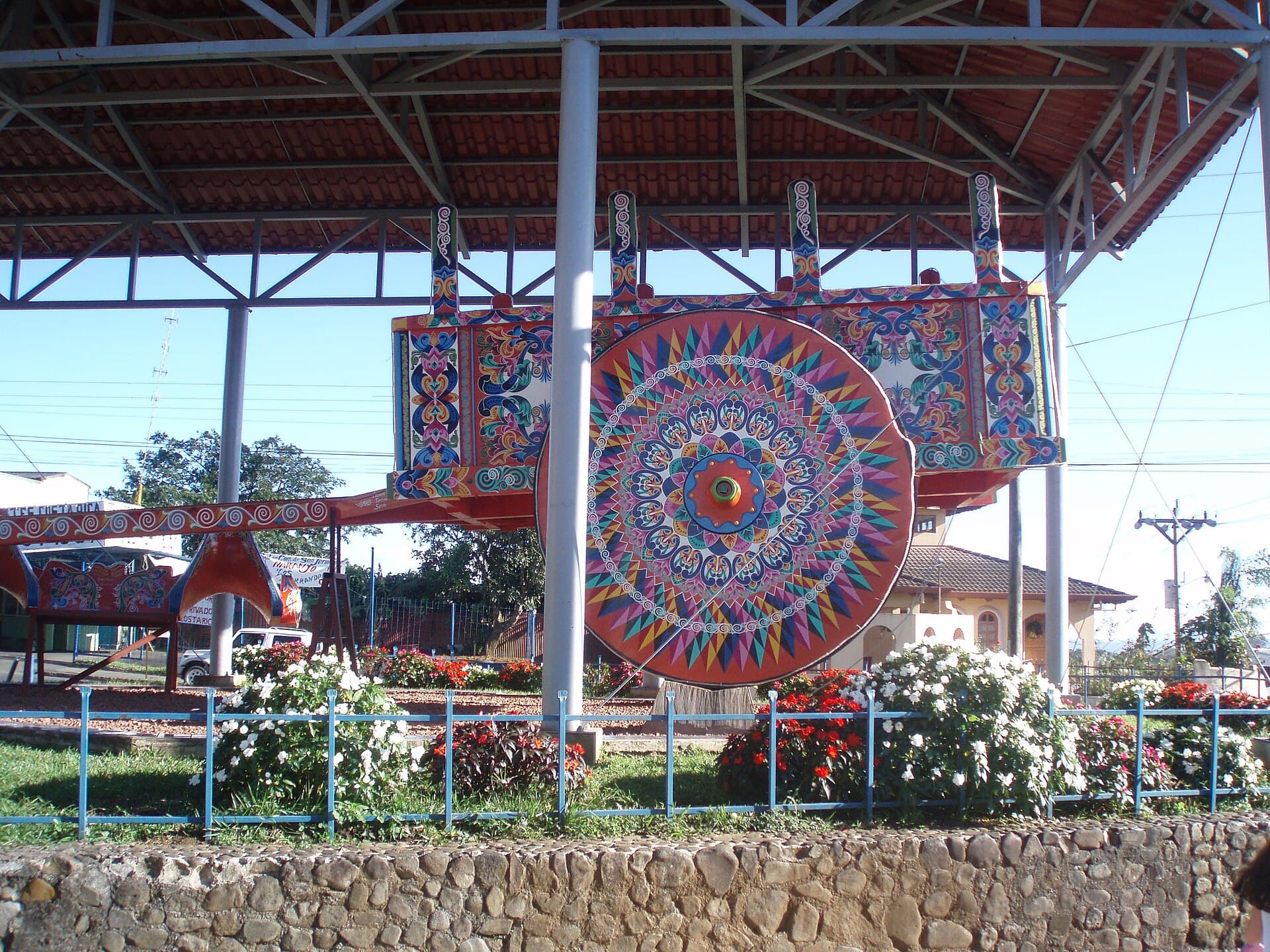
The spirited designs on Sarchí's oxcarts are a national emblem, yet the practice of adorning them wasn't always so vivid.
Full story unlocks in the tour
 Crsoccer08 / CC BY 3.0, via Wikimedia Commons
Self-guided audio walking tour of Sarchí — GPS route, offline playback, story-driven narration in 32 languages.
“Where art rolls on wheels and tradition paints the town.”
Not the postcards. The stories even locals don't know — whispered in your ear, right where they happened.
The spirited designs on Sarchí's oxcarts are a national emblem, yet the practice of adorning them wasn't always so vivid.
The local church distinguishes itself with an unexpected color scheme, a departure from typical religious architecture.
This factory operates on a power source that feels like a journey to an earlier time, a testament to enduring craftsmanship.
Discover every secret of Sarchí
Every address, every reveal in full — in your ear, right where it happened.
You pick your stops. You walk. The voice reveals what the others miss.

Your self-guided audio tour of Sarchí is ready — pick your landmarks, choose your language, and start the moment you arrive.
BuyLume has a built-in augmented-reality guide. Hold your phone up and its camera shows the street ahead of you, with a glowing arrow laid over the real view that always points to your next stop — no map to puzzle over, no wrong turns. Like everything in Lume, it works fully offline.
Sarchí, a town in Costa Rica's Central Valley, is recognized as the country's artisan heart. It is a place where the fragrance of wood shavings mingles with the bright shades of hand-painted oxcarts, a national emblem. Just an hour's drive from Juan Santamaría Airport (SJO), Sarchí offers a gentler pace of life, inviting travelers to connect with Costa Rican traditions.
The town is actually a canton comprising two districts, Sarchí Norte and Sarchí Sur, located a mere 1.5 kilometers from each other. Here, the skill of woodworking and crafting is not merely a trade, but a deeply ingrained element of the community's identity, evident in the numerous family-run workshops and stores that line the streets. Sarchí's dedication to its artistic heritage has earned it the title of Costa Rica's 'craft city.'
The story of Sarchí is intricately connected to the carreta, the traditional Costa Rican oxcart. These carts, once the primary mode of transport for coffee beans and other goods across the country's mountainous terrain, became canvases for detailed artistry. The practice of elaborately painting oxcarts began in the early 20th century at the Joaquín Chaverri Oxcart Factory, established in Sarchí in 1902. Before this, oxcarts were simple, unpainted wood.
As the practice spread, various regions and even individual families developed their own distinct designs and color schemes, making it possible to identify a farmer's origin by their cart. These highly ornate carts, often featuring geometric patterns, flowers, animals, and landscapes, were not only functional but also served as a symbol of social standing. A more elaborately painted cart often indicated a wealthier owner. Each oxcart was also designed to produce a unique chime as it moved, created by a metal ring striking the wheel's hubnut.
In 1988, the oxcart was designated the National Labor Symbol of Costa Rica. Further solidifying its cultural significance, UNESCO proclaimed Costa Rica's brightly painted oxcarts an Intangible World Cultural Heritage in 2005. Today, while modern transportation has largely replaced their original use, oxcarts remain a powerful cultural icon, frequently featured in parades and celebrations. Sarchí continues to be the core of this tradition, with factories like Eloy Alfaro (established in 1923) and Joaquín Chaverri still crafting and painting these symbolic vehicles.
Sarchí offers a variety of attractions that illuminate its artistic heritage and natural splendor. In Sarchí Norte's Central Park, you will encounter the world's largest oxcart, an impressive 15-meter-long, two-ton creation built in 2006 that holds a Guinness World Record. This monumental oxcart, inscribed on UNESCO's list of Intangible Cultural Heritage of Humanity in 2008, displays the intricate designs that define Sarchí's artistry.
Two prominent oxcart factories, the Joaquín Chaverri Oxcart Factory (established 1902) and the Eloy Alfaro Oxcart Factory (established 1923), invite visitors to observe artisans at work, painting and crafting wooden pieces using traditional methods. Beyond oxcarts, Sarchí is recognized for its extensive woodworking, with over 200 stores and family-run factories producing everything from furniture like rocking chairs and beds to smaller items such as bowls, jewelry, and sculptures. The town's Catholic Church, with its distinctive pink and blue exterior and decorative drawings, is also a notable landmark.
For a different experience, the Else Kientzler Botanical Garden, spanning seven hectares, offers a diverse collection of over 2,000 plant species from around the world, alongside mountain views and birdwatching opportunities. Sarchí also serves as a convenient base for exploring nearby natural attractions like Poás Volcano National Park and Bajos del Toro.
Sarchí experiences a pleasant, temperate climate throughout the year, with daytime temperatures typically in the upper 70s Fahrenheit and nights cooling to the lower 60s. The dry season extends from December to April, offering clearer skies and less rainfall, making it ideal for outdoor activities. The green season, from May to November, brings afternoon rain showers but often features sunny mornings, verdant landscapes, and fewer crowds. The heaviest rainfall usually occurs in September and October. For the most comfortable warm-weather activities, the period from early December to mid-March is recommended.
Sarchí is situated just an hour from Juan Santamaría International Airport (SJO) and approximately 30 kilometers northwest of Alajuela. While not a major tourist destination with dedicated shuttle services, Sarchí is accessible via rental car, taxi, ride-sharing apps, or public buses. Buses operate frequently (every 30 minutes) to neighboring towns like Grecia and Naranjo, with connections to Alajuela and San José.
Within Sarchí, the two main districts, Sarchí Norte and Sarchí Sur, are only about 1.5 kilometers apart, making it easy to navigate between artisan shops and attractions. Many stores display the word 'muebles' (furniture), indicating the town's specialization in handcrafted wooden items. For those seeking accommodation, Sarchí offers a relaxed atmosphere with essential amenities, and its central location in the Central Valley makes it a good base for exploring surrounding areas like Poás Volcano National Park.
Sarchí in Korean, in Chinese or in Hebrew — and 29 more languages, every stop narrated by a native voice. The widest language range of any self-guided audio tour.
Available in: