North of Haugesund, an obelisk rises among 29 smaller stones. It marks a crucial moment in Norway's story, but the tale of its precise location involves a king's final repose and enduring legend.
Ryan Hodnett / CC BY-SA 4.0, via Wikimedia CommonsHaugesund
Self-guided audio walking tour of Haugesund — GPS route, offline playback, story-driven narration in 32 languages.
“Where ancient sagas drift on the North Sea air.”
Haugesund, as no one tells it.
Not the postcards. The stories even locals don't know — whispered in your ear, right where they happened.
This distinctively pink building in the city center is more than a municipal office; it stands as a grand expression of affection and civic pride from a prominent local family.
A quiet coastal settlement near Haugesund holds a surprising, tangible connection to a global emblem of freedom, far across the Atlantic Ocean.
Discover every secret of Haugesund
Every address, every reveal in full — in your ear, right where it happened.
You pick your stops. You walk. The voice reveals what the others miss.


How long do you have in Haugesund?
Your self-guided audio tour of Haugesund is ready — pick your landmarks, choose your language, and start the moment you arrive.
BuyThe story of Haugesund
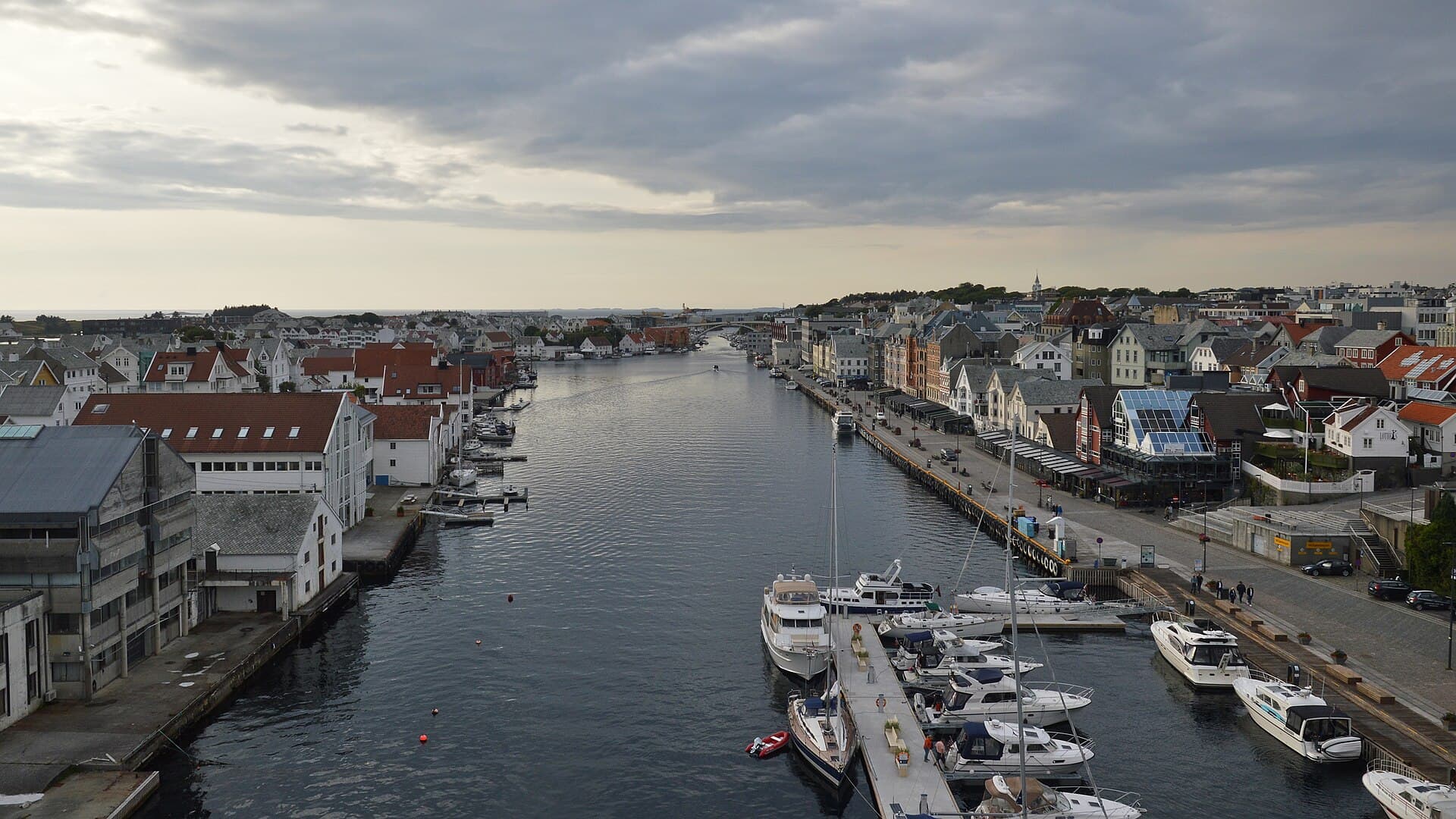
Haugesund, a lively coastal city on Norway's southwestern edge, serves as an inviting entry point to the region's enduring Viking heritage and dramatic North Sea scenery. Positioned between the larger cities of Stavanger and Bergen, it is a place where history feels palpable, from ancient royal seats to active modern harbors. The city itself is defined by its elegant Art Nouveau architecture, a scenic boat-lined waterfront along the Smedasundet strait, and a pedestrian-friendly main thoroughfare, Haraldsgata.
Often called the 'Homeland of the Viking Kings,' Haugesund played a central role in the unification of Norway. Here, Harald Fairhair, the country's inaugural king, established his power base, and his legacy is honored by national monuments and historical sites scattered across the surrounding area. Beyond its historical weight, Haugesund provides a blend of cultural experiences, from international film and jazz festivals to a flourishing culinary landscape focused on fresh seafood.
Travelers will encounter a city that embraces its maritime past while looking toward the future, maintaining strong ties to both the fishing and offshore oil industries. Whether drawn to ancient sagas, striking natural splendor, or the allure of a spirited coastal town, Haugesund offers an authentic and unhurried Norwegian experience.
From Viking Kings to Herring Fortunes
The history of Haugesund, though officially a relatively young city established in 1854, finds deep roots in Norway's ancient past. The name itself, stemming from the Old Norse words Haugar (hills) and Sund (strait), reflects its distinctive landscape. The area surrounding Haugesund was a critical center of power during the Viking Age, long before modern urban development. It was here, along the Karmsund Strait, that Norway's earliest kings resided.
The most significant figure in Haugesund's early history is Harald Fairhair, the legendary Viking king credited with uniting Norway into a single kingdom around 872 AD after the Battle of Hafrsfjord. Avaldsnes, just beyond present-day Haugesund, served as his royal seat and remained a center of royal authority for nearly 500 years. Harald Fairhair is thought to be interred at Haraldshaugen, a national monument erected in 1872 to commemorate the millennium of Norway's unification. This towering obelisk, encircled by 29 standing stones representing the ancient Norwegian counties, stands as a potent symbol of the nation's genesis.
For centuries, Haugesund's economy was intrinsically tied to the sea. Unlike many other cities that grew around agriculture, Haugesund developed as a city of entrepreneurs and seafarers. The plentiful herring catches in the Karmsund Strait were the primary catalyst for the city's rapid expansion in the 19th century, transforming it from a quiet settlement into an active center of trade and export. This period of prosperity led to Haugesund possessing the fourth-largest merchant fleet in Norway by 1913, and the accumulated capital funded the construction of elegant wooden buildings in Neoclassical and Swiss chalet styles throughout the city center.
The 20th century saw the city continue its evolution. The distinctive pink Haugesund Town Hall, a gift from a local shipowner, was completed in 1931, symbolizing urban planning maturity. The opening of the Karmsund Bridge in 1955 further connected the city to Karmøy island. In the 1970s, the discovery of oil in the North Sea brought a new economic impetus to the region, with Haugesund becoming a significant base for offshore oil activities. Today, Haugesund continues to honor its profound past while embracing its role as a modern cultural and industrial hub, hosting internationally recognized events like the Norwegian International Film Festival and the Sildajazz festival.
Begin your exploration at the Haraldshaugen National Monument, an obelisk marking the presumed burial site of Harald Fairhair, Norway's first king. The 29 surrounding stones symbolize the historical counties he brought together. A short journey from the city center, the historical site of Avaldsnes on Karmøy Island offers a deep dive into Viking history. Visit the Nordvegen History Centre and the reconstructed Viking Farm to experience life in a Viking settlement. St. Olav's Church, a medieval stone church, also stands prominently at Avaldsnes.
In the city center, stroll along Haraldsgata, one of Norway's longest pedestrian thoroughfares, offering a variety of shops and cafes. Admire the distinctive Haugesund Town Hall, a striking pink Art Nouveau building that serves as a local landmark. The waterfront along Smedasundet is a scenic area with colorful buildings and a lively atmosphere. For a touch of the unexpected, seek out the Marilyn Monroe Memorial, a tribute to the Hollywood star whose father hailed from Haugesund.
Nature lovers can head to Djupadalen Nature Reserve for scenic walks around a beautiful lake and through forest paths. For expansive views of the city, islands, and fjords, make your way to Steinsfjellet Lookout. Further afield, the grand Langfoss Waterfall, among Norway's most beautiful, cascades into the Åkrafjord and is accessible via a scenic drive or boat trip.
The ideal time to visit Haugesund for warm-weather pursuits is during the summer months, from early July to late August. Temperatures during this period typically range from 15°C to 20°C (59-68°F), with extended daylight hours—sunrise as early as 4 am and sunset around 11 pm in June. This is also when many of the region's attractions, like the Viking Village and museums, are fully operational, and major festivals such as the Norwegian International Film Festival and Sildajazz occur. While the weather is mild, it can be variable, so packing layers and waterproofs is advisable.
The shoulder seasons of April-May and September-October offer cooler temperatures (8°C to 15°C) and fewer crowds, perfect for hiking.
The local currency in Haugesund, and throughout Norway, is the Norwegian Krone (NOK). Credit and debit cards are widely accepted, and Norway is rapidly becoming a cashless society. It's wise to check current exchange rates if you plan to exchange cash, and avoid exchanging money at airports or hotels for more favorable rates.
Norwegian is the official language, with two written forms: Bokmål and Nynorsk. The local Haugesund dialect is distinct. English is widely spoken, especially by educated Norwegians, making it accessible for international visitors.
Haugesund Airport Karmøy (HAU) is situated about 15-20 minutes from the city center on Karmøy island, offering direct flights to Oslo, Bergen, and several international destinations. While an airport bus service previously existed, it ceased operations in October 2024. Taxis and car rentals are available at the airport. The city center is compact and best explored on foot. For broader exploration, Haugesund has a reliable public bus system operated by Kolumbus, which also runs ferry services to nearby islands. Tickets can be purchased via the Kolumbus app, at kiosks, ticket machines, or in cash on board. If you plan to explore beyond the city, such as Karmøy island or the fjords, renting a car is highly recommended.
Most shops generally open around 10:00 AM and close between 5:00 PM and 6:00 PM on weekdays, with extended hours on Thursdays. Nearly all retail stores are closed on Sundays.
- What is Haugesund primarily recognized for?
- Haugesund is primarily recognized as the 'Homeland of the Viking Kings' and the place where Harald Fairhair unified Norway. It is also known for its strong maritime past, particularly its herring industry, and its lively cultural festivals like the Norwegian International Film Festival and Sildajazz.
- Is Haugesund worth a visit?
- Yes, Haugesund is worth a visit for its profound Viking history, lovely coastal scenery, appealing city center, and cultural events. It offers a blend of historical sites, natural attractions, and a lively atmosphere without the crowds of larger Norwegian cities.
- How does one travel to Haugesund?
- Haugesund is accessible by air via Haugesund Airport Karmøy (HAU) with domestic and some international flights. By road, it is connected by bus services from major cities like Stavanger, Bergen, and Oslo, and by car via the E39 and E134 highways.
- What is the local currency and language in Haugesund?
- The local currency is the Norwegian Krone (NOK), and Norwegian is the official language. While a distinct local dialect is spoken, English is widely understood, especially in areas catering to visitors.
- What kind of food should I sample in Haugesund?
- Expect to find typical Norwegian cuisine with a strong emphasis on fresh seafood, including herring, crab, and salmon. Local specialties might include creamy fish soup and waffles with berries and whipped cream.
- Are shops open on Sundays in Haugesund?
- Generally, most retail stores and some restaurants in Haugesund are closed on Sundays. It is advisable to plan your shopping and dining accordingly.