After widespread destruction in WWII, Kristiansund rebuilt with a distinctive, colorful architectural style. Yet, one street holds a secret from this rebuilding, a direct link to a neighboring country's generosity.
Thomas Christian Espenes / CC BY-SA 4.0, via Wikimedia CommonsKristiansund
Self-guided audio walking tour of Kristiansund — GPS route, offline playback, story-driven narration in 32 languages.
“Where islands speak of dried cod and enduring spirit.”
Kristiansund, as no one tells it.
Not the postcards. The stories even locals don't know — whispered in your ear, right where they happened.
The land in and around Kristiansund historically offered little soil. For the town's inaugural public cemetery, an unusual, distant material was sourced to lay the departed to rest.
One of Kristiansund's islands features a surprising, exotically named neighborhood. Its name hints at a lively past, far removed from Norway's chilly northern climate.
Discover every secret of Kristiansund
Every address, every reveal in full — in your ear, right where it happened.
You pick your stops. You walk. The voice reveals what the others miss.
How long do you have in Kristiansund?
Your self-guided audio tour of Kristiansund is ready — pick your landmarks, choose your language, and start the moment you arrive.
BuyThe story of Kristiansund
Kristiansund, often called 'the Atlantic town' or 'the town floating in the sea,' is a captivating Norwegian city spread across four main islands—Kirkelandet, Innlandet, Nordlandet, and Gomalandet—plus numerous smaller islets. This unique geography, with its natural, sheltered harbor, has shaped its identity and history for millennia. From its ancient origins as one of Norway's earliest settlements to its enduring legacy as the klippfisk (dried and salted cod) capital, Kristiansund offers a distinctive blend of maritime heritage, cultural resilience, and an engaging, urban atmosphere.
Heavily bombed during World War II, Kristiansund rose from its ashes with a striking functionalist architectural style, characterized by brightly colored buildings that bring cheer to its coastal landscape. The city's intimate scale makes it easily explorable, particularly by its beloved Sundbåten ferry, which has connected its islands for nearly 150 years. Beyond its historical significance, Kristiansund thrives as a cultural hub, home to Norway's oldest opera house and host to a variety of festivals throughout the year.
Whether drawn by the scent of bacalao, the call of the open sea, or the echoes of a resilient past, Kristiansund invites discovery. It is a place where every corner tells a story, and the connection between land and sea is palpable.
## From Ancient Shores to Klippfisk Capital Kristiansund's story stretches back to the very dawn of human settlement in Norway. Archaeological findings suggest that the area, then known as Fosna, was one of the first ice-free regions after the last Ice Age, attracting settlers around 8000 BC. These early inhabitants were drawn to the abundant food in the surrounding sea and the readily available stone and flint for tools. The name Fosna, or Lille-Fosen ('the small Fosen'), itself hints at a 'hiding place,' likely referring to its naturally sheltered harbor amidst the islands.
For centuries, the settlement remained an important transit point, particularly for timber. However, the 17th century truly marked a turning point with the arrival of Dutch merchants, ushering in the 'Golden Age of the Dutch Merchants.' The economic boom that defined Kristiansund for over 200 years began in earnest when Scottish and Dutch merchants established the production and export of klippfisk – salted and dried cod. The rocky shores and favorable winds of Kristiansund's islands proved ideal for drying fish, and by the late 18th century, the city became Norway's leading exporter of this prized commodity, forging strong trade ties with Catholic countries in Southern Europe, particularly Spain and Portugal.
In 1742, King Christian VI granted the settlement town charter, renaming it Christianssund in his honor, a name that later evolved to Kristiansund. The klippfisk trade brought immense prosperity, transforming the small port into a thriving town with grand merchant mansions and active wharves. This era also saw cultural influences from Southern Europe, reflected in the local cuisine, including the introduction of bacalao.
## War and Rebirth The 20th century brought significant challenges. At the end of April 1940, during the Nazi German invasion of Norway, Kristiansund endured nearly four days of continuous bombing by the German Luftwaffe. The town was left in ruins, with 800 buildings destroyed—28% of Norway's total war damage to buildings during WWII. The bombing resulted from the Germans mistakenly believing the Norwegian King and government were sheltering there.
The post-war period saw a remarkable reconstruction effort. The city was rebuilt in a functionalist style, with architects deliberately choosing a bright, polychrome palette of red, yellow, and green to infuse life into the somber post-war landscape. This 'Reconstruction City' is now highlighted as one of Norway's most significant 20th-century cultural environments, showcasing well-preserved examples of post-war architecture. The building of Kirkelandet Church in 1964 marked the end of this extensive rebuilding phase.
Today, while klippfisk remains a vital part of its identity, Kristiansund has diversified its economy, becoming a central operations and supply base for the offshore oil industry. It continues to celebrate its rich cultural life, particularly its strong opera traditions, which date back to 1805, and its annual festivals.
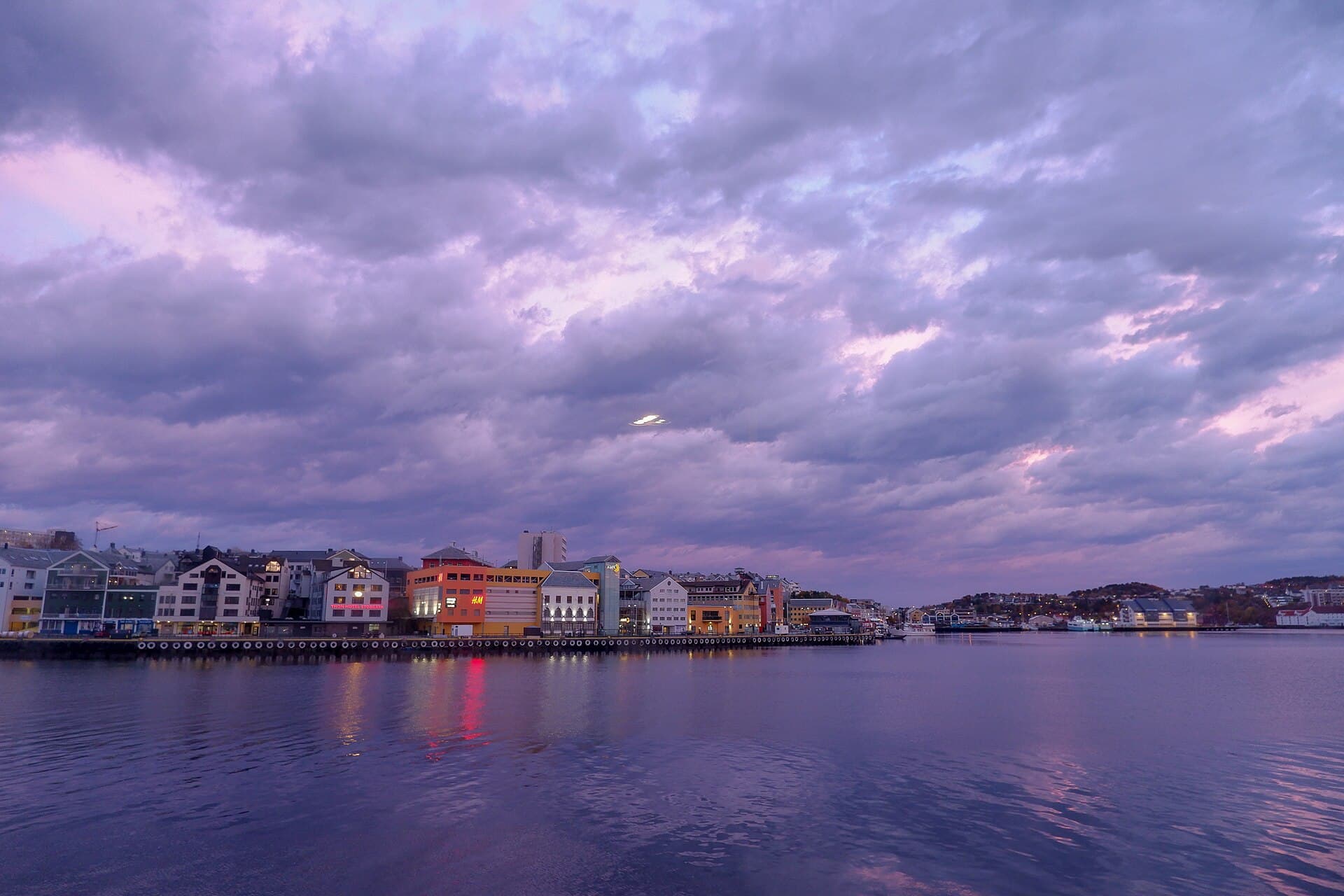
Kristiansund's unique island setting and resilient history offer a wealth of sights. Begin your exploration with a ride on the Sundbåten ferry, the world's oldest public transport system in continuous use, which conveniently connects the city's four main islands. Disembark at Innlandet to wander through the charming Old Town (Gamle Byen), where you will find some of Kristiansund's best-preserved wooden houses, narrow streets, and the 'Tahiti' neighborhood.
On Gomalandet, delve into the city's klippfisk heritage at the Norwegian Bacalao Museum (Klippfiskmuseet), housed in an authentic 18th-century wharf. Nearby, the Mellemværftet Historic Shipyard Museum offers a glimpse into Kristiansund's shipbuilding past. Do not miss the striking Kirkelandet Church, also known as the Atlantic Cathedral, a bold example of modernist church architecture from 1964.
For expansive views, ascend to the Varden viewpoint, a former watchtower providing wide vistas of the city, mountains, and surrounding islands. A highlight for many is a half-day excursion to Grip island, a deserted fishing village 14 km out in the Norwegian Sea, home to the unique Grip Stave Church and the second-tallest lighthouse in Norway. Finally, consider a drive along the iconic Atlantic Road, a dramatic stretch of coastal highway just 30 minutes from Kristiansund, often hailed as one of the world's most scenic drives.
The best time to visit Kristiansund for warm-weather activities is from mid-July to mid-August, when average daily high temperatures are above 58°F (14°C) and the clearest skies are typically found in May. The summer months also offer opportunities for sea fishing and trips to Grip island. For those hoping to witness the Northern Lights, the optimal viewing season runs from September through March, with peak aurora activity in September.
Kristiansund also hosts several annual festivals, including the Opera Festival in February, the Nordic Light International Festival of Photography, the City Festival, and the Tahiti Festival, offering cultural experiences year-round.
Kristiansund is a very safe city with low crime rates, allowing visitors to explore comfortably on foot or by the local Sundbåten ferry. Cruise ships typically dock downtown at Storkaia or Devoldholmen quay on Kirkelandet island, offering easy walking access to shops, restaurants, and attractions. The local currency is the Norwegian Krone (NOK), and while US dollars or Euros are not widely accepted, credit and debit cards are used almost everywhere. ATMs are readily available near the pier.
Coastal weather can change rapidly, so packing layered clothing, a waterproof rain jacket, and comfortable walking shoes is advisable, especially during the cruise season from May through September when temperatures range from 12°C to 18°C (54°F to 64°F). The city center offers various shopping opportunities, including the modern AMFI Storkaia Brygge complex near the cruise dock.
- What is Kristiansund famous for?
- Kristiansund is most recognized for its klippfisk (dried and salted cod) industry, which historically made it Norway's leading exporter. It is also known as the 'Opera City' due to having Norway's oldest opera house and an annual opera festival, and for its distinctive post-WWII reconstruction architecture.
- How do you get around Kristiansund?
- The most iconic way to navigate Kristiansund's islands is by the Sundbåten harbor ferry, which has been in continuous operation since 1876 and is free. The city center is also very walkable, and buses are available.
- Why was Kristiansund bombed in WWII?
- Kristiansund was heavily bombed by the German Luftwaffe in April 1940 because the Germans mistakenly believed the Norwegian King and government were sheltering there during their invasion. The city was almost entirely destroyed over four days of continuous bombing.
- What is klippfisk?
- Klippfisk is cod or other lean white fish that has been salted and dried, traditionally on flat coastal rocks (klipper) in the open air. This process preserves the fish for months without refrigeration and is a key ingredient in dishes like bacalao.
- Can you see the Northern Lights in Kristiansund?
- Yes, you can see the Northern Lights in Kristiansund. The optimal viewing season is from September through March, with peak activity in September. The best viewing hours are typically between 11:00 PM and 1:00 AM local time.
- Is Kristiansund a good place to visit?
- Yes, Kristiansund is considered a worthwhile destination. It offers a unique blend of maritime history, distinctive architecture, an engaging cultural scene, and serves as a gateway to natural wonders like the Atlantic Road and Grip island. Its small, urban center provides a friendly and inviting atmosphere.