The Abbey Church of Saint-André
The church's bell tower has a peculiar, truncated shape.
Full story unlocks in the tour
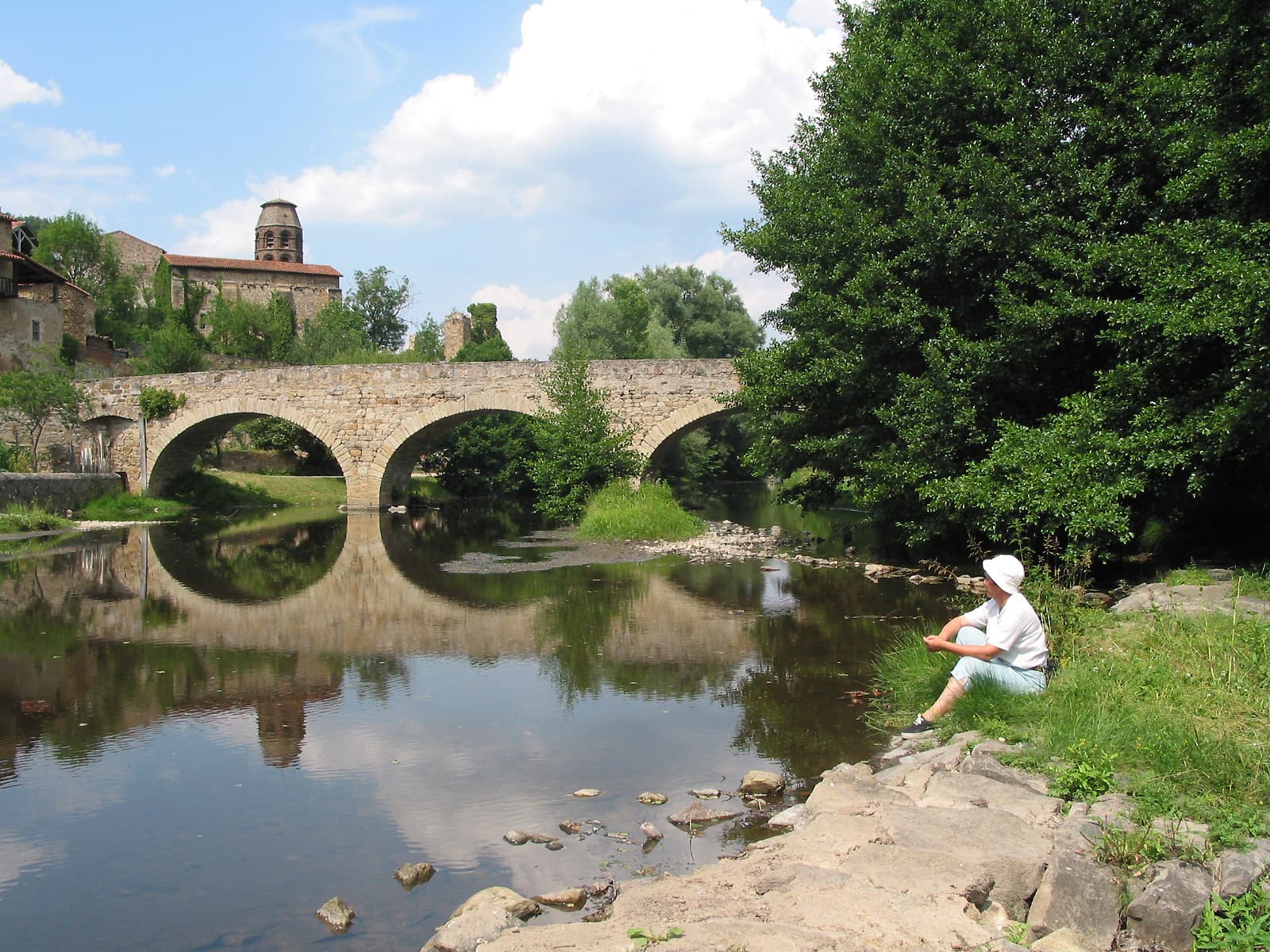 Jean-Pol GRANDMONT / CC BY 3.0, via Wikimedia Commons
Self-guided audio walking tour of Lavaudieu — GPS route, offline playback, story-driven narration in 32 languages.
“Where ancient stones hum with forgotten hymns and the river whispers secrets.”
Not the postcards. The stories even locals don't know — whispered in your ear, right where they happened.
The church's bell tower has a peculiar, truncated shape.
A magnificent fresco here tells a story beyond its religious imagery.
Before it was known as Lavaudieu, this peaceful valley had a different, more divine name.
Discover every secret of Lavaudieu
Every address, every reveal in full — in your ear, right where it happened.
You pick your stops. You walk. The voice reveals what the others miss.


Your self-guided audio tour of Lavaudieu is ready — pick your landmarks, choose your language, and start the moment you arrive.
BuyLume has a built-in augmented-reality guide. Hold your phone up and its camera shows the street ahead of you, with a glowing arrow laid over the real view that always points to your next stop — no map to puzzle over, no wrong turns. Like everything in Lume, it works fully offline.
Lavaudieu, a village in the Haute-Loire department of the Auvergne-Rhône-Alpes region, is a place where time seems to slow. Recognized as one of France's "most beautiful villages" since 1990, it rests peacefully on the banks of the Senouire River. The village's allure lies in its traditional stone houses, small gardens, and paved streets, which invite unhurried exploration.
Life in Lavaudieu revolves around its remarkable Benedictine abbey, the Abbaye de Saint-André, which dates back to the 11th century. The absence of cars within the village, with parking mandated before entry, contributes to its tranquil atmosphere, allowing visitors to fully immerse themselves in the historic setting. From the graceful stone bridge spanning the Senouire to the main square with its obelisk-fountain, Lavaudieu offers picturesque views at every turn.
The story of Lavaudieu truly begins in the early 11th century with the founding of the Abbey of Saint-André. It was established in 1057 by Robert de Turlande, a French nobleman who became a Benedictine monk and had previously founded the famous Benedictine convent of La Chaise-Dieu. Saint Robert chose this location, then known as Saint-André de Comps, for a satellite priory due to its mild climate and proximity to the mother abbey. The name later evolved to Vallis Dei, or "Valley of God," before becoming Lavaudieu in 1487.
Around 1070, Judith of Auvergne, daughter of Count Robert II of Auvergne, moved to the priory, which subsequently attracted many other daughters of prosperous, noble families to join as nuns. This period saw the construction of many of the Romanesque buildings that define the abbey complex today. The priory was elevated to the status of an abbey in 1719. However, by the time of the French Revolution, only 13 nuns remained, and they were forced to leave as the buildings were seized as national property. During this tumultuous period, the top of the abbey church's spire was destroyed, resulting in its distinctive truncated appearance.
Despite these challenges, a significant collection of the original priory's structures has survived. The village itself has retained much of its traditional character, with its population of around 250 people having changed little since the 1960s. Lavaudieu was listed as one of France's "most beautiful villages" in 1990, a testament to its enduring architectural heritage and authentic appeal.
The heart of Lavaudieu is its Benedictine Abbey of Saint-André, a remarkable example of Romanesque architecture. The abbey church, dating from the 11th century, features an arcaded octagonal bell tower and significant 14th-century frescoes, including detailed religious images and an allegorical depiction of the Black Death.
A highlight of the abbey is its Romanesque cloister, the only one of its kind to be fully preserved in Auvergne. This serene space features two levels of arches, with stone columns and decorative capitals on the ground floor. Adjacent to the cloister, the refectory houses a large 12th-century fresco of Byzantine influence, portraying Christ in Majesty surrounded by the symbols of the four Evangelists, with the Virgin and Apostles below.
Beyond the abbey, wander through the village's paved streets to admire traditional golden stone houses with rounded tile roofs, ancient doors, and windows. The main square features an obelisk-fountain, and a stone bridge offers picturesque views of the river and abbey. The Musée des Arts et Traditions Populaires, located in a former bakery, provides insight into daily life in the Auvergne region during the 1800s through its collection of artifacts and historical displays.
The best times to visit Lavaudieu are during the late spring (May to June) and early autumn (September). These months offer mild temperatures, clear skies, and fewer crowds than the peak summer season. The abbey is typically closed from late autumn to late spring, so verify opening hours before planning a visit outside of these recommended periods. September, in particular, offers comfortable daytime temperatures and active towns without the summer rush.
Lavaudieu is a small village where parking is obligatory outside the main village area, ensuring a peaceful, car-free experience within its streets. To enter the village, you will pass through a large stone archway. The village is easily explored on foot, with stone benches along the river offering pleasant spots to rest and admire the views. Public toilets and free parking are available.
The Abbey of Saint-André is open to visitors, though the cloister has specific visiting hours and may not be freely accessible at all times; guided tours are often available. The abbey is generally closed from late autumn to late spring, so it is advisable to check current opening schedules. The village also has a small museum, the Musée des Arts et Traditions Populaires, which is worth a visit.
Lavaudieu in Korean, in Chinese or in Hebrew — and 29 more languages, every stop narrated by a native voice. The widest language range of any self-guided audio tour.
Available in: