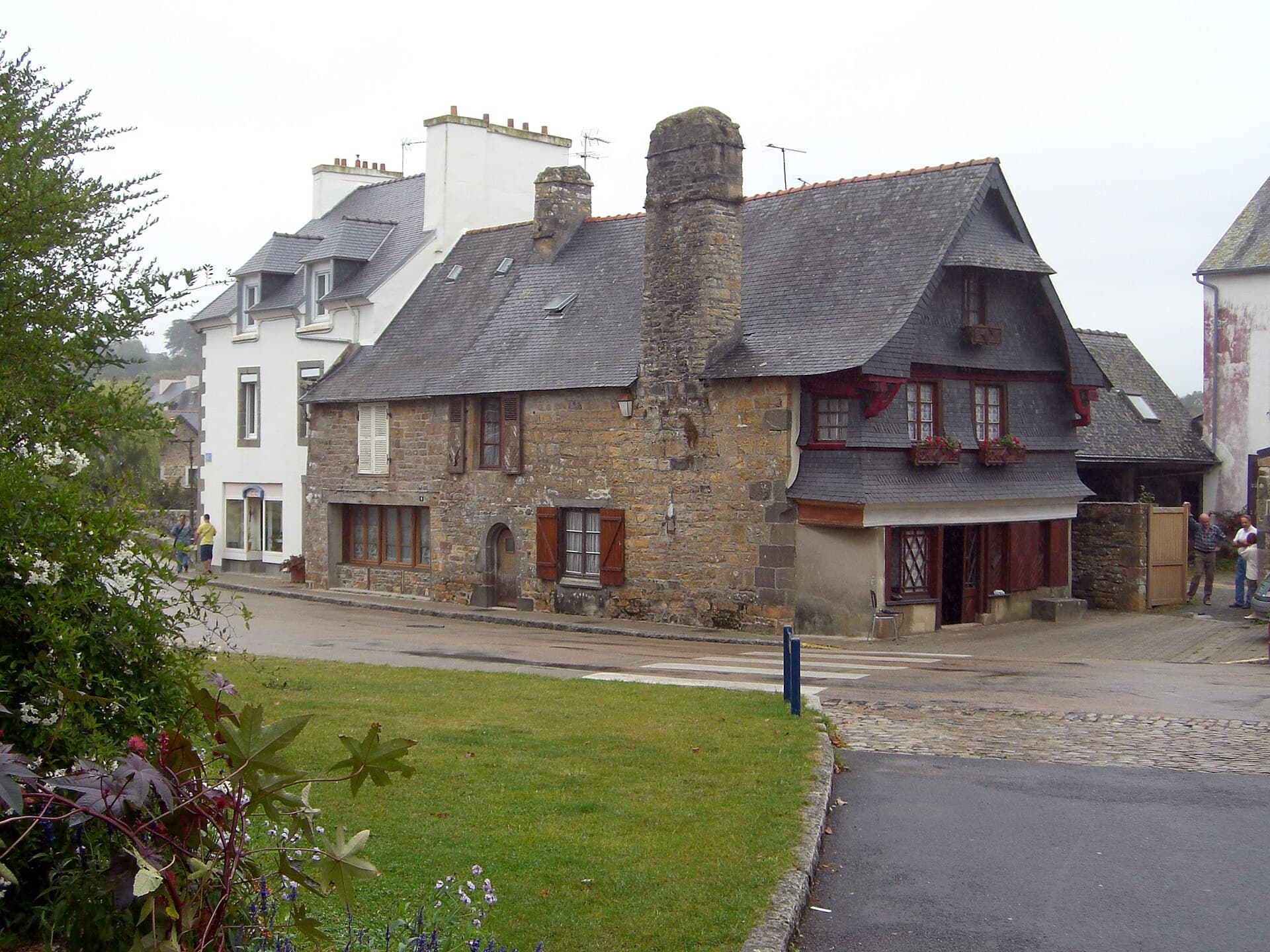
Rue du Général de Gaulle
The distinctive architecture of Le Faou's main street tells a tale of defiance.
Full story unlocks in the tour
 Richard Gertis / CC BY-SA 2.5, via Wikimedia Commons
Self-guided audio walking tour of Le Faou — GPS route, offline playback, story-driven narration in 32 languages.
“Where ancient timber frames meet the rhythm of the tides.”
Not the postcards. The stories even locals don't know — whispered in your ear, right where they happened.
The distinctive architecture of Le Faou's main street tells a tale of defiance.
Look closely at the intricate carvings on the 16th-century baptismal font inside the Church of Saint-Sauveur.
This central square once housed a structure that was, surprisingly, among the largest of its kind in France.
Discover every secret of Le Faou
Every address, every reveal in full — in your ear, right where it happened.
You pick your stops. You walk. The voice reveals what the others miss.


Your self-guided audio tour of Le Faou is ready — pick your landmarks, choose your language, and start the moment you arrive.
BuyLume has a built-in augmented-reality guide. Hold your phone up and its camera shows the street ahead of you, with a glowing arrow laid over the real view that always points to your next stop — no map to puzzle over, no wrong turns. Like everything in Lume, it works fully offline.
Le Faou, a designated "Petite Cité de Caractère" in Brittany, France, offers a glimpse into a maritime past where timber trade fueled its prosperity. Situated at the end of a ria, a long, narrow inlet where the Faou River meets the sea, the village served as a vital port and a strategic stopover town between Quimper and Brest. Its unique character is immediately apparent in its architecture, particularly the sixteenth-century timber-framed houses that line its main streets.
Beyond its architectural appeal, Le Faou acts as a gateway to the Crozon Peninsula and the Armorique Regional Natural Park. This allows visitors to seamlessly transition from exploring the village's historical core to immersing themselves in Brittany's diverse natural landscapes, from forests to coastal areas. The village, though small, invites a slower pace, encouraging exploration of its waterfront, historic lanes, and nearby natural expanses.
Evidence suggests human habitation in the area of Le Faou dates back to Antiquity. The town itself was founded in the 11th century. Its strategic location at the confluence of the Faou River and the Brest roadstead made it a significant trading hub. The proximity of the Cranou forest provided abundant wood, which was then loaded onto boats in the natural harbor, driving the town's early economy. This trade route positioned Le Faou as an important stopover town for stagecoaches traveling between Brest and Quimper.
The wealth generated from trade in the 16th century profoundly shaped Le Faou's urban landscape. Many of the distinctive timber-framed houses, known as 'maisons à encorbellement,' were constructed during this period. These houses, with their upper stories projecting over the ground floor, were a common medieval building style. Despite a ban on this construction method in 1561 due to fire risks, Le Faou's builders continued to erect them, resulting in a remarkable concentration of these structures. The facades of these houses are often covered with finely worked slate tiles, a practical and aesthetic response to Brittany's climate.
The 16th-century Church of Saint-Sauveur, believed to have been built by the Hospitallers of Saint John of Jerusalem in the 12th century, stands opposite the harbor. Rebuilt in 1544 in the Gothic style, it features an elegant Renaissance steeple and a unique 16th-century baptismal font. The town's administrative center also evolved, with the former market hall, established after the French Revolution, housing the town hall and a boys' school in the 19th century. This same square once held a prison, noted for its considerable size.
Le Faou's efforts to preserve its heritage have earned it the "Petite Cité de Caractère" label, recognizing its distinctive historical and architectural interest. The village is also a member of the Armorique Regional Natural Park, highlighting its commitment to protecting both its cultural and natural treasures.
Begin your exploration of Le Faou along Rue du Général de Gaulle, where you can admire the 16th-century timber-framed houses, many of which are protected historical monuments. These 'maisons à encorbellement' with their slate-covered facades offer a distinctive architectural experience. Continue to the Church of Saint-Sauveur, a 16th-century Gothic church with a Renaissance steeple, located opposite the harbor. Inside, observe the intricately carved 16th-century baptismal font.
The harbor area itself is a focal point, offering pleasant walks along the Quelen quays. For a deeper dive into local history, visit the Maison du Pays, a 16th to 18th-century building on Rue du Général de Gaulle, which hosts permanent and temporary exhibitions about the town. Just two kilometers from Le Faou, the village of Rumengol is home to the Church of Notre-Dame, a significant pilgrimage site known for its 16th-century church and impressive altarpiece. For nature enthusiasts, the Cranou Forest, part of the Armorique Regional Natural Park, offers numerous hiking trails and is home to an arboretum and the Saint-Conval fountain.
The most pleasant time to visit Le Faou for general outdoor activities is from late June to early September, with peak conditions in the last week of July. During this period, you can expect comfortable temperatures, typically ranging from 65°F to 80°F, with clearer, rainless days. The warm season extends from mid-June to mid-September, with August being the warmest month, averaging a high of 70°F. May also offers good conditions, with moderately chilly and slightly breezy weather, and temperatures between 48°F and 61°F.
Le Faou is located in the Finistère department of Brittany, in northwest France, south of Brest and Plougastel, and at the gateway to the Crozon Peninsula. The village is part of the Communauté de Communes de l'Aulne Maritime. While Le Faou is a small village, it provides basic services, including a selection of restaurants and shops. For accommodations, options such as hotels, bed & breakfasts, and campsites are available in and around Le Faou. The PARK AN AOD camping area, for instance, accommodates campers and tents along the Faou's ria. The nearest prefecture is Quimper, approximately 42 km away.
An official guided walk around the village can help visitors discover the church, harbor, and the most interesting buildings. Additionally, a heritage interpretation trail links Le Faou with other towns in the Communauté de Communes, offering insights into the area's past and present. Digital tours with multimedia content are also available via the Breizh Tour app.
Le Faou in Korean, in Chinese or in Hebrew — and 29 more languages, every stop narrated by a native voice. The widest language range of any self-guided audio tour.
Available in: