Maison-Musée du Pouldu
The lively murals painted by Gauguin and his artist friends on the inn's walls were once lost to time.
Full story unlocks in the tour
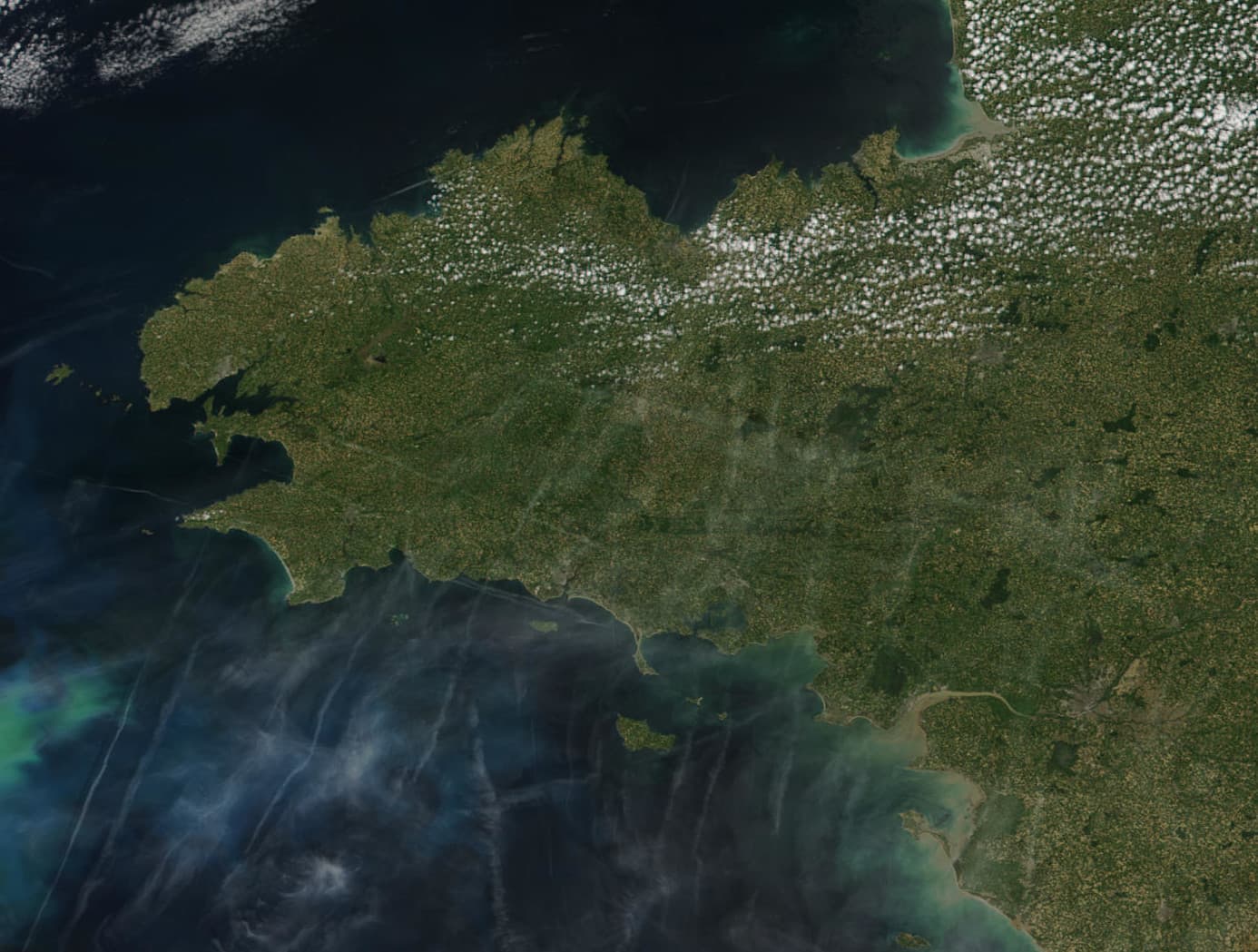 Credit: Jacques Descloitres, MODIS Rapid Response Team, NASA/GSFC / public domain, via Wikimedia Commons
Self-guided audio walking tour of Le Pouldu — GPS route, offline playback, story-driven narration in 32 languages.
“Where the wild Breton coast inspired a revolution in art.”
Not the postcards. The stories even locals don't know — whispered in your ear, right where they happened.
The lively murals painted by Gauguin and his artist friends on the inn's walls were once lost to time.
This popular beach, now known for its golden sand, was once a canvas for artistic experimentation.
The very sand that defines Le Pouldu's beaches played an unexpected role in local agriculture.
Discover every secret of Le Pouldu
Every address, every reveal in full — in your ear, right where it happened.
You pick your stops. You walk. The voice reveals what the others miss.
Your self-guided audio tour of Le Pouldu is ready — pick your landmarks, choose your language, and start the moment you arrive.
BuyLume has a built-in augmented-reality guide. Hold your phone up and its camera shows the street ahead of you, with a glowing arrow laid over the real view that always points to your next stop — no map to puzzle over, no wrong turns. Like everything in Lume, it works fully offline.
Le Pouldu, a delightful seaside resort in southern Finistère, Brittany, offers a blend of rugged coastal beauty and a deep artistic legacy. Once a modest fishing port, it transformed into a favored destination, known for its tranquil atmosphere and preserved natural setting. The village, part of the commune of Clohars-Carnoët, is characterized by its stone houses with slate roofs, flower-lined alleyways, and a lively port.
This corner of Brittany is particularly renowned for its connection to Paul Gauguin and the Pont-Aven School of painters. Gauguin, along with artists like Jacob Meyer de Haan and Paul Sérusier, sought refuge here from 1889 to 1891, drawn by the wild landscapes and unique light that inspired a new artistic movement: Synthetism. Today, visitors can explore this artistic heritage alongside Le Pouldu's inviting beaches and scenic walking trails.
Le Pouldu's Breton name, derived from "poull" (pond) and "du" (black), doesn't quite capture the spirited character of the modern resort. Instead, it's a place where fine sandy beaches, water sports, and hiking opportunities create an ideal environment for enjoying the Breton coast.
Le Pouldu's origins lie as a small fishing port. However, its transformation began in the mid-19th century. Around the 1850s, the beaches of Le Pouldu, particularly Grands Sables, started to attract bathers. The first villas emerged on the sand dunes by 1875, including the Castel Treaz, or "sand castle" in Breton, owned by Henry de Mauduit, an industrialist from Quimperlé. The opening of the Hôtel des Bains in 1887 further solidified Le Pouldu's growing reputation as a seaside resort.
This burgeoning resort soon caught the attention of a group of avant-garde artists. Paul Gauguin, seeking an unspoiled location away from the crowds of Pont-Aven, arrived in Le Pouldu in 1889. He was joined by fellow painters Jacob Meyer de Haan, Paul Sérusier, and Charles Filiger, who all resided at Marie Henry's inn, then known as "La Buvette de la Plage." This period marked a pivotal moment in art history, as these artists developed Synthetism, an approach characterized by simplified forms, strong color contrasts, and a rejection of literal imitation of nature. Gauguin's time in Le Pouldu inspired significant works, including "Les Femmes de Bretagne" and "Le Christ jaune." The artists even used the inn's walls as a canvas, creating murals that were later covered but rediscovered in 1924.
Le Pouldu continued to expand, encompassing the neighboring beaches of Bellangenêt and Kérou. Between the World Wars, the area around Grands Sables beach alone offered no fewer than seven hotels. Today, Le Pouldu maintains the charm of the small seaside resorts that flourished in the early 20th century.
Le Pouldu offers a variety of attractions that blend its artistic heritage with its natural beauty. A key visit is the Maison-Musée du Pouldu, a reconstructed inn where Paul Gauguin and his fellow artists lived and worked. The museum immerses visitors in the world of these painters, showcasing reproductions of their works and the famous murals they painted directly on the inn's walls. The Painters' Trail, a 12 km walking route, allows you to follow in Gauguin's footsteps, exploring the landscapes that inspired him.
The coastline is a major draw, featuring three main sandy beaches: Plage du Kérou, Plage de Bellangenêt, and Plage des Grands Sables. Plage du Kérou is known for its waves, attracting surfers and water sports enthusiasts. Bellangenêt is the largest beach, offering supervised swimming in summer and accessibility for people with reduced mobility. Grands Sables beach, historically significant as the birthplace of the resort, is ideal for relaxation. These beaches have been awarded the Blue Flag label for their water quality.
For outdoor enthusiasts, the GR34 coastal path, also known as the customs officers' path, provides scenic hiking opportunities along cliffs and past secluded coves, with views of the Atlantic Ocean and the island of Groix. You can also explore the charming Port of Doëlan, a fishing port near Le Pouldu, known for its authentic atmosphere.
Other notable sites include the 16th-century Chapelle Saint-Michel, offering views over Quiberon Bay, and the Abbey Site of Saint Maurice, a former 13th-century abbey.
The ideal time to visit Le Pouldu for pleasant weather, perfect for enjoying the beaches and water sports, is from May to September. During these months, temperatures are generally agreeable, and rainfall is lower. July is typically the warmest month, with an average temperature of 18°C (64°F), and June offers the most daily sunshine hours. August also provides warm temperatures, averaging 22°C (71°F) highs and 15°C (58°F) lows, with moderate humidity and average wind speeds. While Le Pouldu is a pleasant destination year-round, visiting outside of the peak summer months (July and August) will offer a quieter experience, though some shops and restaurants may be found in the nearby town of Clohars-Carnoët (5km).
Le Pouldu is easily accessible by various means. If traveling by car, it is approximately 60 km from Lorient and 80 km from Quimper. For those preferring public transport, the nearest train station is in Lorient, with regular bus services connecting Lorient, Quimper, and surrounding towns to Le Pouldu. A ferry service also operates across the Laïta River, connecting Le Pouldu to Guidel-Plages.
Accommodation options in Le Pouldu cater to various budgets, including campsites, gîtes, B&Bs, and hotels. For dining, you'll find local restaurants and crêperies offering Breton specialties, fresh seafood, fish, and cider. Many activities, such as hiking the GR34 coastal path, cycling on dedicated paths, and various water sports like surfing, kitesurfing, kayaking, and sailing, are readily available. The local tourist office in Le Pouldu can provide further information and assist with activity bookings.
Le Pouldu in Korean, in Chinese or in Hebrew — and 29 more languages, every stop narrated by a native voice. The widest language range of any self-guided audio tour.
Available in: