Eggenwald'sches Gartenhaus
This unassuming garden house holds a secret that shaped European history.
Full story unlocks in the tour
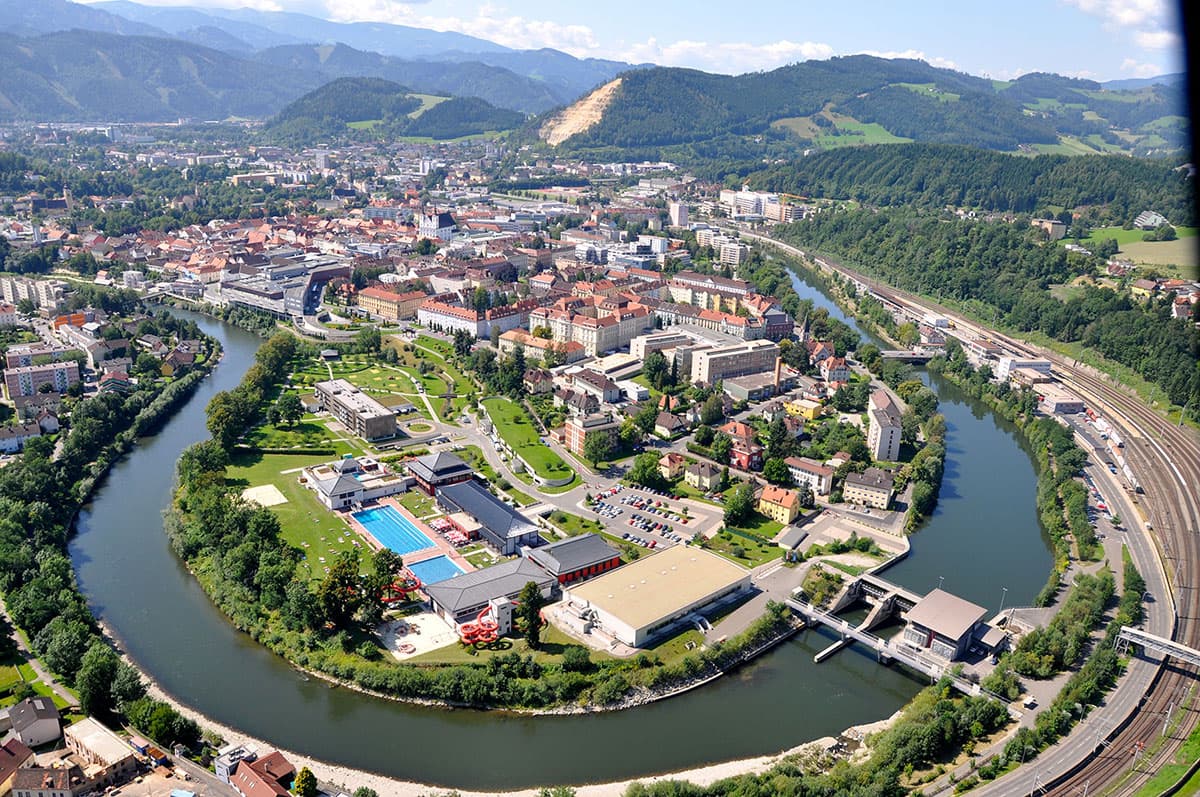 Foto Freisinger / CC BY-SA 4.0, via Wikimedia Commons
Self-guided audio walking tour of Leoben — GPS route, offline playback, story-driven narration in 32 languages.
“Where industrial heritage meets alpine charm.”
Not the postcards. The stories even locals don't know — whispered in your ear, right where they happened.
This unassuming garden house holds a secret that shaped European history.
The city's iconic 'Mushroom Tower' wasn't always so whimsically named.
The oldest women's convent in Styria has a surprising connection to a beloved Austrian beverage.
Discover every secret of Leoben
Every address, every reveal in full — in your ear, right where it happened.
You pick your stops. You walk. The voice reveals what the others miss.


Your self-guided audio tour of Leoben is ready — pick your landmarks, choose your language, and start the moment you arrive.
BuyLume has a built-in augmented-reality guide. Hold your phone up and its camera shows the street ahead of you, with a glowing arrow laid over the real view that always points to your next stop — no map to puzzle over, no wrong turns. Like everything in Lume, it works fully offline.
Leoben, the second-largest city in Styria, Austria, is a place where the Mur River carves a path through a landscape framed by the Hochschwab mountains to the north and the Gleinalpe range to the south. Its identity has been profoundly shaped by centuries of mining and metallurgy, earning it the moniker 'Gateway to the Styrian Iron Road.' Beyond its industrial backbone, Leoben reveals a charming historic core, a lively university presence, and a surprising array of cultural offerings.
The city's main square, the Hauptplatz, dating back to the 13th century, serves as a lively heart, lined with Renaissance and Baroque buildings. It's a place where history is palpable, from the ornate facades to the monuments commemorating past events. Leoben offers a blend of historical depth, academic innovation through its renowned mining university, and access to the natural beauty of the surrounding Styrian mountains, providing opportunities for both urban exploration and outdoor pursuits.
Whether you are drawn to its industrial heritage, the academic buzz, or the serene alpine backdrop, Leoben provides an authentic Austrian experience that often goes unnoticed by those rushing between more famous destinations. It's a city that invites closer inspection, promising unexpected discoveries around every corner.
## From Ancient Settlement to Industrial Hub Leoben's origins stretch back to an ancient settlement, re-established as a town around 1263 by Ottokar II of Bohemia. The name 'Leoben' itself is thought to derive from the Slavic word 'Ljubljana,' meaning 'beloved place,' a testament to its enduring appeal. Its strategic location on the Mur River made it an important administrative and economic center throughout the Middle Ages, particularly due to its involvement in the iron trade.
The 13th century saw the establishment of the Main Square, which remains the city's focal point. Early fortifications, including the Schwammerlturm, were also constructed during this period to guard the city's western entrance. A significant historical event occurred in 1797 when the preliminary Peace Treaty of Leoben, an armistice between Austria and France, was signed here, preceding the Treaty of Campo Formio.
Leoben's industrial identity solidified with the founding of the University of Mining and Metallurgy in 1840. Initially established in Vordernberg, it was relocated to Leoben in 1849 by Peter Tunner. This institution has been central to the region's development, specializing in mining, metallurgy, and materials science. The city's industrial suburbs of Donawitz and Göss were incorporated in 1939, further cementing its role as a key industrial center in Austria. Today, Leoben continues to honor its mining traditions through events like the annual Miners' Parade and the Ledersprung ceremony.
Begin your exploration in Leoben's Hauptplatz, the main square, a pedestrianized area that has been the city's heart since the 13th century. Admire the Hackl House, a Baroque building with a distinctive red and white facade depicting the four seasons and various virtues. In the center stands the Pestsäule (Trinity Column), erected in 1717 to commemorate plague survivors. At either end of the square, you'll find the Angel Fountain (1794) and the Miner's Fountain (1799), the latter featuring a miner in traditional costume.
A short walk from the Hauptplatz leads to the Schwammerlturm, a medieval tower and the only surviving city gate. You can ascend the tower, partly by lift, to a café and observation deck for panoramic views of the city. Do not miss the City Parish Church of St. Xaver, an early Baroque church built in 1660, known for its ornate interior. For a glimpse into the region's industrial and cultural past, visit the MuseumsCenter Leoben, which houses collections on local and regional history.
Just outside the old town, in the Göss district, lies the former Göss Abbey, Styria's oldest women's convent, founded in 1020. Its early Romanesque crypt is a notable feature. Adjacent to the abbey is the Gösser brewery, where you can take a guided tour to learn about traditional brewing methods and sample Gösser beer. For those seeking outdoor activity, the ruins of Massenburg Castle, dating back to the 13th century, offer a pleasant hike and views of Leoben and the surrounding countryside.
The best time to visit Leoben for warm-weather activities is from late June to late August, when temperatures average between 14°C and 25°C (57°F to 77°F). July is typically the warmest month, with an average high of 22°C (72°F) and the clearest skies. If you're interested in cultural events, the Gösser Kirtag, a large street fair, takes place on the Thursday after the first Sunday in October, drawing thousands of visitors. Winter offers opportunities for skiing and snowboarding in nearby mountains like Präbichl, with average temperatures around -3°C to 3°C (27°F to 37°F).
Leoben is easily accessible by train, with direct connections from Graz (approximately 1 hour) and Vienna (approximately 2.5 hours). The Leoben central station is about a 10-minute walk from the Main Square. If arriving by air, Vienna International Airport (VIE) and Graz Airport (GRZ) are the closest options, with train connections to Leoben. Taxis are available from both airports, with pre-booked rates often offered for university visitors.
Within Leoben, the city center is walkable, and public buses provide transportation within the municipal area and to adjacent communities. A 'bus on demand' service also operates for stops not covered by regular routes. Tickets for public transport can be purchased directly on the bus, at the Stadtwerke Leoben Service Center, or at ticket machines at the railway stations. Accommodation options range from hotels to apartments, with several located near the main square and the Asia Spa.
Leoben in Korean, in Chinese or in Hebrew — and 29 more languages, every stop narrated by a native voice. The widest language range of any self-guided audio tour.
Available in: