Old Market Square (Stary Rynek)
The core of Łomża has seen centuries of commerce and community, yet few are aware of its changing architectural forms.
Full story unlocks in the tour
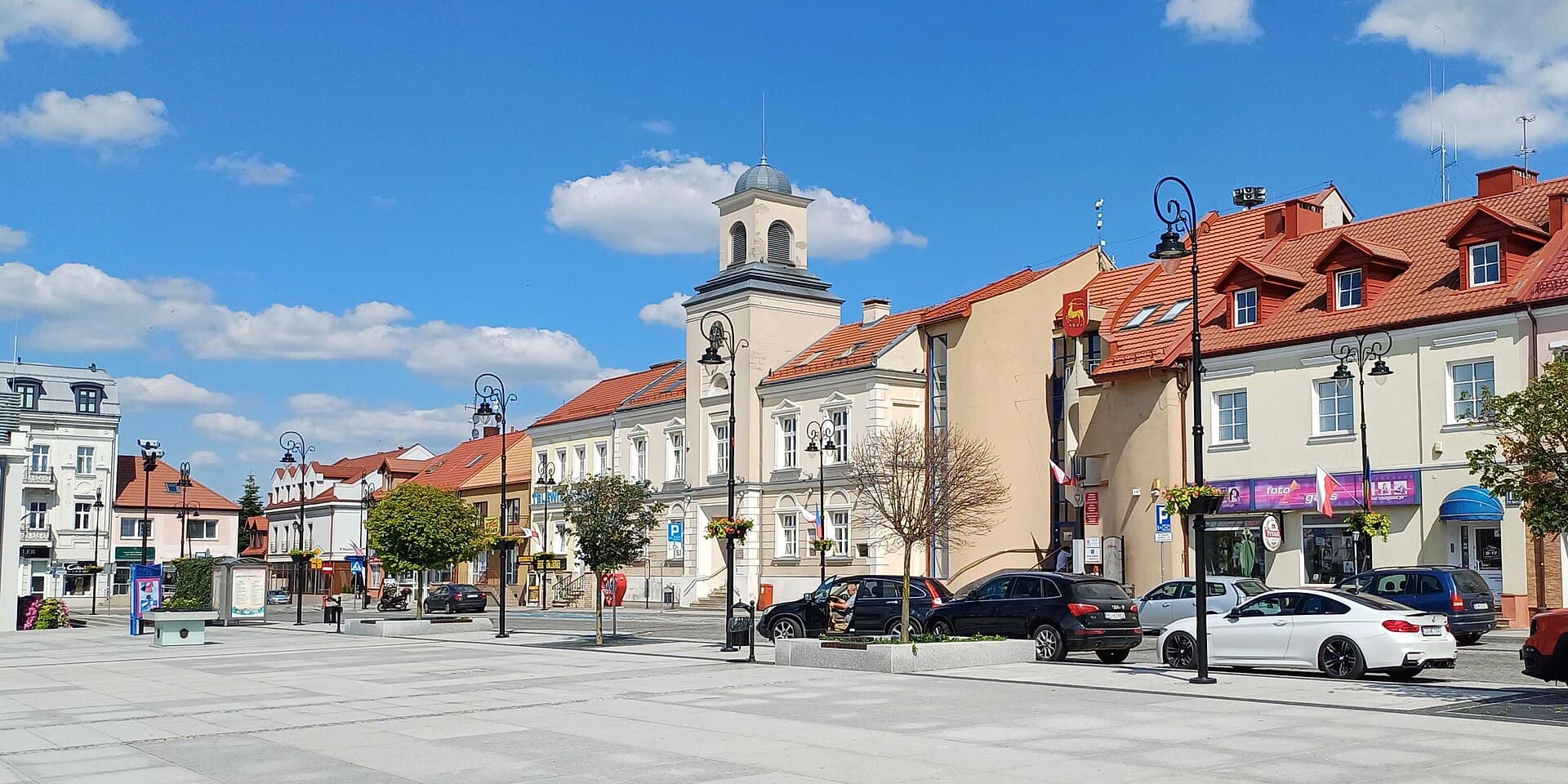 Radosław Botev / CC BY 3.0 pl, via Wikimedia Commons
Self-guided audio walking tour of Łomża — GPS route, offline playback, story-driven narration in 32 languages.
“Where the Narew River traces the city's enduring spirit.”
Not the postcards. The stories even locals don't know — whispered in your ear, right where they happened.
The core of Łomża has seen centuries of commerce and community, yet few are aware of its changing architectural forms.
This imposing Gothic cathedral holds more than just religious significance; it guards a secret beneath its ancient stones.
Before World War II, a magnificent synagogue stood as a testament to Łomża's flourishing Jewish community. Its destruction carries a particularly poignant detail.
Discover every secret of Łomża
Every address, every reveal in full — in your ear, right where it happened.
You pick your stops. You walk. The voice reveals what the others miss.
Your self-guided audio tour of Łomża is ready — pick your landmarks, choose your language, and start the moment you arrive.
BuyLume has a built-in augmented-reality guide. Hold your phone up and its camera shows the street ahead of you, with a glowing arrow laid over the real view that always points to your next stop — no map to puzzle over, no wrong turns. Like everything in Lume, it works fully offline.
Łomża, a city in northeastern Poland, offers a compelling blend of history, culture, and the natural world. Positioned along the Narew River, it stands as a primary economic, educational, and cultural hub within the Podlaskie Voivodeship. With a population of approximately 60,000 residents, Łomża maintains an inviting atmosphere, balancing its historical depth with contemporary life.
The city's strategic location on the Narew has shaped its destiny, transitioning from a bustling trade center in past centuries to a gateway to the region's unspoiled natural landscapes today. It is a place where the echoes of ancient trade routes meet the tranquility of river valleys and protected parklands. Visitors can delve into centuries of Polish history while also appreciating the city's role as part of the "Green Lungs of Poland," an area celebrated for its untouched natural environment.
Łomża invites exploration, from its carefully preserved Old Town and Gothic cathedral to its museums and the surrounding Narew Landscape Park. It is a destination that appeals to both history enthusiasts and those who appreciate nature, providing a serene escape with a profound cultural heritage.
Łomża's origins trace back to the 10th century, with its initial settlement located about 5 kilometers east of the present-day city, in what is now Stara Łomża (Old Łomża). It was first formally mentioned in the 14th century and received its municipal rights in 1416. By the mid-16th century, Łomża had blossomed into a significant political and economic center, owing much to its strategic position on trade routes connecting Prussia, Vilnius, Russia, and Western Europe, as well as its access to the Narew-Vistula water route.
This period of prosperity, however, was not without its challenges. The 17th century brought a series of devastating events, including a major fire in 1618 that destroyed much of the city, followed by a deadly epidemic in 1624 that claimed over 5,000 lives. Further hardships, such as Swedish invasions and Cossack raids, contributed to a significant decline.
Following the Partitions of Poland in 1795, Łomża was annexed by Prussia. It later became part of the Duchy of Warsaw in 1807 and, after the Congress of Vienna in 1815, was integrated into Congress Poland under Russian rule. The 19th century saw some industrial development, and between 1867 and 1915, Łomża served as the capital of the Łomża Governorate, becoming an important administrative hub.
The 20th century, however, brought immense destruction. During the Polish-Soviet War of 1919–1921, the city experienced fierce fighting. World War II proved even more catastrophic; in September 1939, Łomża was heavily damaged during the Battle of Łomża by the Wehrmacht. The city was briefly occupied by Germany, then by the Soviets, who imposed their administration and carried out deportations. The German reoccupation in 1941 led to the tragic liquidation of Łomża's flourishing Jewish community, which had constituted a significant portion of the population. The city was almost entirely destroyed, with its population reduced by approximately 60%.
After its liberation in September 1944 and subsequent cession to Poland, Łomża embarked on an extensive postwar rebuilding and restoration program. Today, the city stands as a testament to its resilience, with its restored Gothic cathedral and a blend of historical remnants and modern architecture. It continues to be an important regional center, preserving its profound heritage while looking towards the future.
Begin your exploration at the Old Market Square (Stary Rynek), the historical core of Łomża. Here, you will find the classicist town hall with its clock tower, a survivor of the city's tumultuous past. Just south of the market square stands the magnificent Cathedral of St. Michael the Archangel and St. John the Baptist, a Gothic masterpiece dating back to the 16th century. Its predominantly Baroque interior houses a precious 16th-century painting of the Virgin Mary, crowned by Pope John Paul II in 1991.
For a deeper dive into regional history and culture, visit the North Mazovian Museum (Muzeum Północno-Mazowieckie w Łomży), located in the former "Parson's House" on Krzywe Koło Street. This museum is notable for its extensive amber collection. Art enthusiasts can also explore the gallery of contemporary arts within the museum. Reflect on the city's diverse past at the Old Cemetery, a unique burial ground that combines Roman Catholic, Protestant, and Orthodox sections, established in the early 19th century.
Beyond the city's architectural heritage, Łomża is a gateway to natural wonders. The city is bordered by the Łomża Landscape Park of the Narew Valley, a protected area ideal for hiking and birdwatching along the Narew River. The nearby Narew National Park offers further opportunities for kayaking and fishing amidst diverse ecosystems.
The ideal time to visit Łomża is during late spring (May-June) and early autumn (September-October). These months offer mild weather, fewer crowds, and the opportunity to enjoy lively foliage in the fall. Summer (July-August) is also a good option, with warm temperatures and lively festivals, though accommodation prices may be higher. For those who don't mind the cold, winter (December-February) provides a charming, quiet visit, with opportunities for winter sports in nearby areas.
The local currency is the Polish Złoty (PLN). Credit cards are widely accepted in most shops, hotels, and restaurants, but it is advisable to carry some cash for smaller establishments. While younger people and service staff may speak basic English, it is helpful to learn a few basic Polish phrases. Tap water in Łomża is safe to drink.
Łomża is generally a very safe city with low crime rates, suitable for solo travelers and families. However, as with any destination, it is wise to secure valuables in crowded areas and avoid poorly lit streets at night. Emergency services can be reached by dialing 112 (EU Emergency), 997 for police, 999 for ambulance, and 998 for fire services.
Healthcare in Łomża is reliable, with a Provincial Hospital and several clinics. EU citizens should carry their European Health Insurance Card (EHIC), while non-EU visitors need comprehensive travel insurance.
Culturally, Poles value politeness. Greet with 'Dzień dobry' (good day) and dress modestly when visiting churches. Tipping 10-15% in restaurants is customary.
Łomża in Korean, in Chinese or in Hebrew — and 29 more languages, every stop narrated by a native voice. The widest language range of any self-guided audio tour.
Available in: