Lörrach Town Hall
Imagine a German town hall where a republic was declared, if only for a moment.
Full story unlocks in the tour
 Wladyslaw Sojka / CC BY 3.0, via Wikimedia Commons
Self-guided audio walking tour of Lörrach — GPS route, offline playback, story-driven narration in 32 languages.
“Where the Black Forest meets the Rhine, Lörrach echoes with revolutions and chocolate.”
Not the postcards. The stories even locals don't know — whispered in your ear, right where they happened.
Imagine a German town hall where a republic was declared, if only for a moment.
Beneath a modern museum lies the faint outline of a medieval moated castle.
One Lörrach district holds a surprisingly different religious history from the rest of the city.
Discover every secret of Lörrach
Every address, every reveal in full — in your ear, right where it happened.
You pick your stops. You walk. The voice reveals what the others miss.

Your self-guided audio tour of Lörrach is ready — pick your landmarks, choose your language, and start the moment you arrive.
BuyLume has a built-in augmented-reality guide. Hold your phone up and its camera shows the street ahead of you, with a glowing arrow laid over the real view that always points to your next stop — no map to puzzle over, no wrong turns. Like everything in Lume, it works fully offline.
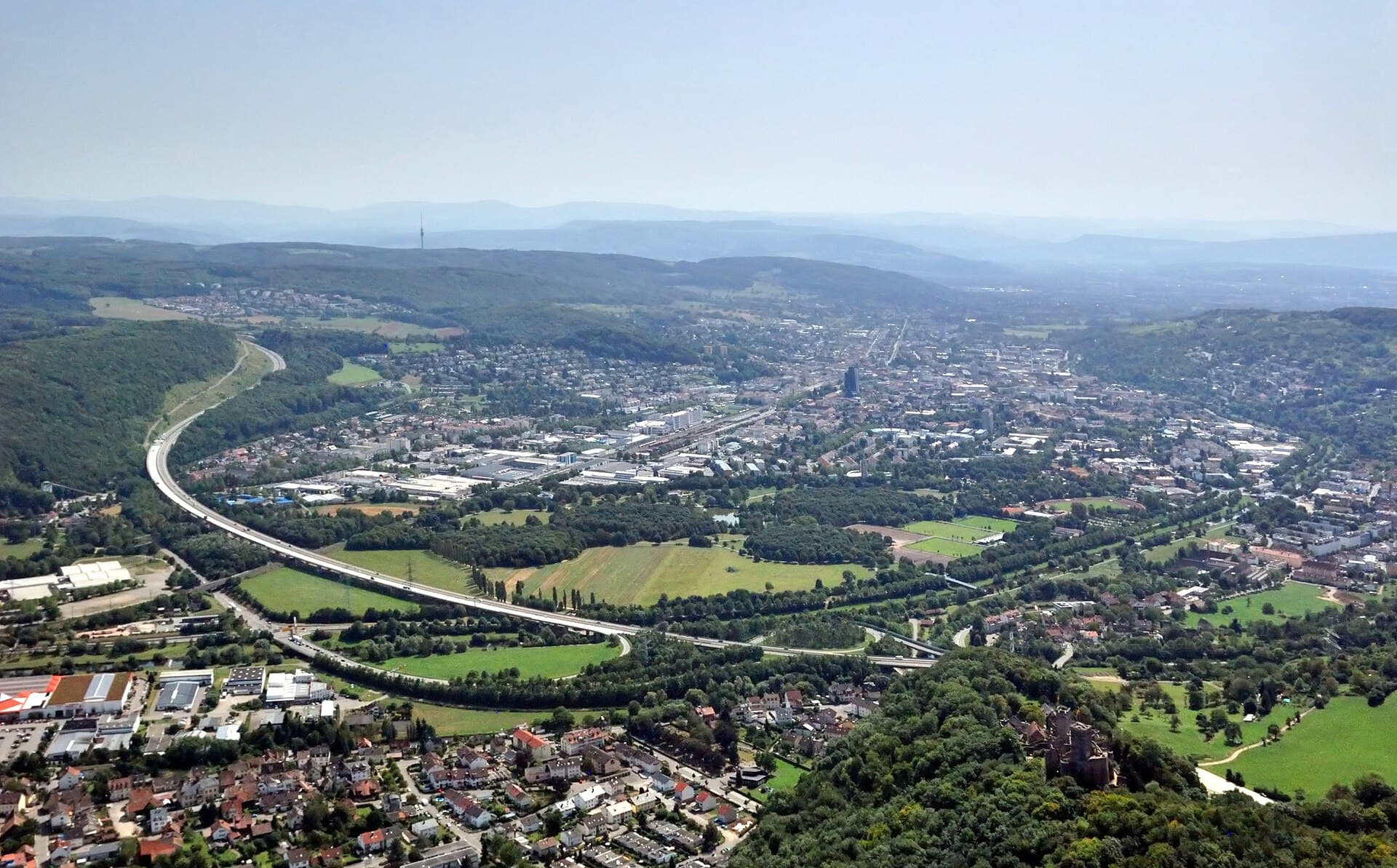
Lörrach, a city of approximately 50,000 residents, is situated in the southwest of Germany, a short distance from the French and Swiss borders. Its location in the Wiese valley, at the foothills of the Black Forest, grants it a unique blend of natural splendor and international character. Often referred to as the 'German Tuscany' due to its mild climate and abundant sunshine, Lörrach extends a warm invitation for exploration.
The city serves as a portal to the varied landscapes of the Black Forest, the Rhine Valley, and the nearby Swiss city of Basel. Lörrach's identity is shaped by its position at the 'Three Country Corner,' a geographical nexus where Germany, France, and Switzerland converge. This proximity has fostered a rich cultural exchange and makes it an excellent foundation for cross-border adventures.
The history of Lörrach stretches back to the Paleolithic period, with archaeological discoveries confirming early human presence. The first documented mention of Lörrach, then known as Lorracho, dates to 1102. For centuries, its development was closely tied to the powerful city of Basel, often remaining a largely rural settlement. In 1403, Lörrach was granted market rights by King Rupert of the Palatinate, a significant step in its early growth.
Lörrach achieved city status in 1682, bestowed by Frederick VII, Margrave of Baden-Durlach. However, these rights were reportedly forgotten amidst various conflicts and had to be renewed in 1756, marking its second elevation to city status. The 19th century brought a wave of industrialization, driven by its location along the Wiese River and its strategic position on a major trade route. The textile industry, in particular, brought Lörrach widespread recognition.
A pivotal moment in Lörrach's history occurred in 1848 during the German Revolution. On September 21, Gustav Struve proclaimed the German Republic from the town hall, a revolutionary act that, though quickly suppressed, cemented Lörrach's place in the annals of German democratic movements.
The late 19th and early 20th centuries saw further development, including the opening of the Wiesentalbahn railway in 1862, connecting Lörrach to Basel and Schopfheim. This railway was notably the first private railway in the Grand Duchy of Baden and became one of Germany's earliest electrified lines in 1913. Throughout its history, Lörrach's affiliations shifted between various noble families and territories, eventually becoming part of Baden-Württemberg in 1952. Today, Lörrach continues to thrive as a district capital, embracing its cross-border identity and enduring heritage.
Begin your exploration at the Rötteln Castle ruins, one of the largest and most powerful castles in southwest Germany, offering sweeping views over the Wiese valley. The castle, which dates back to the 11th century, is open to visitors from March to October. Delve into the region's unique identity at the Dreiländermuseum (Three Countries Museum), which explores the history and shared culture of the German, French, and Swiss border region. Lörrach is also known as the 'City of Sculptures,' with numerous public art installations throughout its center, inviting an open-air art walk.
For a touch of architectural history, visit the Stadtkirche (City Church), first mentioned in the 12th century, or the neoclassical Church of St. Fridolin, built in 1822. The neo-Romanesque Bonifatiuskirche (St. Boniface Church), consecrated in 1867, is another significant religious landmark. If you're seeking green spaces, the Grüttpark, created for the 1983 State Garden Show, offers varied routes past a lake, small forests, and meadows, complete with sports facilities. For those interested in local products and a lively atmosphere, the weekly market at the Alter Marktplatz is a rewarding visit.
The best time to visit Lörrach for general outdoor activities is from late June to early September, with a peak in the first week of August, when temperatures are comfortable and skies are clearest. The warm season extends from early June to early September, with average daily highs above 70°F (21°C). For those interested in cultural events, the STIMMEN Festival, an international music event, takes place in early summer, typically July. Autumn is also lovely, particularly for hikers and wine enthusiasts, with harvest festivals and rich vineyard colors.
Lörrach is well-connected by train, with services from Basel SBB to Lörrach Hauptbahnhof running every half hour. The EuroAirport (BSL; MLH; EAP) near Basel serves as the closest international airport. Once in Lörrach, public transport, including buses and trains, makes getting around easy, though many central areas are also walkable. If you're visiting from Switzerland, remember to carry Euros for bus tickets purchased directly from drivers. The local cuisine reflects its border location, blending German, French, and Swiss influences. Be sure to try Baden specialties like Kässpätzle (cheese noodles) and local wines from the Markgräflerland region.
Lörrach in Korean, in Chinese or in Hebrew — and 29 more languages, every stop narrated by a native voice. The widest language range of any self-guided audio tour.
Available in: