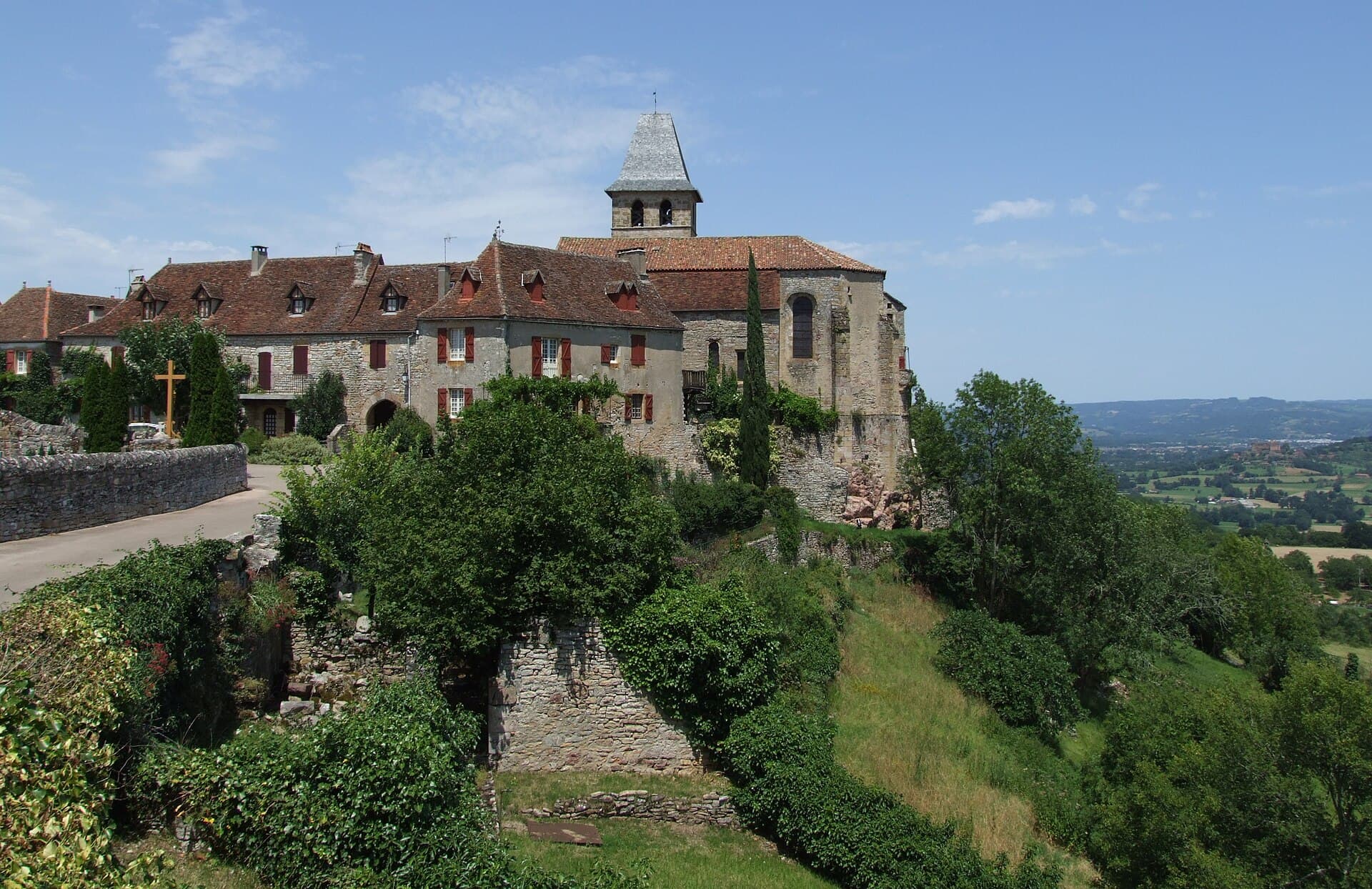
Château de Loubressac
The imposing medieval castle that dominates Loubressac holds a secret about its later life.
Full story unlocks in the tour
 Christophe.Finot / CC BY-SA 2.5, via Wikimedia Commons
Self-guided audio walking tour of Loubressac — GPS route, offline playback, story-driven narration in 32 languages.
“Where time slows, and views stretch to forever.”
Not the postcards. The stories even locals don't know — whispered in your ear, right where they happened.
The imposing medieval castle that dominates Loubressac holds a secret about its later life.
The village's main church has an unusual connection to an older, lost sanctuary.
The wide panoramas from Loubressac have captivated more than just casual visitors.
Discover every secret of Loubressac
Every address, every reveal in full — in your ear, right where it happened.
You pick your stops. You walk. The voice reveals what the others miss.


Your self-guided audio tour of Loubressac is ready — pick your landmarks, choose your language, and start the moment you arrive.
BuyLume has a built-in augmented-reality guide. Hold your phone up and its camera shows the street ahead of you, with a glowing arrow laid over the real view that always points to your next stop — no map to puzzle over, no wrong turns. Like everything in Lume, it works fully offline.
Loubressac, recognized as one of France's "Most Beautiful Villages," rests upon a rocky outcrop in the Lot department of the Occitanie region. This medieval village offers expansive views across the valleys of the Dordogne, Cère, and Bave rivers, with distant glimpses of several castles like Castelnau-Bretenoux, Montal, and Saint-Laurent-les-Tours.
The village is characterized by its ochre-colored stone houses with brown-tiled roofs and decorative balconies, often adorned with abundant floral displays that have earned it titles like 'most beautiful flowering village of the Lot' and 'best flowering village of the Midi-Pyrenees'. Its narrow streets and central square evoke a sense of a bygone era, inviting exploration of its well-preserved medieval architecture.
Loubressac's serene atmosphere and picturesque setting make it an ideal starting point for exploring the surrounding countryside, which includes other "Most Beautiful Villages" such as Autoire and Carennac, as well as natural wonders like the Gouffre de Padirac.
The story of Loubressac stretches back approximately 2,000 years, with evidence of Celtic and Gallo-Roman settlements. The village's name itself is of Gallo-Roman origin, with the suffix '-ac' deriving from the Gaulish '-acon'. The first mention of Loubressac appears around the 9th century, initially as a locality situated slightly below the current village.
During the medieval period, Loubressac developed around a fortified castrum on its strategic rocky promontory. In the 12th and 13th centuries, the seigneury was under the suzerainty of the house of Castelnau. The 13th century saw the region, including Loubressac, significantly impacted by the Hundred Years' War. The village was captured by the English during this conflict, and many of its buildings were destroyed. Following the war, a new castle and ramparts were constructed in the 14th and 15th centuries by Adhémar d'Aigrefeuille, a field marshal of Pope Clement VI's pontifical court, who became the first "Baron of Loubressac."
Despite the fortifications, Loubressac faced further challenges. The Black Plague in 1443 decimated the population, leaving only five inhabitants. The village was repopulated with people from Limousin and Auvergne. The Wars of Religion in the 15th century again halted the village's growth. In 1572, Protestants occupied Loubressac, and the sculpted portal of the Église Saint-Jean-Baptiste still bears the marks of their actions, with the tympanum partially hammered.
The French Revolution brought an end to the region's medieval order in 1789. The last Baron of Loubressac, Raphael-François de Tournier, Count of Vaillac, was guillotined in Paris in 1794. The old administrative structures were replaced by mayors and town councils, with Pierre Certain elected as Loubressac's first mayor in 1790. In the 19th century, the Château de Loubressac was transformed into a manor, and its defensive features were largely removed, though later restored.
Loubressac also played a role in more recent history. On July 14, 1944, during Operation Cadillac, it was the site of one of the largest parachute drops of weapons for the French Resistance during the Second World War. Over 500 containers of weapons were parachuted onto a field at La Maresque, with hundreds of men protecting and recovering the supplies.
Today, Loubressac is celebrated for its preserved historical heritage and natural beauty. It was one of the earliest villages to be classified as one of the "Most Beautiful Villages of France" in 1983, a distinction it continues to hold. The village has also received numerous awards for its abundant floral displays, further enhancing its appeal.
Loubressac's compact size allows for easy exploration on foot, revealing architectural details and sweeping vistas at every turn. Begin with a stroll through the narrow streets, admiring the ochre-colored stone houses with their brown-tiled roofs and often flower-bedecked balconies.
The Église Saint-Jean-Baptiste, dating from the 14th to 16th centuries, is a central feature. Its imposing bell tower, accessible by a spiral staircase in a side tower, and a richly ornamented interior with golden statues and painted details are noteworthy. The carved portal, partially defaced during the Wars of Religion, depicts a Christ in Majesty and the Crucifixion.
While the Château de Loubressac is privately owned and not open to the public, its imposing gateway is visible, and the lawns next to it offer exceptional panoramic views of the Dordogne Valley and distant castles like Castelnau-Bretenoux and Montal. Another excellent viewpoint is found near the church, providing vistas across the Bave, Cère, and Dordogne river valleys.
Beyond the village, numerous hiking trails lead through the surrounding countryside, offering opportunities to discover other appealing hamlets, lush woodlands, and river valleys. The Pont de Maday, a three-arched bridge over the Bave river, is the oldest bridge in the region and part of a pilgrim route. Nearby, the Dolmen d'Aurast, a well-preserved Neolithic dolmen, offers a glimpse into ancient history.
The most pleasant times to visit Loubressac are typically from May through October. During these months, average daytime temperatures range from a comfortable 12°C (54°F) to 27°C (81°F), with July and August being the warmest. Spring and summer bring abundant floral displays, enhancing the village's appeal. While October can be one of the rainier months, it still offers comfortable temperatures for exploration.
To experience local culture, consider visiting in August, when a large flea market and fun activities are held, and the church hosts performances as part of the Rocamadour lyrical art festival.
Loubressac is a small, car-free village, so visitors typically park in a large car park on the edge of the village before entering on foot. The village is easily explored, with narrow streets and alleys surrounding a central grass area. It's advisable to wear comfortable shoes for walking on cobbled streets and potential hiking trails.
While Loubressac is less developed than some other regional villages, it offers options for dining, including appealing terraced cafés and restaurants serving local cuisine. Specialties of the region include truffles, foie gras, and local wines. Fresh food markets are also available in nearby towns like Bretenoux on Tuesday and Saturday mornings. The village is well-situated for day trips to other popular sites in the Dordogne Valley, such as the Gouffre de Padirac and Rocamadour.
Loubressac in Korean, in Chinese or in Hebrew — and 29 more languages, every stop narrated by a native voice. The widest language range of any self-guided audio tour.
Available in: