The Lucheux Belfry
This UNESCO-listed belfry holds a secret about French postal history.
Full story unlocks in the tour
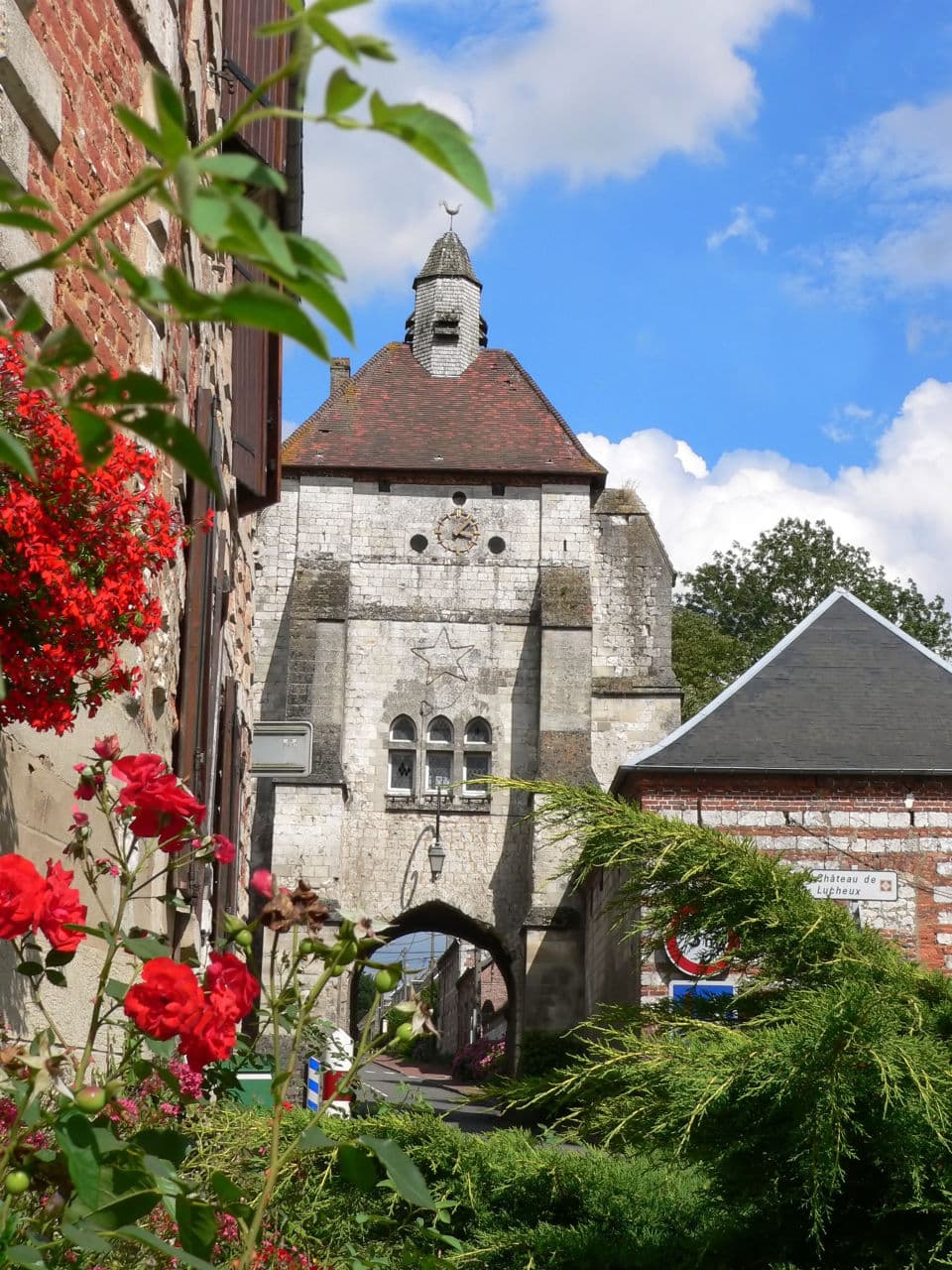 Matthieu Debailleul, http://aascalys.free.fr / CC BY-SA 2.5, via Wikimedia Commons
Self-guided audio walking tour of Lucheux — GPS route, offline playback, story-driven narration in 32 languages.
“Where medieval echoes linger in stone and story.”
Not the postcards. The stories even locals don't know — whispered in your ear, right where they happened.
This UNESCO-listed belfry holds a secret about French postal history.
Look closely at the Romanesque capitals in the church's choir. They depict more than just religious scenes.
There's a specific way to walk around this intertwining pair of lime trees if you want to ensure a happy marriage.
Discover every secret of Lucheux
Every address, every reveal in full — in your ear, right where it happened.
You pick your stops. You walk. The voice reveals what the others miss.


Your self-guided audio tour of Lucheux is ready — pick your landmarks, choose your language, and start the moment you arrive.
BuyLume has a built-in augmented-reality guide. Hold your phone up and its camera shows the street ahead of you, with a glowing arrow laid over the real view that always points to your next stop — no map to puzzle over, no wrong turns. Like everything in Lume, it works fully offline.
Lucheux, a commune in the Somme department of northern France, is a place where medieval history is not just preserved in books, but etched into the very stones of its buildings. With a population of around 521 inhabitants as of 2023, it offers a quiet, close-knit community feel. This village is a testament to medieval French society, featuring a fortified castle, a Romanesque church, and a belfry that together tell tales of centuries past.
Situated in the Hauts-de-France region, Lucheux is approximately 7 kilometers north of Doullens. Its historical landmarks, natural features like the Lucheux Forest, and cultural sites provide a diverse range of exploration opportunities for visitors. The town's commitment to preserving its heritage and natural beauty has earned it the "Villes et Villages Fleuris" label with three flowers.
For those seeking a journey back in time, Lucheux presents an evocative setting. The blend of impressive architecture and the surrounding tranquil landscapes invites a contemplative stroll through history, revealing the layers of events that shaped this corner of France.
The origins of Lucheux's fortified castle trace back to approximately 1120, when Hugh II, Count of Saint-Pol, initiated its construction. The castle's design incorporated techniques Hugh II brought back from the Crusades, establishing it as a significant stronghold on the border of Artois and Picardy. Over the centuries, it underwent substantial modifications; Guy III of Saint-Pol, for instance, added four corner towers, a hall, and a chapel around 1275.
The castle played a crucial role during various conflicts. It faced multiple assaults from the English army during the Hundred Years' War. In 1568, Protestants under Captain Cocqueville seized the château during the Wars of Religion, and it was besieged again in 1595 by the Spanish. Ultimately, the castle was destroyed by the Spanish and later officially dismantled in 1640 under the orders of Cardinal Richelieu. Today, only the massive gate, some walls, and a preserved section of the keep remain.
The Église Saint-Léger, a Romanesque church, dates back to the 12th century and stands as one of the few examples of Romanesque architecture in the Somme department. It was originally part of a Benedictine priory founded in 1095 by Hugues II Campdavesne, Count of Saint-Pol. The church is dedicated to Saint Léger, Bishop of Autun, who was martyred in the nearby forest in the 7th century.
Another defining monument of Lucheux is its belfry, a fortified gate constructed around 1380 on the site of an older town gate. Recognized by UNESCO as a World Heritage Site in 2005, it is a rare example of a belfry-porch in Northern Europe. This belfry symbolizes the communal freedoms granted to the people of Lucheux in 1201 through their communal charter. It was here, in 1464, that Louis XI signed the "Édit des Postes," establishing a royal postal service. These three structures—the castle, church, and belfry—collectively represent the enduring medieval heritage of Lucheux.
Begin your exploration at the Lucheux Belfry, a UNESCO World Heritage site and a unique fortified gate. This 14th-century structure, built upon an older town gate, is the only belfry-porch in Northern Europe. From there, walk to the Église Saint-Léger, a Romanesque church dating from the 12th century. Inside, observe the historiated capitals in the choir, which feature diverse carvings including human, demonic, animal, and plant figures.
Though a private property and closed to the public, the ruins of the Château de Lucheux are still visible, offering a glimpse into its 12th to 15th-century military architecture. You can discern the facade of the 13th-century ceremonial hall, defensive towers, and the imposing 35-meter donjon. The Porte du Bourg and the Porte du Haut-Bois, both part of the castle's defensive system, also remain.
Beyond the village center, consider a visit to the Chapel of Saint Léger in the Lucheux Forest, marking the site where Saint Léger was martyred in 678. While the current chapel was built in 1989 after previous destructions, a fresco inside depicts his martyrdom. For a unique natural landmark, seek out the Arbre aux épousailles, an intertwining pair of lime trees with a local legend attached to them.
The period between May and September offers pleasant weather for exploring Lucheux's outdoor historical sites and the surrounding natural landscapes. This timeframe also aligns with medieval festivals and markets that occur in the broader Hauts-de-France and Burgundy regions, though specific events in Lucheux itself may vary. Spring and early autumn provide comfortable temperatures for walking and sightseeing, while avoiding the peak summer crowds.
Lucheux is a small commune in the Somme department, with a population of approximately 521 people. The local currency is the Euro (EUR). The average visit duration for the medieval town is about 90 minutes for a self-guided tour. While the Château de Lucheux is private and not open to the public, the belfry and church are accessible. Some attractions may charge an adult price of approximately 5 Euros.
For dining, options are available in nearby towns like Doullens, which is about 7 kilometers away. Restaurants in the vicinity offer French and Western cuisine. Accommodation can be found in the surrounding area, including hotels, guesthouses, and vacation rentals. Lucheux is served by the 80600 postal code. The local mayor as of 2020-2026 is Michel Duhautoy.
Lucheux in Korean, in Chinese or in Hebrew — and 29 more languages, every stop narrated by a native voice. The widest language range of any self-guided audio tour.
Available in: