Mende Cathedral
The grand bell tower of Mende Cathedral once held a secret that echoed across the Gévaudan.
Full story unlocks in the tour
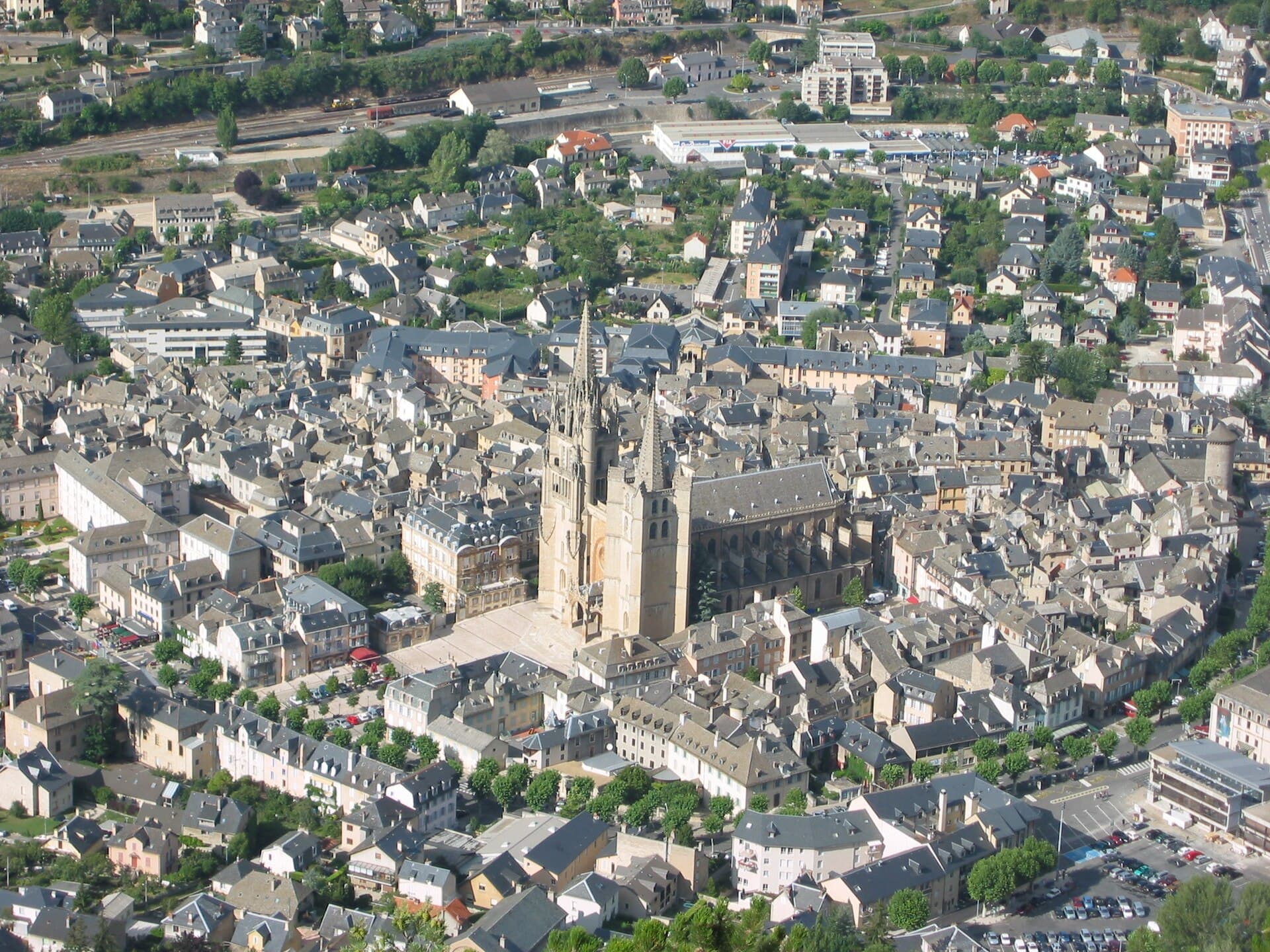 User:civodule / CC BY-SA 3.0, via Wikimedia Commons
Self-guided audio walking tour of Mende — GPS route, offline playback, story-driven narration in 32 languages.
“Where medieval echoes meet mountain air.”
Not the postcards. The stories even locals don't know — whispered in your ear, right where they happened.
The grand bell tower of Mende Cathedral once held a secret that echoed across the Gévaudan.
This seemingly ordinary tower holds a surprising reason for its survival when the city walls were dismantled.
The medieval Notre-Dame Bridge once bore a name that has since been lost to time, hinting at a forgotten detail.
Discover every secret of Mende
Every address, every reveal in full — in your ear, right where it happened.
You pick your stops. You walk. The voice reveals what the others miss.


Your self-guided audio tour of Mende is ready — pick your landmarks, choose your language, and start the moment you arrive.
BuyLume has a built-in augmented-reality guide. Hold your phone up and its camera shows the street ahead of you, with a glowing arrow laid over the real view that always points to your next stop — no map to puzzle over, no wrong turns. Like everything in Lume, it works fully offline.
Mende, the historic capital of Gévaudan and now the prefecture of Lozère, offers a journey through time amidst the picturesque Lot Valley. This compact city, with a population of just over 12,000, retains the unassuming character of a medieval town, where narrow, winding streets, ancient fountains, and unique houses with roofs resembling overturned boat hulls create a distinctive architectural ensemble.
Positioned between the dramatic landscapes of the Cévennes and Aubrac, Mende serves as a portal to a preserved natural world. It is a city that invites unhurried exploration, offering a blend of historical treasures and natural splendor. Recognized as France's most sporty town, Mende provides numerous outdoor activities, from hiking and mountain biking to via ferrata on the nearby Causse de Mende.
Mende's origins stretch back to antiquity, with the territory initially inhabited by the Gallic tribe of the Gabali. The city's true development began in the 3rd century AD with the spread of Christianity, centered around the work and martyrdom of Saint Privat, the first bishop of the Gabales. Legend states that Saint Privat sought refuge in a hermitage on Mont Mimat, the mountain overlooking modern Mende, and after his death, his tomb became a significant pilgrimage site, fostering the growth of the settlement then known as Mimate.
By the 10th century, Mende had become the seat of the bishopric. A pivotal moment arrived in 1161 when Bishop Aldebert III du Tournel paid homage to King Louis VII of France, who in turn granted the bishops the rank of Count of Gévaudan, bestowing temporal power over the entire province. This solidified Mende's position as the administrative and political heart of the region, leading to the construction of city walls to symbolize its new status. The city's strategic location at the crossroads of trade routes between Languedoc and Auvergne further fueled its commercial and artisanal prosperity.
The 14th century saw significant development, with Pope Urban V, a native of the Gévaudan region, commissioning the construction of the imposing Gothic Saint-Privat Cathedral in 1368. The cathedral, consecrated in 1469, became a symbol of the bishops' power. However, this grandeur was challenged during the Wars of Religion. In 1579, Protestant troops led by Captain Merle partially destroyed the cathedral, including its famous 'Non Pareille' bell. The cathedral was later rebuilt between 1598 and 1620, largely following the original plans but with a more austere aesthetic.
The 18th century brought a curious decision: the city walls, built for defense, were largely demolished in 1768 to allow for "better air circulation." The 19th century witnessed both progress and decline. Mende was a pioneer in France, becoming one of the first departmental capitals after Paris to install public electric lighting in 1888. However, the wool industry, once a cornerstone of its economy, began a slow decline, eventually disappearing in the 20th century. Despite these shifts, Mende maintained its status as the prefecture of Lozère after the French Revolution, continuing its role as a regional administrative center. Today, Mende embraces its enduring past, with a protected zone in its historic center established in 1982 to preserve its medieval architectural heritage.
Begin your exploration in Mende's historic center, where the majority of the city's notable landmarks are concentrated. The Cathédrale Notre-Dame-et-Saint-Privat dominates the skyline with its two distinct bell towers, one significantly taller and more ornate than the other. Inside, discover the crypt of Saint Privat, a 12th-century Black Madonna, 17th-century organs by the Eustache brothers, and 18th-century Aubusson tapestries depicting scenes from the Virgin's life. Guided tours are available, offering access to areas like the cathedral's bell tower.
Stroll to the Pont Notre-Dame, a medieval stone arch bridge from the 13th century that spans the Lot River, offering picturesque views of the old town and its distinctive tiled roofs. Close by, you'll find the Tour des Pénitents, a 14th-century watchtower and one of the last remaining sections of the city's original ramparts. The Lavoir des Calquières, a listed ancient washhouse, showcases the city's historical relationship with its underground water network, visible through numerous public fountains throughout Mende. Don't miss the Pharmacy of the Former Hospital of Mende, a beautifully preserved 19th-century pharmacy, accessible on guided tours. For a sweeping vista of the city and the Lot Valley, consider a hike or drive up to the Hermitage of Saint Privat on Mont Mimat.
Mende is most enjoyable during the summer months, from late June to late August, when temperatures are comfortable, averaging around 23-24°C, ideal for walking and outdoor activities. July is typically the warmest month, with an average high of 24°C. Rainfall is minimal during this period, with approximately 5-8 rainy days per month, making it the driest season.
For those who prefer cooler temperatures and fewer crowds, spring (May) and early autumn (September) offer pleasant conditions, with daytime highs ranging from 15°C to 19°C. While October is the wettest month, with an average of 113 mm of rainfall, the overall climate is notably wet throughout the year.
Mende is accessible by car via the A75, with junction 39 located 25 km away. The N106 connects it to Nîmes. The city also has a train station, with Intercités trains from Paris (requiring a change in Clermont-Ferrand) and TER trains from Nîmes. For air travel, Rodez-Aveyron Airport is 1.5 hours away, while Montpellier and Clermont-Ferrand Airports are approximately 2.5 hours away.
Within Mende, the historic center is best explored on foot, allowing you to appreciate the narrow streets and architectural details. The Tourist Office of Mende Coeur de Lozère provides guided tours of the historic center and the cathedral. Accommodation options include hotels, vacation rentals, and campsites. Local markets, particularly in Place Urbain V, offer fresh produce and regional specialties. Don't forget to sample the city's signature 'croquants,' almond sablé biscuits.
Mende in Korean, in Chinese or in Hebrew — and 29 more languages, every stop narrated by a native voice. The widest language range of any self-guided audio tour.
Available in: