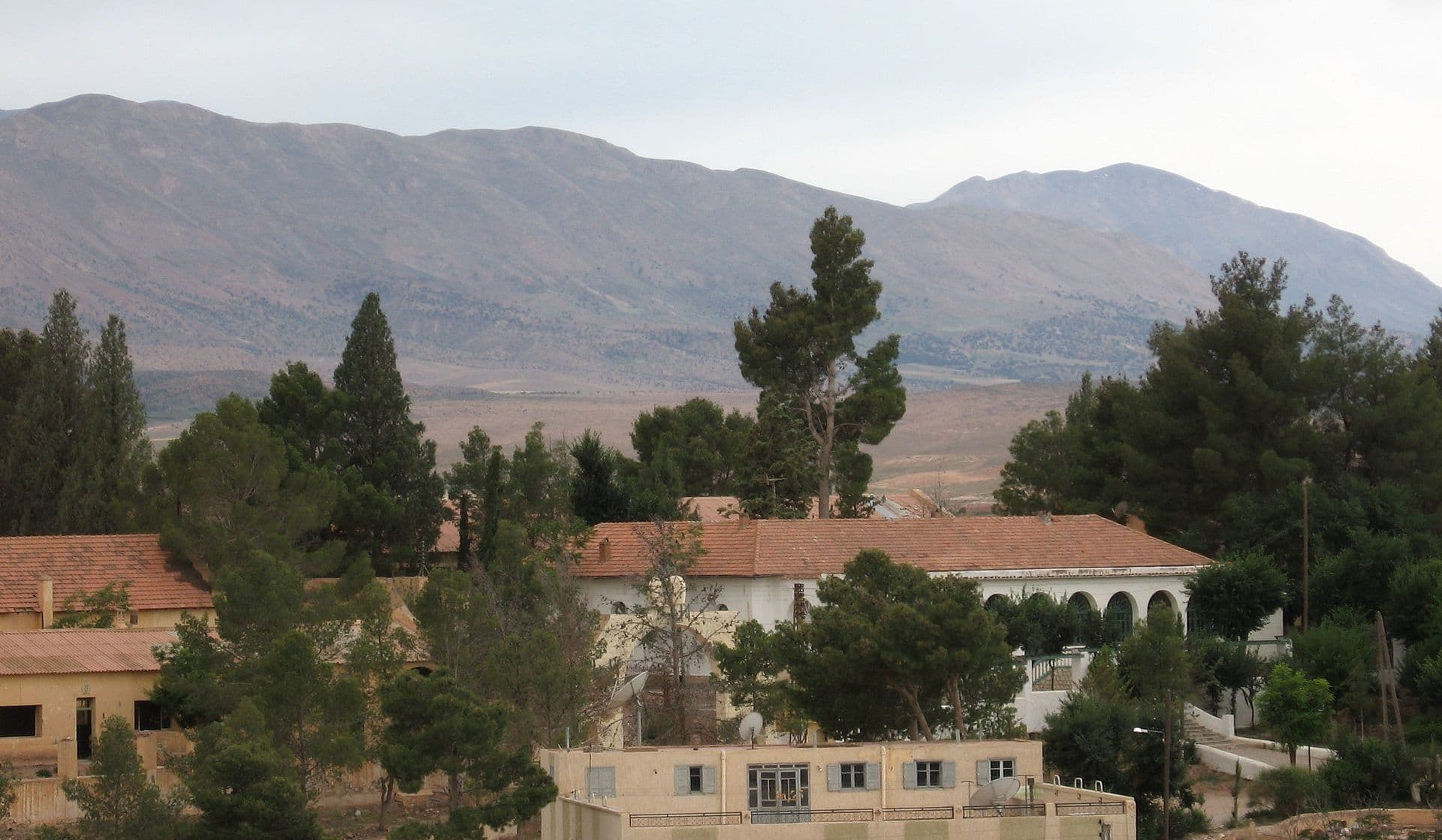
Mibladen Mining District
The brilliant red crystals sought by collectors worldwide have a surprising origin, intertwined with this region's industrial past.
Full story unlocks in the tour
 Innocentsabroad at English Wikipedia / Public domain, via Wikimedia Commons
Self-guided audio walking tour of Midelt — GPS route, offline playback, story-driven narration in 32 languages.
“Where Atlas peaks meet apple orchards and ancient stories drift on the wind.”
Not the postcards. The stories even locals don't know — whispered in your ear, right where they happened.
The brilliant red crystals sought by collectors worldwide have a surprising origin, intertwined with this region's industrial past.
This mountain town received electricity long before many larger Moroccan cities.
Beyond a place to acquire apples, Midelt's weekly market offers a singular window into the rhythm of local life, where conversations weave ancient and modern tongues.
Discover every secret of Midelt
Every address, every reveal in full — in your ear, right where it happened.
You pick your stops. You walk. The voice reveals what the others miss.


Your self-guided audio tour of Midelt is ready — pick your landmarks, choose your language, and start the moment you arrive.
BuyLume has a built-in augmented-reality guide. Hold your phone up and its camera shows the street ahead of you, with a glowing arrow laid over the real view that always points to your next stop — no map to puzzle over, no wrong turns. Like everything in Lume, it works fully offline.
Midelt, a town of approximately 62,648 inhabitants, rests singularly on the high plains where the Middle and High Atlas mountains converge. This elevated position, around 1,508 meters (4,948 ft) above sea level, grants it a distinct climate and expansive panoramic views, making it one of Morocco's most elevated major settlements. Often considered a natural waystation for travelers journeying between Fes and Meknes to the north and Errachidia and the Sahara Desert to the south, Midelt is far more than a stopover; it is a destination in its own right, offering a blend of natural splendor, profound cultural heritage, and a slower, more contemplative rhythm of life.
The town serves as a vital commercial center for the surrounding agricultural region, particularly famed for its extensive apple orchards, which contribute significantly to Morocco's national production. Beyond its agricultural prowess, Midelt is also recognized for its mining history, especially for lead and valuable minerals like vanadinite. The blend of Berber traditions, evident in its lively markets and local crafts, with a history shaped by colonial influences, creates a distinctive atmosphere that invites visitors to explore its unique character and connect with authentic Moroccan life away from the more frequented tourist routes.
## From Berber Villages to Colonial Outpost Centuries before Midelt was formally established, the fertile highlands where it now stands were home to scattered Berber communities. These indigenous inhabitants lived in traditional villages and ksour (fortified settlements), speaking a distinctive Central Atlas dialect of Tamazight.
Midelt's modern identity began to take form in the early 20th century, emerging around a French administrative post. The French established this post to facilitate the mining of lead, gypsum, and other minerals and fossils from nearby sites like the Ahouli and Mibladen mines. The expanding mining industry led to significant infrastructure development, including the construction of a railroad linking Midelt to the Mediterranean coast for efficient mineral transportation. Remarkably, Midelt was electrified in 1930, becoming only the second Moroccan location after Casablanca to receive electricity, underscoring the economic importance French administrators placed on these operations.
## Post-Independence and Enduring Heritage After Morocco gained independence in 1956, stewardship of Midelt and its valuable mining assets transferred to the newly sovereign government. Large-scale commercial mining eventually diminished, with the Mibladen mine ceasing operations in 1976. However, private mineral collection activities continued, and Midelt has since assumed its role as the provincial capital of Midelt Province, functioning as a significant administrative center while preserving its mining heritage. Some observers even refer to Midelt as Morocco's "mineral capital" due to the concentration of mineral dealers and traders.
Today, Midelt's cultural fabric remains rich with centuries-old Berber traditions. The local markets, particularly the lively Sunday souk, display traditional handicrafts like carpets and blankets crafted in distinctive nomadic patterns, providing essential income for local craftspeople and authentic cultural souvenirs for visitors. The town's history is a compelling blend of ancient Berber roots, French colonial influence, and ongoing development as a key agricultural and administrative hub in the Atlas Mountains.
Midelt offers a range of experiences for those looking to immerse themselves in authentic Moroccan mountain life. A particular highlight is the Sunday Souk, a lively weekly market where local Berber families gather to buy, sell, and connect. Here, you can discover everything from fresh produce, including the region's celebrated apples, to traditional handicrafts like carpets and blankets.
For outdoor enthusiasts, the surrounding Atlas Mountains provide excellent opportunities for hiking and trekking. Popular destinations include Cirque Jaffar, situated southwest of Midelt, which offers sweeping mountain scenery and glimpses of traditional Berber villages, and the trails around Jebel Ayachi, the highest mountain in the East High Atlas.
The region's mining history can be explored by visiting the nearby Mibladen mining sites. While large-scale operations have concluded, these areas are still recognized for mineral and fossil collection, particularly the brilliant red vanadinite crystals. For a singular cultural insight, consider visiting the Kasbah Miryam des Soeurs, also known as the Priory of Our Lady of Atlas, where Franciscan nuns contribute to the local community through craft and education. Additionally, simply driving along the scenic roads around Midelt offers expansive views of cedar forests, valleys, and traditional Berber villages.
The most agreeable times to visit Midelt are during late spring (April–June) and early autumn (September–October). During these months, the weather is mild and pleasant, with temperatures ideal for outdoor activities like hiking and exploring the markets. Spring also brings verdant landscapes and spectacular wildflower displays after the winter rains. While summers can be warm, Midelt's high elevation offers a cooler respite compared to other inland Moroccan towns. Winters are cold and can bring snow to the surrounding peaks, offering a different kind of beauty for those interested in alpine scenery, though with potential driving considerations.
Midelt is accessible by car or bus, serving as a convenient stopover between major cities like Fes and Marrakech to the north, and the Sahara Desert regions to the south. CTM and private companies operate bus services to and from various Moroccan cities, including Casablanca, Fes, Meknes, and Rabat. Grand taxis are also available for inter-city travel. For exploring the surrounding mountainous areas, hiring a car is recommended for greater freedom.
While the region is generally considered safe, it is always advisable to remain attentive, especially on mountain roads. Moroccan Dirham (MAD) is the local currency. French is widely spoken alongside the official languages of Arabic and Amazigh (Berber), particularly Central Atlas Tamazight in this region. You will find branches of major banks like Banque Populaire and BMCI for currency exchange.
Midelt in Korean, in Chinese or in Hebrew — and 29 more languages, every stop narrated by a native voice. The widest language range of any self-guided audio tour.
Available in: