City Entrance
You're greeted by two colossal white figures at the city's edge. They are not ancient gods or forgotten rulers.
Full story unlocks in the tour
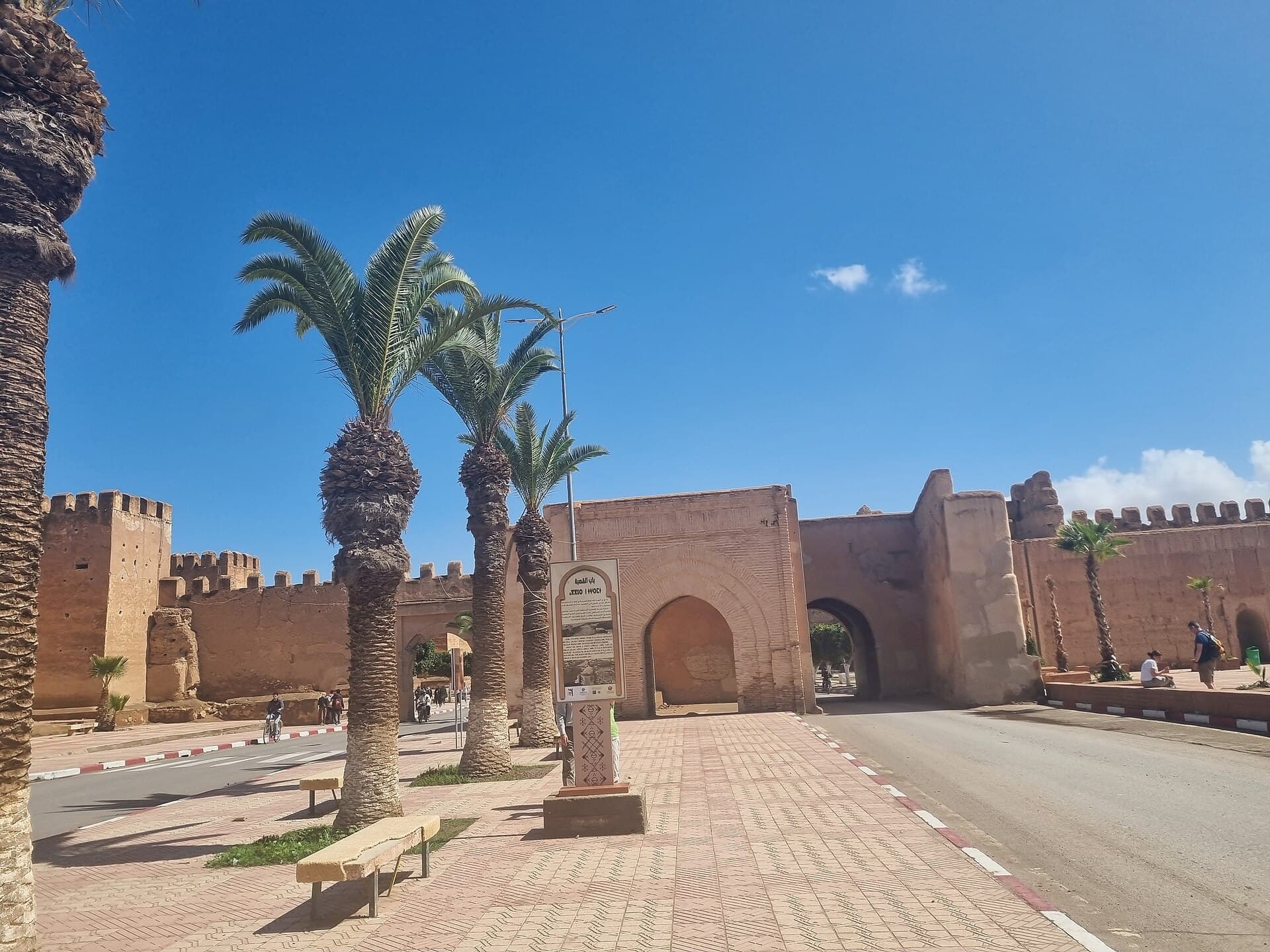 Photo of Taroudant, via Wikimedia Commons
Self-guided audio walking tour of Tan-Tan — GPS route, offline playback, story-driven narration in 32 languages.
“Where the Sahara meets the Atlantic, a nomadic soul endures.”
Not the postcards. The stories even locals don't know — whispered in your ear, right where they happened.
You're greeted by two colossal white figures at the city's edge. They are not ancient gods or forgotten rulers.
The very name of the city echoes a sound you might hear if you were drawing water from a deep well.
Beneath the desert sands and along the riverbanks, one of the oldest human-form sculptures in the world might have been found.
Discover every secret of Tan-Tan
Every address, every reveal in full — in your ear, right where it happened.
You pick your stops. You walk. The voice reveals what the others miss.


Your self-guided audio tour of Tan-Tan is ready — pick your landmarks, choose your language, and start the moment you arrive.
BuyLume has a built-in augmented-reality guide. Hold your phone up and its camera shows the street ahead of you, with a glowing arrow laid over the real view that always points to your next stop — no map to puzzle over, no wrong turns. Like everything in Lume, it works fully offline.
Tan-Tan, a city in southwestern Morocco, acts as a pivotal gateway where the vast, stony plains of the Sahara begin their dramatic shift towards the Atlantic coast. With a population of around 73,000 to 80,000, it offers a raw, unvarnished authenticity, far removed from Morocco's more polished tourist centers. The city sits in the Guelmim-Oued Noun region, approximately 330 kilometers south of Agadir, and is crossed by the Drâa River, Morocco's longest, which empties into the Atlantic nearby. This unique geographical position grants Tan-Tan a blend of desert landscapes and cooling maritime influences, making it a compelling destination for those seeking a less-traveled Moroccan experience.
Often described as a "transit city," Tan-Tan serves as a crucial link between the north and south of Morocco, attracting people due to the significant maritime activity of its port, El Ouatia, located 25 kilometers to the west. Beyond its strategic location, Tan-Tan is the cultural heartland of the Sahrawi tribes, where nomadic heritage is a living reality, evident in the local people, their clothing, and the blue chèches worn against the sun and sand. The city's identity is deeply intertwined with its history as a gathering point for nomadic desert peoples, a legacy celebrated most vibrantly during the UNESCO-recognized Tan-Tan Moussem.
The origins of Tan-Tan are rooted in necessity, emerging around a vital well known as "Hassi Tan-Tan." The city's very name is believed to be an onomatopoeic echo of a bucket hitting the water in this well ('ṭān-ṬĀN'), signifying its historical importance as a resting and watering point for nomadic desert tribes and caravans for centuries. Unlike many of Morocco's ancient cities, Tan-Tan did not begin as a fortress or a capital, but rather as a crucial stop on migration routes.
The transformation from a seasonal campsite to a permanent urban settlement began relatively recently, primarily in the 1940s. During this period, Tan-Tan was officially founded as a Spanish military outpost, becoming a strategic passage within the southern Moroccan protectorate. The region, known at various times as the Tekla zone, Tarfaya zone, or Spanish Southern Morocco, was eventually returned to Moroccan sovereignty in 1958.
Post-independence, Tan-Tan continued to evolve. In 1963, the first official Tan-Tan Moussem was held, a gathering to promote local traditions and provide a space for exchange and celebration among Saharan tribes. This festival is said to be associated with Mohamed Laghdaf, an influential Saharan leader who resisted French and Spanish colonization, and whose tomb lies near the city. However, the region's geopolitical sensitivities led to the Moussem's suspension between 1979 and 2004 due to security concerns related to the Western Sahara conflict, during which the town was raided twice by the Polisario Front guerrillas in 1979.
The late 1970s marked another significant development with the construction of a deep-water port at El Ouatia, 25 kilometers from the city. This port transformed Tan-Tan into a leading center for Morocco's fishing industry, especially for sardines, and spurred the growth of El Ouatia as a satellite city with fish processing and canning facilities. In 2004, the Tan-Tan Moussem was revived with the support of UNESCO and the Moroccan Ministry of Tourism, and in 2008, it was officially inscribed on the UNESCO Representative List of the Intangible Cultural Heritage of Humanity, recognizing its importance in preserving Sahrawi oral and artistic cultures. Today, Tan-Tan continues to be a focal point for the region, balancing its economic development with a deep commitment to its nomadic traditions and unique cultural heritage.
Tan-Tan offers a distinct blend of desert and coastal experiences. Begin your exploration in the town itself, where two enormous white dromedary statues greet you at the entrance, immediately signaling the city's deep connection to its nomadic roots. Wander through the local souks, particularly lively on Sundays, to experience the daily life of southern Morocco, with spices, Sahrawi textiles, and traditional babouches. For a deeper dive into nomadic life, visit the Musée Nomade (Nomad Museum), a small but authentic museum showcasing Saharan tents, tools, textiles, and oral histories.
Just 25 kilometers west, you will find El Ouatia, also known as Tan-Tan Plage, a coastal town that feels like a different world. Its active fishing port is a bustling hub, and the long, wild, and often empty beaches are perfect for relaxation, surf-casting, and enjoying sunsets over the Atlantic. When conditions allow, swimming is also possible.
For those interested in the region's unique natural beauty, consider day trips to the surrounding areas. Khenifiss National Park, located along the coast between Tan-Tan and Tarfaya, features Naïla, Morocco's largest coastal lagoon, a haven for thousands of migratory birds, including flamingos. East of Tan-Tan, the Ouin Medkour oasis provides a surprising patch of green amidst the arid expanses. If your visit coincides with May or June, the Tan-Tan Moussem is an unparalleled cultural experience, bringing together Saharan nomadic tribes for horse races, traditional dances like the Guedra, and vivid displays of living nomadic heritage.
The most comfortable time to visit Tan-Tan is during the winter months, from December to February, when temperatures are mild and pleasant. Spring (March to May) and autumn (September to October) also offer agreeable weather, with warm days and cooler nights, making them ideal for cultural touring and desert excursions. Summers, particularly July and August, can be hot and humid, with the possibility of sandstorms. If you plan to attend the renowned Tan-Tan Moussem, it typically takes place between May and June, though historically it has been held in December.
Tan-Tan is a more affordable destination compared to cities like Agadir or Marrakech, making it an excellent choice for budget-conscious travelers. Accommodation options are generally simple but adequate, with solid choices like the Sables d'Or, Bir Azzarane, and Al Medina in town, and a few seafront properties at Tan-Tan Plage. Getting to Tan-Tan is most commonly done by road, with a scenic drive from Agadir taking about three and a half hours, and around six hours from Marrakech. CTM and Supratours buses also serve the town from both cities. Tan-Tan has a small airport with charter connections.
While generally calm, it is advisable to be aware of your surroundings in crowded markets and to politely decline unsolicited help from overly friendly locals to avoid potential scams. For desert excursions, always go with a local guide and carry ample water. On the beaches, be mindful of the powerful Atlantic swells, especially with children. Pack breathable, loose-fitting clothing for daytime heat, but also bring a warm jacket for cooler evenings, as temperatures can drop significantly after sunset. Modest attire is recommended when walking in the city.
Tan-Tan in Korean, in Chinese or in Hebrew — and 29 more languages, every stop narrated by a native voice. The widest language range of any self-guided audio tour.
Available in: