Place Deng Xiaoping
This unassuming square at the Montargis train station holds a secret, connecting this tranquil French town to a global power.
Full story unlocks in the tour
 Christian Guthier / CC BY 2.0, via Wikimedia Commons
Self-guided audio walking tour of Montargis — GPS route, offline playback, story-driven narration in 32 languages.
“Where French grace intertwines with a foundational chapter of Chinese history.”
Not the postcards. The stories even locals don't know — whispered in your ear, right where they happened.
This unassuming square at the Montargis train station holds a secret, connecting this tranquil French town to a global power.
Before becoming a cherished French confection, the praline began with a kitchen accident.
A statue of a dog in this garden memorializes a medieval trial by combat.
Discover every secret of Montargis
Every address, every reveal in full — in your ear, right where it happened.
You pick your stops. You walk. The voice reveals what the others miss.

Your self-guided audio tour of Montargis is ready — pick your landmarks, choose your language, and start the moment you arrive.
BuyLume has a built-in augmented-reality guide. Hold your phone up and its camera shows the street ahead of you, with a glowing arrow laid over the real view that always points to your next stop — no map to puzzle over, no wrong turns. Like everything in Lume, it works fully offline.
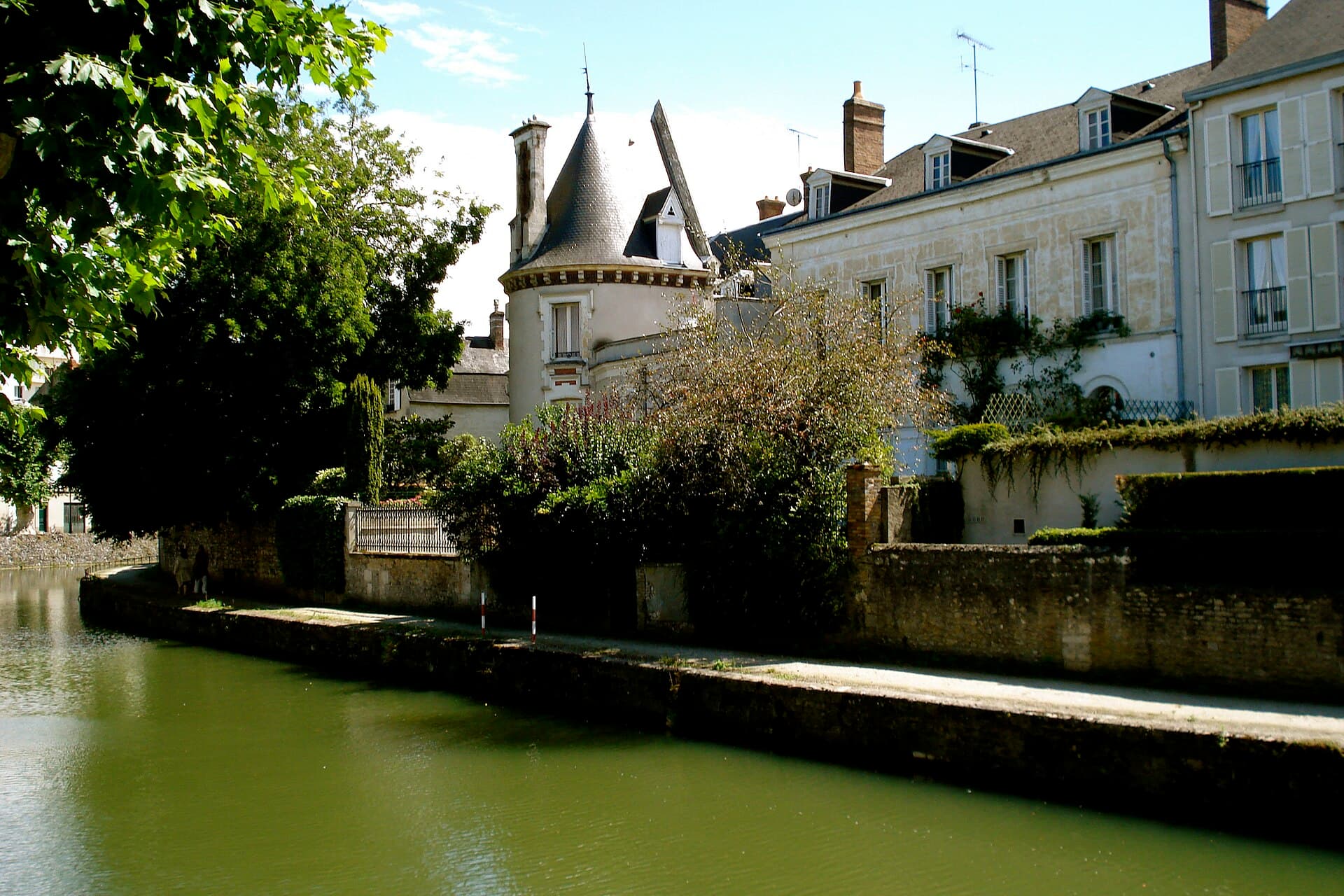
Montargis, often known as the “Venice of Gâtinais” for its extensive network of canals and 131 bridges, offers a captivating blend of natural beauty and profound history. Situated in the Loiret department of north-central France, approximately 110 kilometers south of Paris, the town unfolds around the Loing River and the Briare Canal. Its inviting waterways, framed by houses in soft, aged colors and half-timbered designs, invite unhurried walks and offer picturesque vistas. Beyond its scenic canals, Montargis reveals a surprising international connection and a significant past that belies its calm appearance.
The town's strategic location within the Gâtinais region, characterized by low-lying plains and plateaus, has shaped its historical importance. Montargis is not only a delightful destination for those seeking a quintessential French experience but also a place where unexpected narratives from centuries past and pivotal moments in global history converge.
Montargis possesses a long and layered history, with origins reaching back to Roman times. Numerous Gallo-Roman artifacts unearthed in the area are now preserved in the town's Gâtinais Museum. The town's name itself is thought to derive from "Mons arediacum," meaning "Mount of Aredius's domain," reflecting its ancient roots.
During the Middle Ages, Montargis was a fortified stronghold, initially a seat of the House of Courtenay, who constructed a château overlooking the town. It was given to the French king in 1188 and later became a royal residence in the 14th and 15th centuries. The remnants of the Château of Montargis, including a square tower and parts of the crypt and cellars, still stand today, providing a glimpse into its former life as a formidable royal dwelling. A crucial moment in Montargis's history occurred in 1427 during the Hundred Years' War, when the town successfully withstood an English siege led by the Earl of Warwick. The town's residents famously sabotaged dikes, flooding the area and drowning many of the besieging Plantagenet forces. A French force, including commanders who would later serve under Joan of Arc, eventually broke the siege, marking a decisive victory for King Charles VII.
On July 25, 1525, a devastating fire consumed much of Montargis, leaving only the church and the castle intact. Consequently, most of the buildings visible in Montargis today were erected after this date, contributing to the town's Renaissance and later architectural styles. Following this, in 1528, King Francis I granted Montargis to his sister-in-law, Renée of France, who extended protection to Protestants in the town, embracing the Reformed religion herself.
The late 19th and early 20th centuries saw industrial growth in the Montargis area, including the establishment of a Hutchinson SA rubber factory in nearby Châlette-sur-Loing, which continues to operate today. However, one of the most singular and impactful chapters in Montargis's history is its deep connection to modern China. Between 1912 and 1927, thousands of young Chinese intellectuals journeyed to France as part of a work-study program, seeking Western knowledge and techniques. Around 300 of these students settled in Montargis, drawn by its accessibility from Paris and lower pollution levels. Many of these individuals, including future Chinese leaders like Deng Xiaoping, Zhou Enlai, Cai Hesen, and Chen Yi, spent formative years working in local factories, like the Hutchinson plant, and engaging in discussions that would shape the Chinese Communist Party. This period solidified Montargis's reputation as a "cradle of New China" and has led to ongoing cultural exchanges and a dedicated Franco-Chinese Friendship Museum in the town.
Montargis invites exploration of its waterways and historic architecture. Begin with a walk through the Quartier de la Pêcherie, the old fishing district, where soft-hued facades line the canals and footbridges. There are 131 bridges and footbridges throughout the town, earning Montargis its nickname, the “Venice of Gâtinais.”
Visit the remains of the Château of Montargis, a former royal residence dating back to the 6th century, with visible elements from the 12th, 14th, and 15th centuries. Explore the Church of Sainte-Marie-Madeleine, a historical monument with parts dating to the 12th century, featuring Renaissance elements and stained-glass windows by the Lobin workshops.
Delve into the town's unique connection to China at Place Deng Xiaoping near the train station, where a monument marks the "Chinese trail." The Musée historique de l'Amitié franco-chinoise (Historic Museum on Franco-Chinese Friendship) further explores this significant historical link. For art enthusiasts, the Musée Girodet (currently undergoing renovations, with a smaller "P'tit Musée Girodet" available) houses collections of paintings, drawings, and sculptures, including works by the 18th-century painter Anne-Louis Girodet-Trioson, a native of Montargis. Do not miss the Maison de la Prasline, where you can learn about and sample the town's famous praline confectionery.
The most pleasant times to visit Montargis are generally from May to September, when the weather is most comfortable for exploring. Summers are warm, with average daily highs in July reaching around 26°C (78°F) and lows around 14°C (57°F). Spring and early autumn offer mild weather, with gardens in bloom and colorful foliage, respectively, making them ideal for unhurried walks along the canals. July is also the sunniest month, averaging 8.0 hours of sunshine per day. Outdoor events and festivals are common during the summer months. Winters are cold, with average daily highs in January around 8°C (46°F) and lows around 2°C (36°F).
Montargis is located approximately 110 kilometers (68 miles) south of Paris and is accessible by train, with connections to Nevers, Melun, and Paris. The A77 autoroute also passes west of the town. The town center is walkable, making it easy to explore the canals, bridges, and historic sites on foot. Bicycles are also a good option for navigating the town and its surroundings. The Montargis Tourist Office, located at 35 Rue Renée de France, can provide maps and suggested walking routes.
Montargis experiences a temperate climate, so pack layers, especially if visiting in spring or autumn. Summers are warm, but evenings can be cooler. Basic French phrases are appreciated, with a simple "Bonjour" going a long way in shops and restaurants. The local currency is the Euro (€).
Consider visiting the Montargis Forest, located northeast of the town, for walking trails, particularly in spring and autumn. For water activities, Lac des Closiers is a recreational area a few hundred meters southwest of the center. Montargis is generally a safe town, but it's always wise to remain vigilant in crowded areas.
Montargis in Korean, in Chinese or in Hebrew — and 29 more languages, every stop narrated by a native voice. The widest language range of any self-guided audio tour.
Available in: