Sanctuary of San Michele Arcangelo
The Archangel Michael himself consecrated this sacred cave.
Full story unlocks in the tour
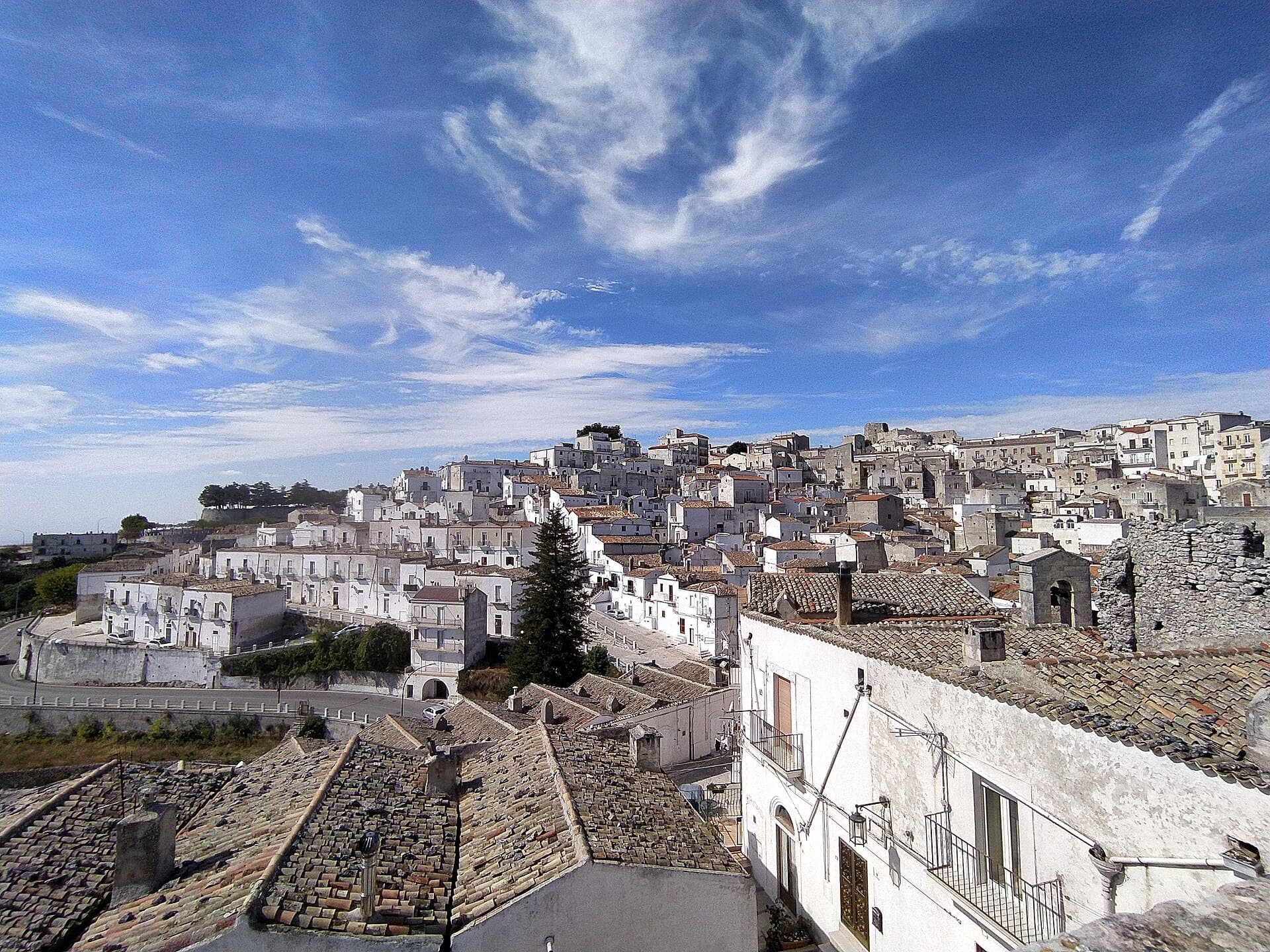 S.loiacono96 / CC BY-SA 4.0, via Wikimedia Commons
Self-guided audio walking tour of Monte Sant'Angelo — GPS route, offline playback, story-driven narration in 32 languages.
“Where earth opens to heaven, and history echoes in stone.”
Not the postcards. The stories even locals don't know — whispered in your ear, right where they happened.
The Archangel Michael himself consecrated this sacred cave.
Look closely at the cave walls, and you might spot ancient messages.
A mysterious invisible line connects this sanctuary to six other sites dedicated to St. Michael across Europe and the Middle East.
Discover every secret of Monte Sant'Angelo
Every address, every reveal in full — in your ear, right where it happened.
You pick your stops. You walk. The voice reveals what the others miss.
Your self-guided audio tour of Monte Sant'Angelo is ready — pick your landmarks, choose your language, and start the moment you arrive.
BuyLume has a built-in augmented-reality guide. Hold your phone up and its camera shows the street ahead of you, with a glowing arrow laid over the real view that always points to your next stop — no map to puzzle over, no wrong turns. Like everything in Lume, it works fully offline.
Monte Sant'Angelo, a town that feels less built and more carved from the very rock it inhabits, rises atop the Gargano promontory in Puglia. Its winding roads ascend to an altitude of 800 meters, revealing sweeping panoramas of the Gulf of Manfredonia below. This is not a coastal resort town; Monte Sant'Angelo's identity is deeply rooted in faith, a legacy palpable in its ancient stones and hushed alleys.
At its heart lies the Sanctuary of San Michele Arcangelo, a UNESCO World Heritage site and a destination for pilgrims for over 1,500 years. The town's medieval quarter, Rione Junno, is a maze of whitewashed houses and narrow passageways that invite slow exploration. Monte Sant'Angelo offers a unique blend of spirituality, history, and natural splendor, making it a compelling stop for those seeking an authentic Italian experience away from typical tourist paths.
The story of Monte Sant'Angelo begins in the late 5th century AD, around 490, with the legendary apparitions of the Archangel Michael in a natural cave on Mount Gargano. The first appearance occurred after a wealthy gentleman lost his bull, only to find it kneeling inside an inaccessible cave. When he shot an arrow at the bull, it miraculously returned and wounded him. Bishop Lorenzo Maiorano of Siponto, after three days of prayer and penance, received a vision from Archangel Michael, who requested the cave be dedicated to Christian worship. This divine consecration, according to tradition, meant the cave became a sacred church not by human hands, but by the Archangel himself.
This event transformed the remote mountain into one of Western Europe's most significant pilgrimage centers. In the 7th and 8th centuries, the Lombards, a Germanic people who had converted to Christianity, adopted St. Michael as their patron saint. They made the Gargano sanctuary their national shrine, depicting Michael on their shields and coins, further solidifying its importance. The sanctuary became a key stop on the Via Francigena, a major medieval pilgrim route stretching from Mont-Saint-Michel in France to the Holy Land.
Monte Sant'Angelo's strategic location also made it a coveted stronghold. The town itself was developed by the Normans in the 11th century. Between 1081 and 1103, it even served as the capital of a significant Norman dominion. The imposing castle, with its earliest parts dating back to the 9th century, was expanded and fortified by successive rulers, including the Normans, Swabians, and Aragonese. Emperor Frederick II notably restored the castle, using it as a residence, while the Angevins later converted it into a prison.
Over the centuries, the sanctuary continued to draw pilgrims, including popes, kings, and saints like St. Francis of Assisi. In 1656, another reputed appearance by St. Michael during a plague outbreak further enhanced the site's reputation. Today, the Sanctuary of San Michele Arcangelo is recognized as a UNESCO World Heritage Site, inscribed in 2011 as part of the "Longobards in Italy: Places of Power" series. In a rare distinction, Monte Sant'Angelo also encompasses a second UNESCO site: a portion of the ancient beech woods of the Umbra Forest, added in 2017.
Begin your exploration at the Sanctuary of San Michele Arcangelo, the spiritual heart of Monte Sant'Angelo. Descend the 86-step Angevin staircase into the sacred grotto, where the Archangel Michael is said to have appeared. Inside this natural cave, admire the Carrara marble statue of Saint Michael by Andrea Sansovino and the ancient inscriptions left by pilgrims.
Above the sanctuary, the Castle of Monte Sant'Angelo offers a glimpse into the town's defensive past. Explore its Norman towers, underground prisons, and historical halls, and climb to the Torre dei Giganti for far-reaching views of the Gargano promontory and the Gulf of Manfredonia.
Wander through the Rione Junno, the oldest part of town, characterized by its labyrinthine alleys and whitewashed houses. This medieval quarter provides a charming atmosphere for a leisurely stroll. Nearby, visit the Monumental Complex of San Pietro, which includes the ruins of the Church of San Pietro, the Baptistery of San Giovanni in Tumba (also known as the Tomba di Rotari), and the medieval Church of Santa Maria Maggiore with its Romanesque façade and frescoes.
For a deeper understanding of local life, the META – Museo Etnografico Tancredi offers insights into the arts and traditions of Monte Sant'Angelo and the Gargano region.
The best time to visit Monte Sant'Angelo is during late spring (May-June) or early autumn (September-October). During these months, the weather is pleasantly mild, making it ideal for walking the town's hilly streets and exploring the surrounding natural areas. The air in spring is often filled with the scent of citrus blossoms. While summer can be lively with local festivals, it can also be quite warm, though the town's altitude keeps it cooler than the coast. January and February are generally not recommended due to potentially cold and snowy conditions.
Monte Sant'Angelo is located in Puglia, on the Gargano promontory. The easiest way to reach the town is by car, which also allows for exploration of the wider Gargano National Park. The nearest airport is Bari Karol Wojtyła (BRI), approximately 1.5 to 2 hours away by car. While there is no train station in Monte Sant'Angelo itself, the closest is Foggia, with onward bus or taxi connections available. A half-day is generally sufficient to see the main attractions, though staying a night or two offers a more immersive experience, especially if you plan to hike in the nearby Umbra Forest or visit the Pulsano Hermitages. Wear comfortable shoes, as the old town involves a fair amount of walking uphill and on cobbled streets.
Monte Sant'Angelo in Korean, in Chinese or in Hebrew — and 29 more languages, every stop narrated by a native voice. The widest language range of any self-guided audio tour.
Available in: