St. Lamberti Church
Gaze up at the steeple of St. Lamberti Church, and you will discern three iron cages. They have endured for centuries, a stark testament to a radical chapter in Münster's past.
Full story unlocks in the tour
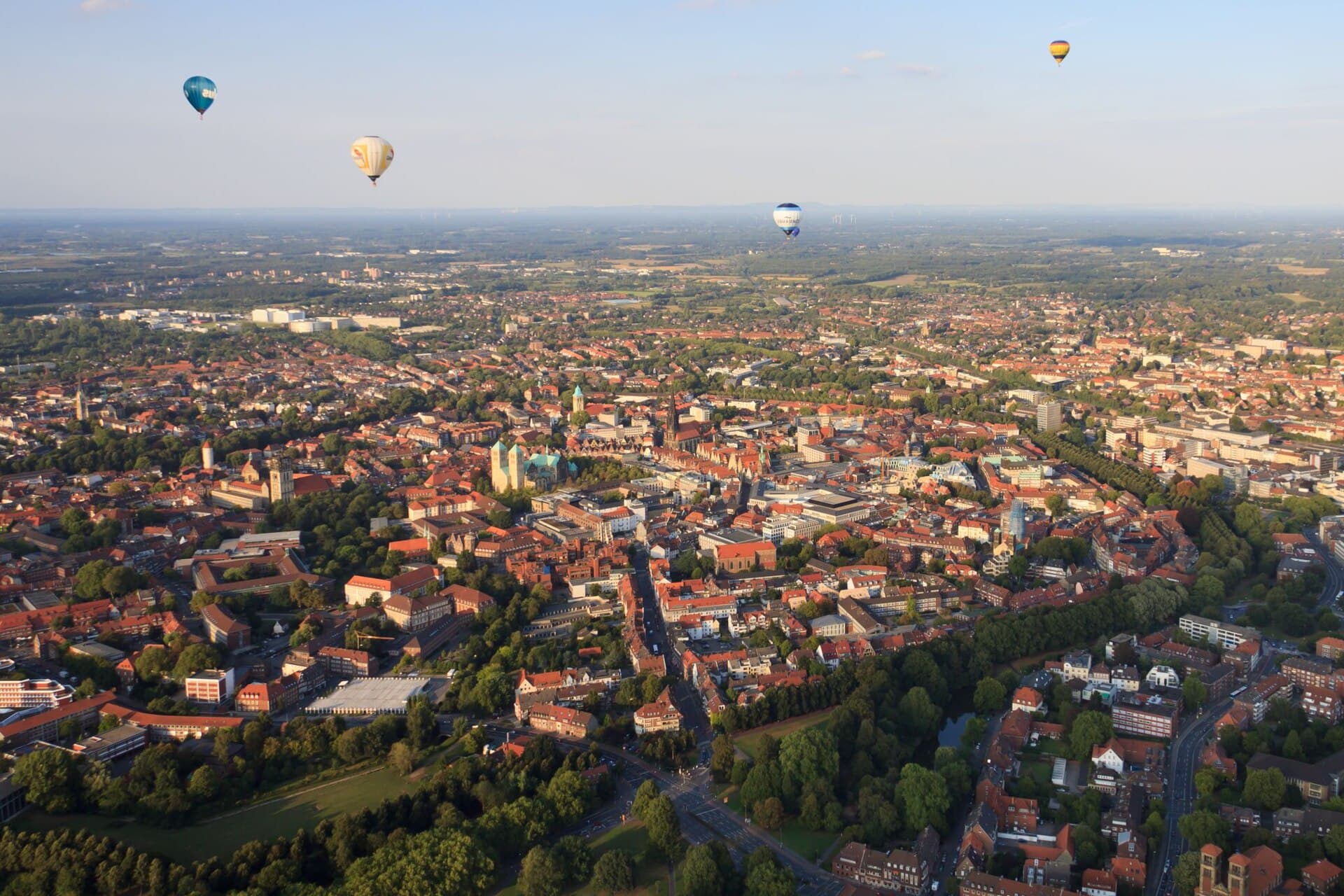 Bernhard Kils / CC BY-SA 3.0, via Wikimedia Commons
Self-guided audio walking tour of Münster — GPS route, offline playback, story-driven narration in 32 languages.
“Where bicycles outnumber people, and history breathes from gabled facades.”
Not the postcards. The stories even locals don't know — whispered in your ear, right where they happened.
Gaze up at the steeple of St. Lamberti Church, and you will discern three iron cages. They have endured for centuries, a stark testament to a radical chapter in Münster's past.
Within Münster's grand cathedral, a remarkable clock does more than simply mark the hours; it was conceived to foretell the future.
Münster is celebrated for its bicycles, yet the city's primary cycling artery possesses a surprising origin, far removed from contemporary urban planning.
Discover every secret of Münster
Every address, every reveal in full — in your ear, right where it happened.
You pick your stops. You walk. The voice reveals what the others miss.


Lume has a built-in augmented-reality guide. Hold your phone up and its camera shows the street ahead of you, with a glowing arrow laid over the real view that always points to your next stop — no map to puzzle over, no wrong turns. Like everything in Lume, it works fully offline.
Münster, a city in Germany's North Rhine-Westphalia region, gracefully merges medieval architecture with a spirited, youthful energy. Revered as Germany's "bicycle capital," it is a place where bicycles are said to outnumber residents, and an expansive network of paths makes cycling the preferred mode of transit. This university city, with its considerable student population, cultivates a relaxed yet intellectually stimulating atmosphere.
The city's historical core, substantially reconstructed after extensive devastation in World War II, displays beautifully restored gabled houses, stately churches, and lively squares. Münster occupies a central position in European history as the location where the Peace of Westphalia treaties were signed in 1648, concluding the Thirty Years' War. From its ancient pathways to its verdant spaces, Münster delivers an authentic and engaging experience that harmonizes heritage with contemporary life.
Beyond its historical significance, Münster is recognized for its dedication to sustainability and liveability, having been named the world's most liveable city in 2004. The city's cultural calendar is active, featuring events like the Münster Send funfair, the Schauraum art and culture festival, and acclaimed Christmas markets.
Münster's origins can be traced back to 793 CE when Charlemagne dispatched the Frisian missionary Liudger to evangelize the Saxons. Liudger established a monastery at Mimigernaford, a name derived from "ford over the Aa river," which is where Münster derives its name. In 805, Liudger became Münster's first bishop, and a school he founded in 797 is believed to be the precursor to the Gymnasium Paulinum, one of Germany's oldest schools. This convergence of a ford, crossroads, marketplace, and an episcopal center solidified Münster's position as a significant hub.
During the Middle Ages, Münster prospered as a prominent member of the Hanseatic League, a powerful medieval trading confederation. By the early 16th century, the city had a population exceeding 15,000 and enjoyed considerable self-governance under its territorial leader, the Bishop of Münster.
A dramatic chapter in Münster's history unfolded in 1534 with the Anabaptist rebellion. Radical Protestants, led by figures like Bernt Rothmann and Bernhard Knipperdolling, seized control of the city. They attempted to establish a polygamous "New Jerusalem," claiming all property and burning all books except the Bible. The Anabaptist rule was brief, however, and the city was recaptured a year later. The executed leaders' bodies were displayed in iron cages on the tower of St. Lamberti Church as a grim warning, where they remain to this day.
Perhaps Münster's most profound historical event was the signing of the Peace of Westphalia in 1648. This series of treaties, negotiated in Münster and neighboring Osnabrück, concluded the devastating Thirty Years' War, fundamentally reshaping the political and religious landscape of Europe. The historic Town Hall, particularly its Peace Hall, is a tangible reminder of this pivotal moment.
Münster endured extensive damage during World War II, with much of the city center obliterated. However, the city was meticulously rebuilt, preserving its medieval layout and incorporating original design elements and materials. This dedication to historical integrity, combined with a forward-thinking approach to urban planning, has shaped modern Münster. The city's post-war reconstruction prioritized bicycles and buses as primary modes of transit, leading to its current reputation as Germany's "Bicycle Capital." Today, Münster is a spirited university town, recognized for its high student population and a strong emphasis on sustainability and quality of life.
Commence your exploration at the Prinzipalmarkt, the historic pulse of Münster. This arcaded street is lined with beautifully restored gabled merchant houses, boutiques, and cafes, offering a window into the city's medieval past. The Historic Town Hall, with its renowned Peace Hall where the Peace of Westphalia was signed, is an essential stop.
Dominating the Domplatz is St. Paulus Dom (Münster Cathedral), a Romanesque-Gothic architectural triumph. Be sure to observe its intricate 16th-century astronomical clock, which performs a daily spectacle at noon. Just a short walk away, St. Lamberti Church commands attention with its Gothic spires and the three iron cages suspended from its tower, a chilling historical artifact.
For a different rhythm, cycle or stroll along The Promenade, a car-free green belt that encircles the old town upon the former city walls. It is an ideal way to immerse yourself in Münster's cycling culture. The Aasee, an urban lake just a 15-minute walk from Prinzipalmarkt, provides opportunities for repose, boat rentals, and lakeside cafes. Here you can also find the Allwetterzoo Münster and the LWL-Museum of Natural History with Planetarium.
Art enthusiasts can visit the Pablo Picasso Museum of Graphic Art, the sole museum globally dedicated exclusively to Picasso's graphic works. The Schloss Münster, a Baroque palace that now serves as the administrative core of the University of Münster, is another architectural highlight, with its formal gardens and the adjacent Botanical Garden.
The most pleasant times to experience Münster are during spring and early autumn (mid-May to mid-September) when the weather is temperate, and the city is particularly animated. Summer months, especially July and August, are generally warm, though occasional rain is possible. During the summer holidays, many students depart, rendering the city quieter. Winter is a calmer period, but December is especially captivating with its Christmas markets. June often proves to be the sunniest month.
Münster is well-connected by train, with regular Deutsche Bahn services from major German cities. Münster Osnabrück International Airport (FMO) is approximately 30 minutes from the city center, offering regional and limited international flights. The A1 and A43 motorways provide straightforward access if driving, but parking in the old town is restricted.
Once in Münster, the city is exceptionally bicycle-friendly, with an extensive network of cycle paths. Renting a bicycle is a favored and efficient method of exploration. Public transport, primarily buses, offers a comprehensive network for navigating the city. The MünsterCard is a convenient option for visitors, often including bike rental and public transport, alongside museum entry. The city center is also very walkable, especially the old town area, though some parts feature ancient pathways.
For accommodation, options span from budget-friendly hostels to mid-range hotels and luxurious stays. Students can discover affordable housing through Studierendenwerk Münster.
Münster in Korean, in Chinese or in Hebrew — and 29 more languages, every stop narrated by a native voice. The widest language range of any self-guided audio tour.
Available in: