The Old Tower (La Vieille Tour)
Paimpol's most prominent ancient structure stands in a surprising location.
Full story unlocks in the tour
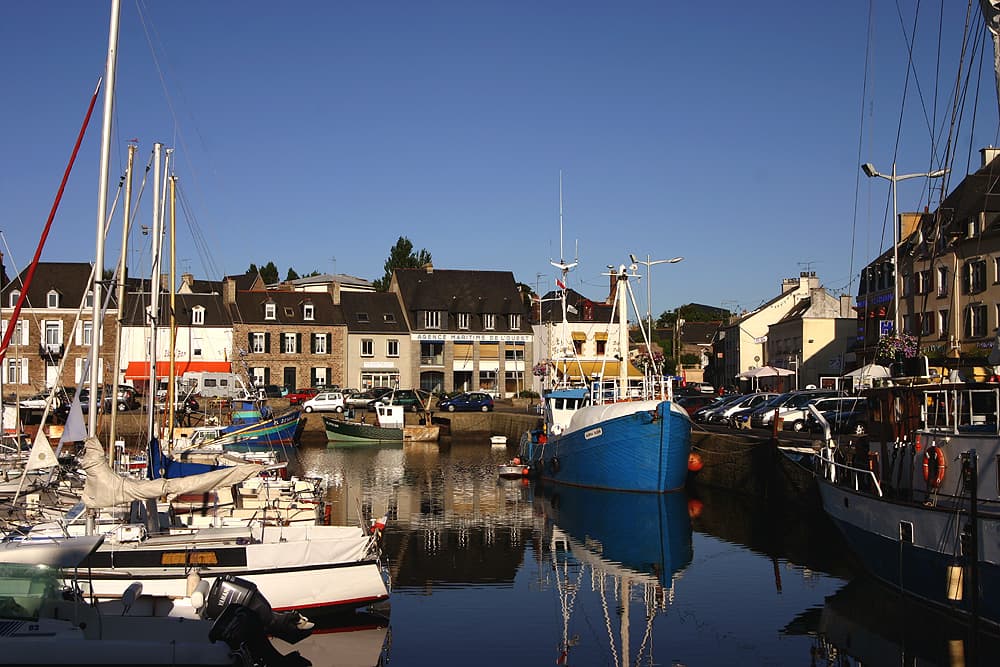 Rüdiger Wölk This photo was taken by Rüdiger Wölk. Please credit this photo Rüdiger Wölk, Münster. View all photos (large page) of Rüdiger Wölk I would also appreciate an email to rudiger.wolk@gmail.com with details of use. Für Hinweise auf Veröffentlichungen (rudiger.wolk@gmail.com) oder Belegexemplare bin ich Ihnen dankbar. / CC BY-SA 2.5, via Wikimedia Commons
Self-guided audio walking tour of Paimpol — GPS route, offline playback, story-driven narration in 32 languages.
“Where Breton spirit meets the Atlantic's gentle breath.”
Not the postcards. The stories even locals don't know — whispered in your ear, right where they happened.
Paimpol's most prominent ancient structure stands in a surprising location.
A particular house on this street holds a long and unexpected history.
The active harbor once offered an unusual pedestrian shortcut.
Discover every secret of Paimpol
Every address, every reveal in full — in your ear, right where it happened.
You pick your stops. You walk. The voice reveals what the others miss.


Your self-guided audio tour of Paimpol is ready — pick your landmarks, choose your language, and start the moment you arrive.
BuyLume has a built-in augmented-reality guide. Hold your phone up and its camera shows the street ahead of you, with a glowing arrow laid over the real view that always points to your next stop — no map to puzzle over, no wrong turns. Like everything in Lume, it works fully offline.
Paimpol, a captivating coastal town in Brittany's Côtes-d'Armor, blends maritime heritage with the quiet beauty of the sea. Known as the "City of Icelanders" (Cité des Islandais), Paimpol's identity is deeply woven into its historic role as a significant cod fishing port. Its animated harbor, now graced by colorful fishing boats and pleasure yachts, remains the town's beating heart, inviting wanderers to stroll along its quays and savor the freshest seafood.
The town's allure extends beyond the waterfront into a labyrinth of narrow lanes lined with half-timbered houses and venerable stone buildings. Paimpol serves as a gateway to compelling natural attractions, including the car-free Île de Bréhat, often called the "Island of Flowers," and the dramatic sea cliffs of the Côte de Goëlo. Whether drawn to its seafaring past, its lively culture, or the quiet appeal of the Breton coast, Paimpol promises a memorable sojourn.
The name "Paimpol" originates from the Breton words "pen" (extremity) and "poull" (lake or pond), reflecting its historical landscape as a peninsula marked by numerous ponds that would flood during high tides.
Paimpol's existence as a port reaches back to at least the 12th century, with early indications of maritime activity preceding the 18th century. During the Hundred Years' War, it functioned as a base for privateers. The town's true maritime prosperity, however, commenced in the 17th century with ships embarking for Newfoundland. By the 18th century, Paimpol engaged in trade of cider, salt, and oil with England, and its merchants prospered through the Bordeaux wine trade and the abundant fishing grounds of Newfoundland.
The mid-19th century marked a pivotal moment for Paimpol. In 1852, shipowner Louis Morand initiated cod fishing expeditions to Iceland, inspired by the success of Dunkirk fishermen. This undertaking proved immensely lucrative, establishing Paimpol as France's foremost port for offshore fishing. By 1895, a fleet of 82 two-masted schooners would depart annually for the arduous six- to eight-month voyages to the Icelandic fishing banks. These expeditions, while economically vital, exacted a heavy toll, with over 2,000 sailors and nearly 100 boats lost between 1852 and 1935 due to severe conditions, storms, and fogs. The era of Icelandic cod fishing, immortalized in Pierre Loti's 1886 novel Pêcheur d'Islande, gradually receded after 1914, with the last schooner sailing in 1935.
The expansion of Paimpol's fishing fleet necessitated substantial port development. The first basin was constructed in 1878, utilizing stones from the old castle of Bréhat, and a second basin was completed in 1902 to accommodate the increasing number of schooners. Following the decline of cod fishing, the port diversified its activities to include general fishing and pleasure boating. Today, Paimpol's economy is largely sustained by oyster farming and tourism. The town has embraced its past, with the Musée de la Mer (Sea Museum) dedicated to its seafaring history, including the cod fishing expeditions to Iceland. Paimpol also proudly holds the "Ville et métiers d'art" (City of Art and Crafts) label, recognizing its flourishing arts scene and numerous galleries.
Begin your exploration at Paimpol's active harbor, the town's lively core, where colorful fishing boats and pleasure yachts create a memorable scene. From here, wander into the Old Quarter, a delightful network of narrow lanes lined with historic half-timbered and stone houses. Notable streets include Rue des Huit-Patriotes and Place du Martray, where you can admire 15th and 16th-century architecture.
Be sure to visit the Old Tower (La Vieille Tour) in Place de Verdun, the solitary bell tower of a former 18th-century church. For a deeper understanding of Paimpol's maritime past, explore the Musée de la Mer (Sea Museum), housed in a former cod-drying building, which chronicles the town's fishing heritage. The Church of Notre Dame de Bonne Nouvelle, completed in 1914, also merits a visit.
Beyond the town center, the magnificent Abbaye de Beauport, a remarkably preserved 13th-century monastic complex, offers a glimpse into medieval history and sweeping sea views. A brief ferry ride will transport you to the car-free Île de Bréhat, known as the "Island of Flowers," with its unique microclimate and appealing landscapes perfect for walking or cycling.
For expansive coastal views, journey to Pointe de Guilben, a rugged promontory offering striking vistas of the sea and rocky coves. Paimpol also serves as an excellent base for exploring the wider region, including the dramatic Pink Granite Coast and the medieval town of Dinan.
Paimpol offers something throughout the year, but the most agreeable time for outdoor pursuits and lively celebrations is from late spring to early autumn, specifically from late June to early September. During these months, temperatures are comfortable, ranging from 18°C to 21°C (64°F to 70°F), and rainfall is at its lowest. Summer brings an animated atmosphere with numerous events, including the biennial Festival du Chant de Marin (Sea Shanty Festival) in August, which celebrates the town's seafaring culture with music and old ships.
Spring and early autumn provide milder temperatures and fewer crowds, creating ideal conditions for exploring the coastal paths and enjoying the sublime light for photography. While winter is quieter, it offers a different kind of appeal with a cozy atmosphere and dramatic stormy landscapes.
Paimpol is situated in the Côtes-d'Armor department of Brittany, France. The town center is easily navigated on foot, with many attractions clustered around the harbor and old quarter. For exploring beyond the immediate town, such as the Abbaye de Beauport or Île de Bréhat, a car can be beneficial, though ferries to Bréhat depart from Pointe de l'Arcouest, a short drive away. Ample parking is available near the harbor and town center, often free or reasonably priced, but it is wise to arrive early during peak season or on market days.
Paimpol hosts a weekly market on Tuesday mornings, a lively event showcasing local products. The town is also recognized for its local specialties, including the Paimpolaise oyster and the coco de Paimpol, a semi-dry bean with AOC status. Dining options span from seafood restaurants along the harbor to crêperies and specialty shops offering local cheeses and charcuterie. The local Tourist Office is open year-round and can provide further information and assistance for your visit.
Paimpol in Korean, in Chinese or in Hebrew — and 29 more languages, every stop narrated by a native voice. The widest language range of any self-guided audio tour.
Available in: