Diocesan Museum in Pelplin
Among Pelplin's treasures rests a book that altered the course of human knowledge, yet only a handful of its kind endure.
Full story unlocks in the tour
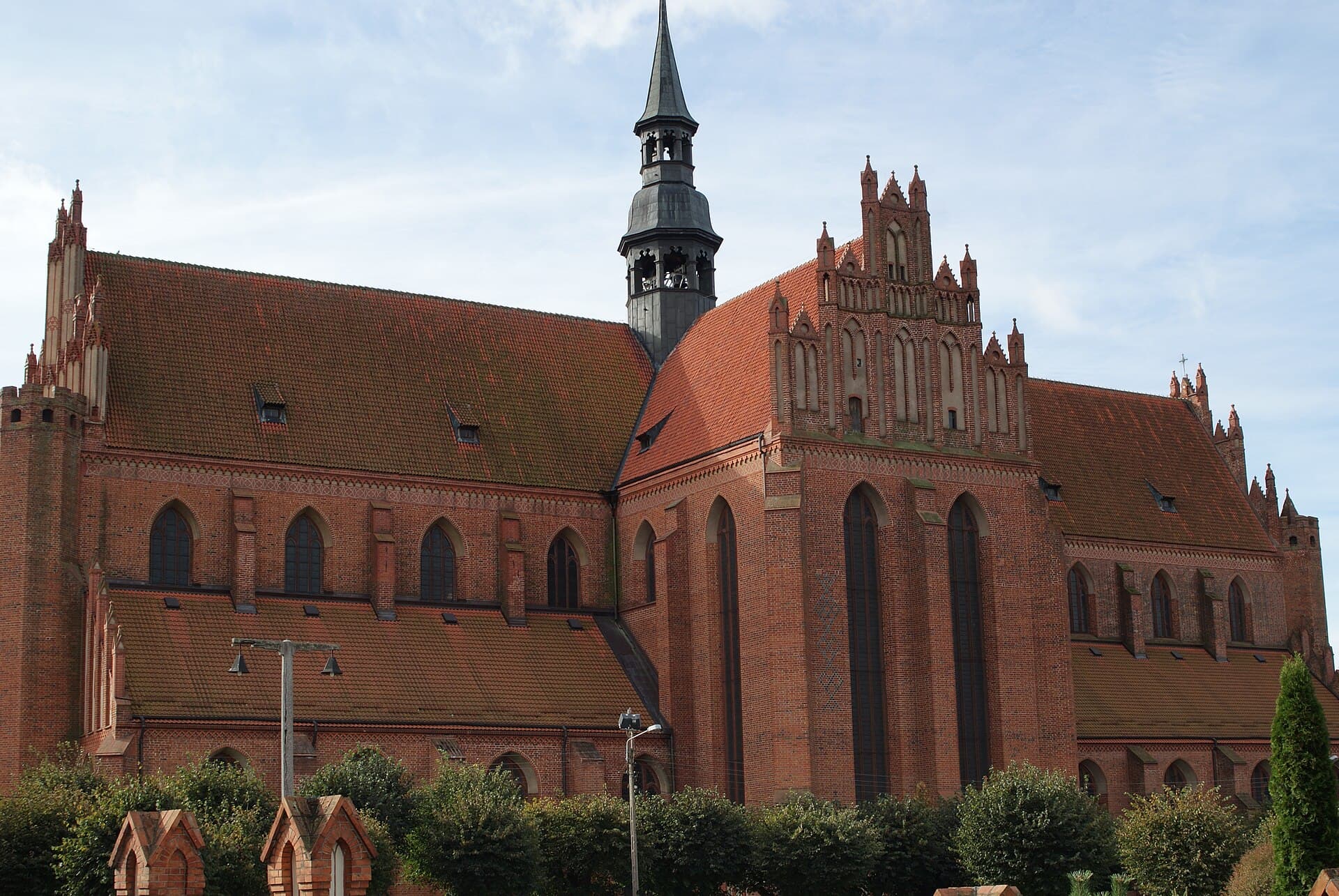 Dawid Pryba / CC BY-SA 3.0 pl, via Wikimedia Commons
Self-guided audio walking tour of Pelplin — GPS route, offline playback, story-driven narration in 32 languages.
“Where Gothic grandeur meets quiet reflection, and ancient secrets murmur from brick and parchment.”
Not the postcards. The stories even locals don't know — whispered in your ear, right where they happened.
Among Pelplin's treasures rests a book that altered the course of human knowledge, yet only a handful of its kind endure.
Local lore suggests the site for Pelplin's grand abbey was not chosen by the monks themselves, but by a remarkably determined animal.
The river flowing through Pelplin carries a legend of a devil's thwarted attempt to demolish the magnificent cathedral.
Discover every secret of Pelplin
Every address, every reveal in full — in your ear, right where it happened.
You pick your stops. You walk. The voice reveals what the others miss.
Your self-guided audio tour of Pelplin is ready — pick your landmarks, choose your language, and start the moment you arrive.
BuyLume has a built-in augmented-reality guide. Hold your phone up and its camera shows the street ahead of you, with a glowing arrow laid over the real view that always points to your next stop — no map to puzzle over, no wrong turns. Like everything in Lume, it works fully offline.
Pelplin, a town in northern Poland within the Pomeranian Voivodeship, is a place where centuries of history are etched into its brick Gothic architecture and serene landscapes. Known primarily for its magnificent Pelplin Cathedral, a former Cistercian abbey and one of Poland's grandest Gothic churches, the town offers a profound journey into religious heritage and medieval life.
Beyond its architectural grandeur, Pelplin is deeply intertwined with the Roman Catholic Diocese of Pelplin, serving as its seat since 1824. The town's tranquil atmosphere, set along the Wierzyca River, provides a contemplative escape, inviting visitors to explore its deep past and uncover the enduring legacy of the Cistercian monks who shaped its identity.
## From Cistercian Roots to Diocesan Seat Pelplin's story begins in 1258, when Cistercian monks, initially from Doberan in Mecklenburg, were settled in the nearby village of Pogódki by Duke Sambor II. However, it was Duke Mestwin II who, in 1274, granted them the lands around Pelplin, leading to their relocation two years later to the picturesque valley of the Wierzyca River. Here, the "gray monks" began constructing their impressive abbey complex, with the monumental Gothic cathedral taking nearly 250 years to complete, finally finished around 1557.
The abbey flourished, receiving land grants from various Polish dukes and kings. However, its peace was not unbroken. The monastery endured attacks by the Hussites in 1433, was plundered during the Thirteen Years' War (1454-1466), and faced an epidemic in 1474 that nearly wiped out the convent. During the Reformation, King Sigismund I the Old intervened to prevent the secularization of the order's lands.
The political landscape shifted dramatically after the First Partition of Poland in 1772, when Pelplin came under Prussian rule. Prussian King Frederick II secularized church property, and in 1823, the Cistercian order was formally dissolved by Frederick William III. This could have spelled ruin for the magnificent complex. However, a pivotal decision by Pope Pius VII to merge the Chełmno diocese with the Pomeranian archdiocese, and the subsequent choice of Pelplin as the new episcopal seat in 1824, saved the abbey from degradation. The former Cistercian church became the Cathedral Basilica of the Assumption, and the monastery buildings were repurposed to house the theological seminary and the Collegium Marianum. Pelplin officially received town rights in 1931.
World War II brought immense suffering to Pelplin. Gdańsk Pomerania was annexed by Nazi Germany, and the Polish population faced mass arrests, repressions, and executions, with many Pelplin priests among the victims. Despite the wartime devastation to some of its elements, the Basilica itself survived without major damage, though its stained-glass windows were destroyed during artillery bombardments. In 1992, the Diocese of Chełmno was renamed the Diocese of Pelplin by Pope John Paul II, solidifying the town's ecclesiastical importance. Today, the post-Cistercian complex is recognized as a Historic Monument of Poland.
The undeniable focal point of Pelplin is the Cathedral Basilica of the Assumption of the Blessed Virgin Mary, a monumental brick Gothic structure and the second-largest brick church in Poland. Step inside to marvel at its impressive stellar, net, and crystal vaults, and discover 23 altars, including the towering, six-story main altar with its Baroque splendor and paintings by Hermann Hahn. Do not miss the intricately carved Gothic stalls from the 15th century, the Baroque pulpit depicting Samson, and the grand 17th-century organ.
Adjacent to the cathedral, the former monastery buildings now house the Diocesan Museum. This museum is a repository of religious art, ancient manuscripts, and Gothic sculptures, but its most cherished possession is one of the only 49 surviving copies of the 15th-century Gutenberg Bible—the sole copy in Poland. Explore the cloisters with their 15th-century wall paintings and the historic refectory.
For a different perspective, visit John Paul II Hill (Góra Papieska), located just 2 kilometers from the town center. It offers a peaceful walk or bike ride and commemorates Pope John Paul II's visit in 1999. The Diocesan Tourist Information Centre, located in the old gate building, is an excellent starting point for your visit, offering maps and assistance. If your visit aligns, experience the medieval charm of the annual Cistercian Fair in September.
The most pleasant time to visit Pelplin for warm-weather activities extends from mid-June to late August. During these months, temperatures are comfortable, typically ranging from 56°F to 77°F (13°C to 25°C). July generally brings the clearest skies, with less cloud cover. However, prepare for occasional rainy days during summer. Late spring (May) and early autumn (September) also offer agreeable weather, with fewer crowds. The Cistercian Fair, a significant cultural event, takes place on the third weekend of September.
Pelplin is situated in northern Poland, in the Tczew County, Pomeranian Voivodship, approximately 4 km from the A1 motorway. The town is accessible by train, with the train station located near Pub Klimat, one of the few pubs in town. The main attractions, such as the Pelplin Cathedral and Diocesan Museum, are within easy walking distance of each other. The Diocesan Tourist Information Centre, located in the old gate building of the former abbey, provides professional assistance, guides, maps, and information.
Admission to the Cathedral Basilica costs 15 PLN for a regular ticket and 12 PLN for a reduced ticket. A combined ticket for the Cathedral Basilica and Diocesan Museum is available for 20 PLN. Guided tours in Polish cost 80 PLN, while tours in English or German are 100 PLN. The Basilica is open daily except Mondays. While Pelplin is a smaller town, it offers a tranquil experience.
Pelplin in Korean, in Chinese or in Hebrew — and 29 more languages, every stop narrated by a native voice. The widest language range of any self-guided audio tour.
Available in: