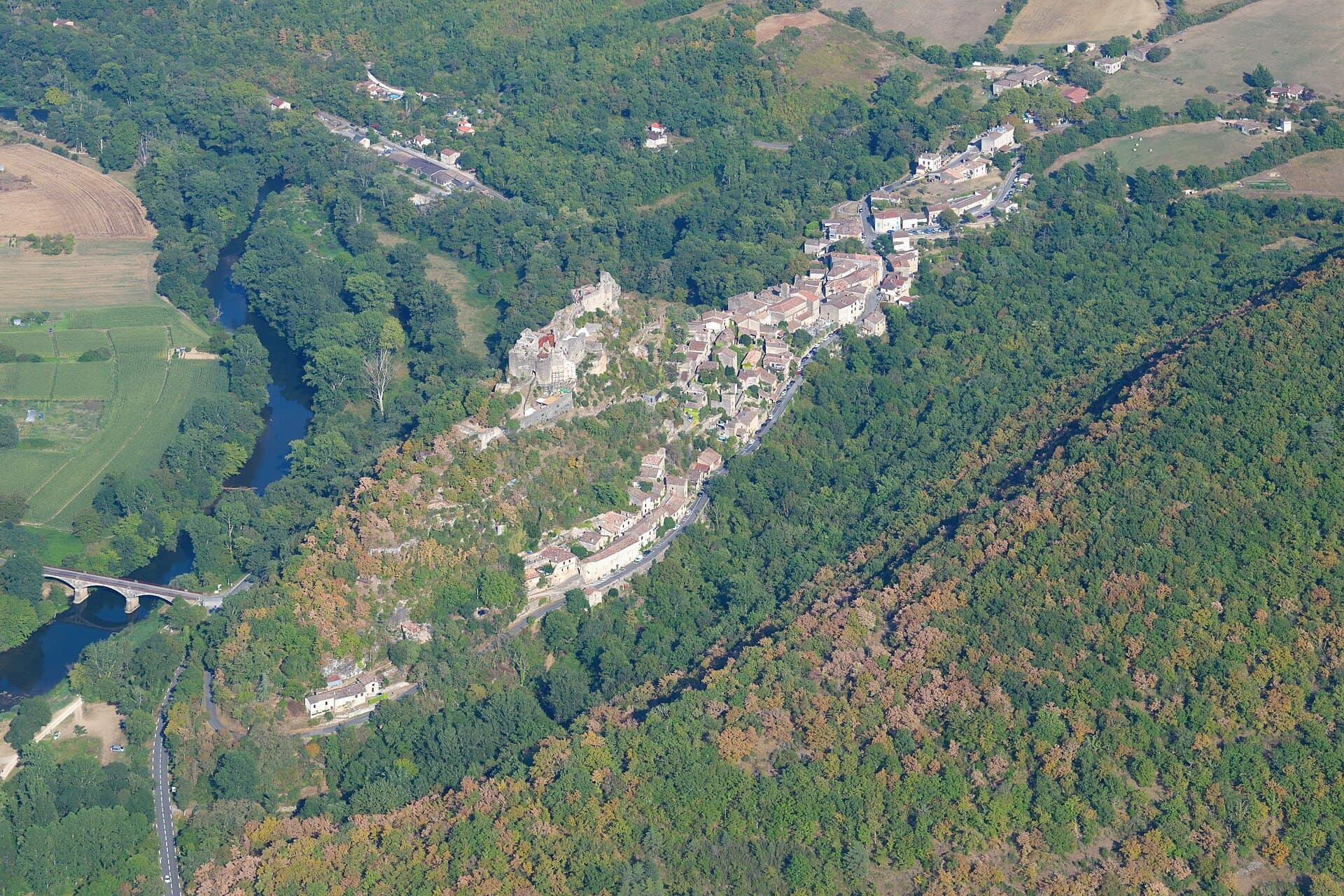
The formidable Château de Penne, a sentinel over the Aveyron gorges, was abandoned for centuries. But its resurrection holds a surprising detail about its former residents.
Carsten Steger / CC BY-SA 4.0, via Wikimedia CommonsPenne
Self-guided audio walking tour of Penne — GPS route, offline playback, story-driven narration in 32 languages.
“Where medieval stones tell tales of Cathars, kings, and enduring spirit.”
Penne, as no one tells it.
Not the postcards. The stories even locals don't know — whispered in your ear, right where they happened.
This hilltop village, known for its medieval character, has a name rooted in something surprisingly literal.
The village's Saint-Catherine Church, part of its ancient defenses, once lost a crucial element during a tumultuous period. Yet, it was eventually recovered.
Discover every secret of Penne
Every address, every reveal in full — in your ear, right where it happened.
You pick your stops. You walk. The voice reveals what the others miss.
How long do you have in Penne?
Your self-guided audio tour of Penne is ready — pick your landmarks, choose your language, and start the moment you arrive.
BuyThe story of Penne
Penne, a captivating village in the Tarn department of Occitanie, France, rises dramatically from a rocky spur overlooking the Aveyron gorges. Often called 'the eagle's nest' or 'the citadel of vertigo,' Penne's medieval fortress and village are intertwined, forming a 'castrum' that has defied gravity and time. Its narrow, winding streets, lined with houses of blond stone and half-timbering, evoke a sense of stepping into another era.
This authentic and poetic place, though not officially designated one of 'The Most Beautiful Villages of France,' offers a genuine glimpse into medieval life. It's a destination where history is palpable, from the ruins of its commanding castle to the preserved architecture of its village heart. Penne's strategic location, at the crossroads of the Albigeois, Rouergue, and Quercy regions, near the Grésigne forest and Gaillac vineyards, has shaped its tumultuous past and contributes to its wild, unspoiled environment.
Whether exploring the medieval fortress, strolling through artisan workshops, or simply taking in the panoramic views of the Aveyron Gorges and Grésigne Forest, Penne offers a memorable experience. It's a place where children and adults alike can engage with history, making it an ideal half-day visit with plenty to see in the surrounding area.
From Ancient Roots to Medieval Stronghold
The history of Penne stretches back to ancient times, with excavations revealing traces of Gallo-Roman settlements. The name 'Penne' itself is of Celtic origin, meaning 'ridge' or 'spur,' a fitting description for its elevated position. The first recorded mention of a castle in Penne dates to 825 AD, during the reign of Pepin, King of Aquitaine, highlighting its early strategic importance.
Catharism and Crusades
Throughout the Middle Ages, Penne was a focal point of military and political activity. In the early 13th century, it became embroiled in the Albigensian Crusade, a campaign against the Cathar heresy. The lords of Penne stood firm against Simon de Montfort, a key crusader leader, and the castle was seized and reclaimed multiple times. Cathar sympathizers found refuge within its walls, and the castle's contested status underscored its role in the regional power struggles of the time.
Hundred Years' War and Wars of Religion
The castle's strategic importance continued through the Hundred Years' War, during which it changed hands repeatedly between English and French rule. The village and castle suffered greatly during these conflicts. Later, in the 16th century, Penne became a Protestant stronghold and endured a terrible siege in 1562 during the French Wars of Religion. The castle and village were left in ruins, and some defenders were tragically slaughtered.
Abandonment and Rebirth
After centuries of conflict, the Château de Penne was dismantled in 1586 and lay abandoned for approximately 400 years. In a pragmatic move, Louis XIII authorized the inhabitants to use the castle's stones to rebuild their own homes. It wasn't until the 20th century that the castle's cultural and historical value was recognized, leading to its designation as a historic monument in 1902. Extensive restoration efforts began in the 1980s and continue today, with the castle reopening to the public in 2010. These ongoing projects allow visitors to witness medieval building techniques firsthand and explore a new museum space within the fortress, showcasing artifacts and the site's architectural evolution.
The most striking feature of Penne is its medieval fortress, the Château de Penne. Situated dramatically on a rocky ridge, the castle offers panoramic views of the Aveyron Gorges, the Grésigne Forest, and the Gaillac vineyards. Visitors can explore its impressive ruins, including the keep, gatehouse, and ramparts, and learn about its history through an interpretation trail. A new museum space within the fortress, opened in June 2024, displays medieval objects, models, and a film detailing the site's history and ongoing restoration.
Beyond the castle, the village itself invites exploration. Wander through its narrow, winding streets, which have largely retained their medieval character with half-timbered houses, ancient grain measures, and mullioned windows. The Gothic-style Sainte-Catherine Church, integrated into the village's defensive system, is also worth a visit. Penne is also home to various artisan workshops, where you can observe glassblowers, weavers, and jewelers at work, particularly from July to August. For those seeking more, the nearby Gorges de l'Aveyron offer opportunities for outdoor activities, and several other 'Most Beautiful Villages of France,' such as Bruniquel and Puycelsi, are a short drive away.
Penne is best visited during the months of May, June, July, August, September, and October, when the weather is most favorable. Daytime temperatures during this period typically range from 18°C to 29°C (64°F to 84°F), offering pleasant conditions for exploring. July is the sunniest month, with an average of 8.4 hours of daily sunshine. While there can be some rainfall during these months, it generally consists of light showers. The Château de Penne is typically open from February until mid-November, with medieval games and costumed workers often present in July and August, offering activities for children.
Penne is a small village, so comfortable walking shoes are essential for navigating its steep, stone streets. Parking is available at the bottom of the hill, from where you can walk through ancient gates to reach the village center and the castle. While Penne itself can be explored in half a day, consider allocating more time to enjoy the surrounding area, including the Grésigne Forest and other medieval villages. The village has a few shops and cafés. For a more in-depth visit, check the Château de Penne's website for specific opening hours, guided tours, and special events, especially if traveling with children. The nearest major airport is Toulouse, approximately an hour's drive south.
- What is the main attraction in Penne?
- The main attraction is the Château de Penne, a medieval fortress dramatically situated on a rocky spur overlooking the Aveyron gorges.
- Is Penne suitable for visitors with mobility issues?
- The village has steep, stone streets that may be challenging for individuals with mobility issues or strollers.
- Are there any artisan shops in Penne?
- Yes, Penne is known for its art workshops, with genuine creators offering weaving, jewelry, leather goods, and blown glass. Some workshops are open year-round, while others are seasonal.
- What is the best way to get to Penne?
- Penne is located in the Tarn department, north-east of Toulouse. It is accessible by car, with parking available at the base of the village.
- What kind of events take place in Penne?
- Penne hosts various medieval-themed events, especially in July and August, including archery contests and demonstrations of medieval life. The village also has a festival on the first weekend of August.
- Is there a fee to enter the Château de Penne?
- Yes, there is an entrance fee to visit the Château de Penne, which is considered worthwhile for exploring the ruins and enjoying the views.