Scone Palace
For centuries, Scottish monarchs were crowned upon a legendary stone at Scone Palace. Yet, the stone you encounter there today is not the original.
Full story unlocks in the tour
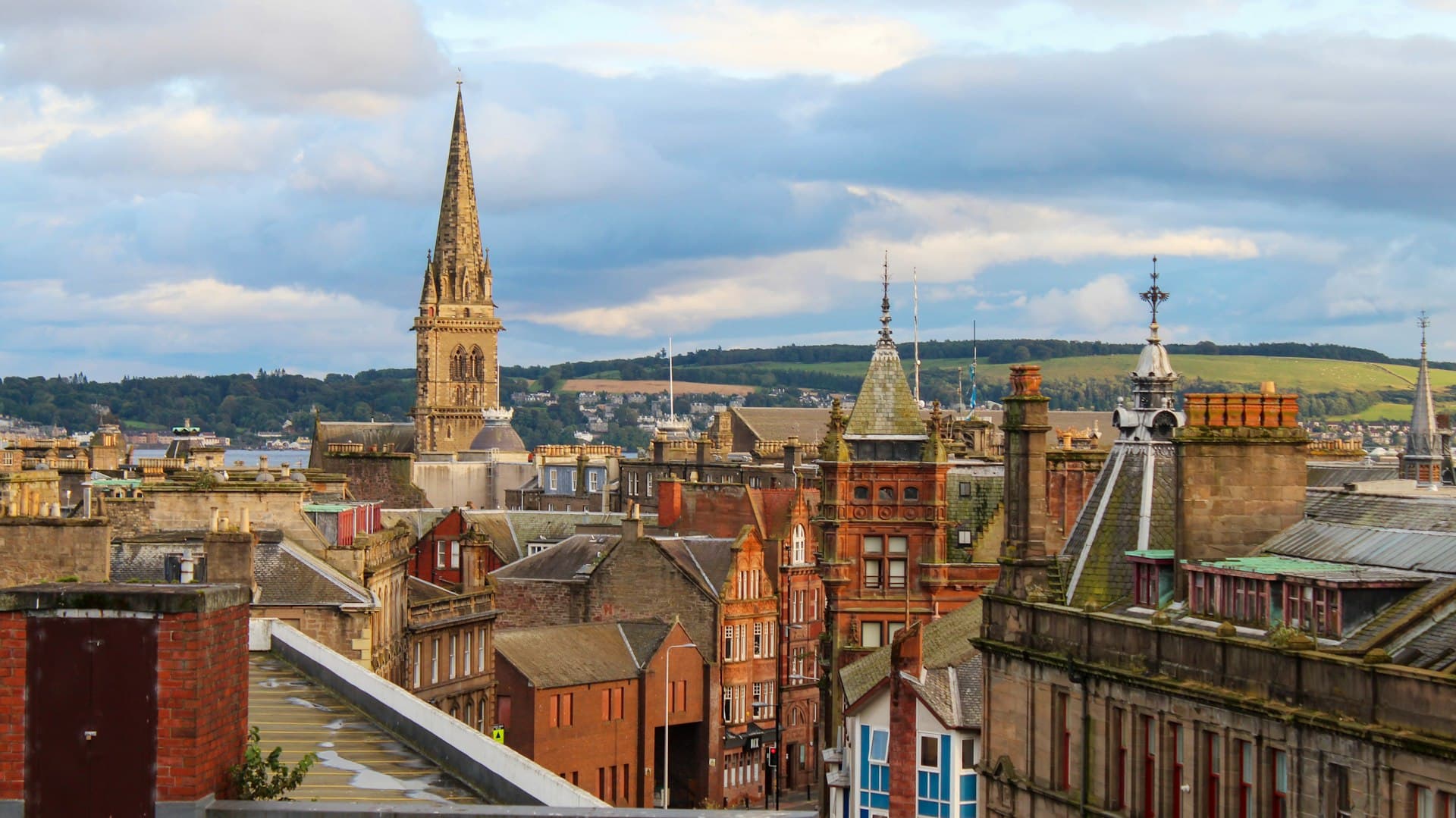 Photo of Dundee, via Wikimedia Commons
Self-guided audio walking tour of Perth — GPS route, offline playback, story-driven narration in 32 languages.
“Where ancient kings were crowned and histories whisper along the Tay.”
Not the postcards. The stories even locals don't know — whispered in your ear, right where they happened.
For centuries, Scottish monarchs were crowned upon a legendary stone at Scone Palace. Yet, the stone you encounter there today is not the original.
This 15th-century castle holds a romantic, albeit risky, tale of a forbidden love affair.
Beneath the tranquil expanse of North Inch Park lies the site of a brutal medieval clan battle.
Discover every secret of Perth
Every address, every reveal in full — in your ear, right where it happened.
You pick your stops. You walk. The voice reveals what the others miss.


Your self-guided audio tour of Perth is ready — pick your landmarks, choose your language, and start the moment you arrive.
BuyPerth, often called 'The Fair City,' is a central Scottish city gracefully situated on the banks of the River Tay. Once the ancient capital of Scotland, Perth has a complex history that stretches back to prehistoric times, with evidence of Mesolithic hunter-gatherers and Neolithic standing stones in the area. Its strategic location as the lowest crossing point of the Tay made it a significant hub for trade, a frequent royal residence, and a focal point for many pivotal moments in Scottish history.
Today, Perth serves as the administrative center of the Perth and Kinross council area and is known as the 'Gateway to the Highlands.' It blends centuries of heritage with a spirited modern identity, offering a diverse array of cultural experiences, independent shops, and award-winning restaurants. The city's elegant Georgian townhouses, paved lanes, and medieval spires stand testament to its enduring past, while its two expansive public parks, the North and South Inch, provide ample green space along the riverside.
## From Ancient Settlements to Royal Capital Perth's story begins long before recorded history, with evidence of Mesolithic hunter-gatherers inhabiting the area and Neolithic standing stones dating back to 4000 BC. The city's name itself, derived from a Pictish word for 'wood' or 'copse,' hints at its ancient, forested landscape. Situated on a natural mound above the River Tay's flood plain, the early settlement was strategically positioned for both defense and access to the river.
By the 12th century, Perth was a well-established burgh, gaining royal burgh status in 1210. For nearly 300 years, until around 1452, Perth served as the capital of Scotland, making it a frequent royal residence and a center of government. Nearby Scone Palace was the traditional crowning place for Scottish kings, including figures like Macbeth and Robert the Bruce, on the legendary Stone of Destiny. This royal connection significantly enhanced Perth's early importance.
## Sieges, Sermons, and Uprisings Perth's strategic location also made it a target during conflicts. It was taken by Edward I of England in 1298 during the Scottish Wars of Independence, who fortified it, only for Robert the Bruce to retake it in 1313 by famously swimming its moat and climbing its walls. The city experienced further sieges and was held by the English again from 1335 to 1339. The 16th century brought religious upheaval when John Knox's fiery sermon at St John's Kirk in 1559 incited mobs to destroy four monasteries, a pivotal event in the Scottish Reformation.
Perth also played a role in the Jacobite uprisings of 1715 and 1745, with James Edward, the Old Pretender, being proclaimed king at its market cross. Few buildings from this tumultuous past remain, with the exception of St John the Baptist Church, built around 1440. The city's long-standing connection to trade, particularly with France, the Low Countries, and the Baltic, contributed to its wealth, importing goods like Spanish silk and French wine.
## Industrial Growth and Modern Identity The founding of Perth Academy in 1760 spurred industrial growth, leading to the production of linen, leather, bleach, and whisky. The arrival of railways in 1848 further cemented Perth's role as a key transport hub. The city gained its enduring nickname, 'The Fair City,' from Sir Walter Scott's 1828 novel The Fair Maid of Perth. After losing its city status in the late 20th century, Perth proudly regained it in 2012. Today, it remains a significant commercial and cultural center, recognized in 2018 as 'Scotland's Food Town' and a UNESCO City of Craft & Folk Art.
Begin your exploration in the city center, where you can stroll along Tay Street, admiring the grand historic buildings that line the River Tay. Do not miss St John's Kirk, a 12th-century church that played a significant role in the Scottish Reformation. The recently opened Perth Museum, home to the Stone of Destiny, offers a deep dive into Scotland's national story through world-class exhibitions and remarkable objects.
Just north of the city, Scone Palace is a captivating visit, offering tours of its historic rooms, beautiful gardens, and even a maze. For military history enthusiasts, the Black Watch Castle & Museum, housed in Balhousie Castle, chronicles the story of Scotland's oldest Highland regiment. Art lovers will appreciate the Perth Art Gallery and Museum, set in a 19th-century building, with collections spanning art, archaeology, and natural history.
For outdoor pursuits, the North Inch and South Inch parks offer expansive green spaces for leisurely walks and recreation. Kinnoull Hill Woodland Park provides sweeping views over the River Tay and the city, with various trails for walking and cycling. Consider a visit to a local whisky distillery, such as Dewar's Distillery or The Glenturret, Scotland's oldest working distillery, for tours and tasting sessions. The Scottish Crannog Centre also offers a journey back to Scotland's prehistoric past.
The best times to visit Perth are during spring (late March to May) and autumn (September to November). During these shoulder seasons, temperatures are milder, crowds are fewer, and the landscapes are particularly beautiful. May is especially pleasant with blooming wildflowers and longer daylight hours, while October showcases glorious autumnal foliage, especially in Perthshire's 'Big Tree Country.' Summer (June to August) brings the warmest weather and numerous festivals, but also the largest crowds. Winter (December to February) offers a quieter experience with festive events, though some sites may have reduced hours or be closed.
Perth is easily accessible by car, train, and bus, making it a convenient base for exploring Scotland. It's just over an hour by public transport from Edinburgh and Glasgow, and 20 minutes by train from Dundee. The city offers a range of accommodation, from luxury hotels to charming bed and breakfasts. For popular attractions like Scone Palace, it's advisable to book tickets in advance, especially during peak season. The city center is compact and walkable, making it easy to explore on foot. Public parking is available throughout the city, and a growing number of EV charging points are being installed. If attending events like the Perth Highland Games, be aware that on-site parking may be limited, and bringing your own chair or rug is recommended.
Perth in Korean, in Chinese or in Hebrew — and 29 more languages, every stop narrated by a native voice. The widest language range of any self-guided audio tour.
Available in: