Château des Rohan
The formidable Château des Rohan, a 15th-century fortress, once served a dual purpose that might surprise you.
Full story unlocks in the tour
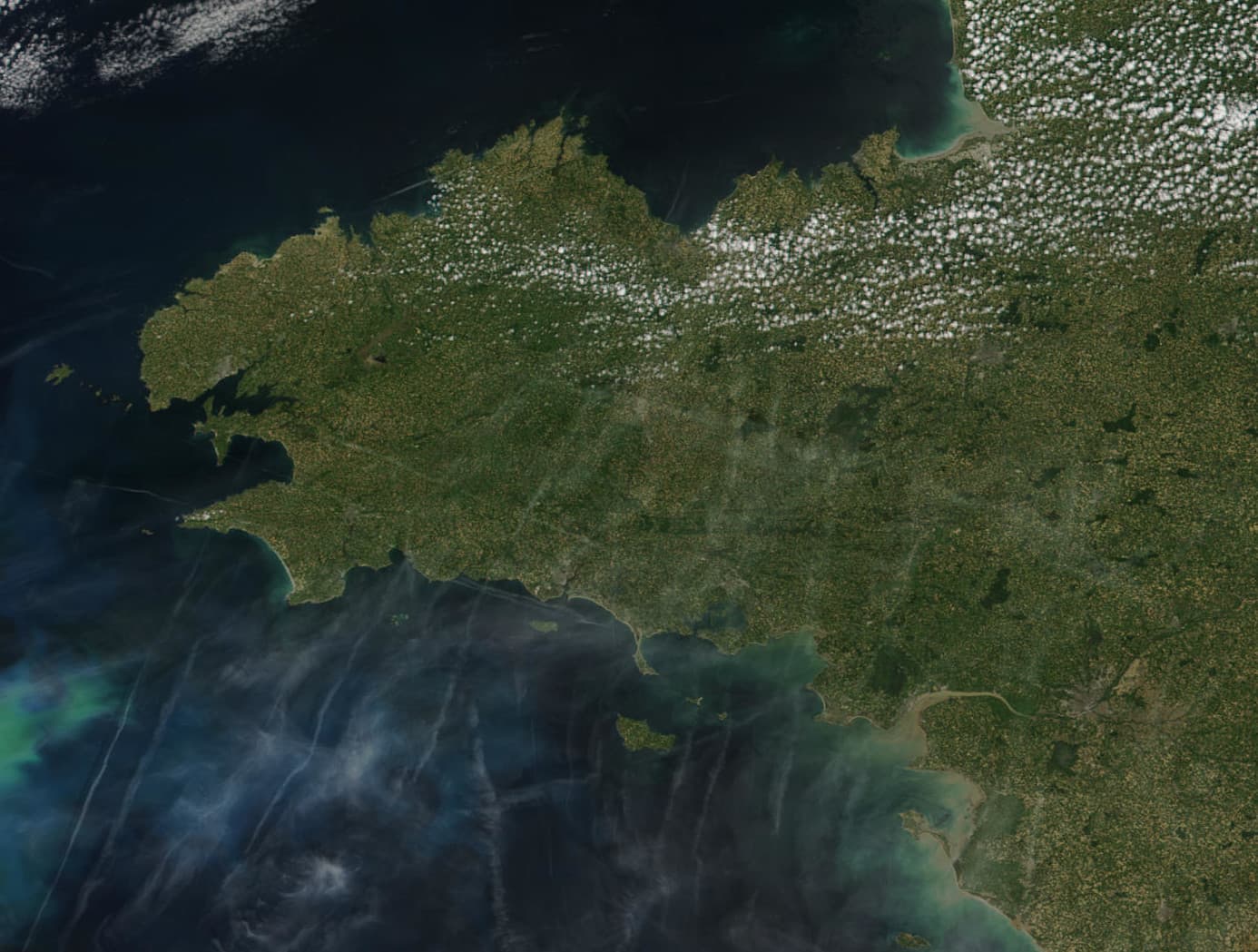 Credit: Jacques Descloitres, MODIS Rapid Response Team, NASA/GSFC / public domain, via Wikimedia Commons
Self-guided audio walking tour of Pontivy — GPS route, offline playback, story-driven narration in 32 languages.
“Where medieval lanes meet Napoleonic grandeur.”
Not the postcards. The stories even locals don't know — whispered in your ear, right where they happened.
The formidable Château des Rohan, a 15th-century fortress, once served a dual purpose that might surprise you.
Wandering through Pontivy's medieval Old Town, you'll find Rue du Fil, a street whose name hints at a very specific, prosperous past.
While the Basilique Notre-Dame de Joie is a significant religious site, a curious detail within its architecture often goes unnoticed.
Discover every secret of Pontivy
Every address, every reveal in full — in your ear, right where it happened.
You pick your stops. You walk. The voice reveals what the others miss.


Your self-guided audio tour of Pontivy is ready — pick your landmarks, choose your language, and start the moment you arrive.
BuyLume has a built-in augmented-reality guide. Hold your phone up and its camera shows the street ahead of you, with a glowing arrow laid over the real view that always points to your next stop — no map to puzzle over, no wrong turns. Like everything in Lume, it works fully offline.
Pontivy, a town in the Morbihan department of Brittany, France, offers a striking blend of medieval heritage and Napoleonic urban planning. The town's singular character stems from its dual identity: an ancient stronghold of the powerful Rohan family and a "new town" envisioned by Napoleon Bonaparte.
Divided into two distinct sections, Pontivy unfolds a journey through contrasting architectural styles. The medieval quarter features narrow, winding lanes and half-timbered houses, while the Napoleonic district presents a grid-like layout with grand 19th-century buildings and wide avenues. This captivating juxtaposition, along with its location along the Blavet River and the Nantes-Brest Canal, makes Pontivy a compelling destination for those interested in history, architecture, and tranquil waterways.
## From Ancient Origins to Rohan Power Pontivy's origins trace back to the 7th century when a monk named Ivy is said to have built a bridge over the Blavet River, giving the town its name, 'Pont-Ivy' (Ivy's bridge). The town remained modest until the 12th century when the Viscounts of Rohan established their seat here, transforming Pontivy into an important political and administrative center. In 1485, Jean II de Rohan began construction of the formidable Château des Rohan, a military fortress that also served as a residence, solidifying the family's presence in central Brittany. The medieval quarter flourished around this castle, with streets like Rue du Fil becoming the economic hub for cloth and leather merchants.
## Napoléonville: An Imperial Vision The late 18th and early 19th centuries marked a dramatic shift for Pontivy. Recognized by Napoleon Bonaparte for its strategic position, he envisioned it as a crucial administrative and military center. In 1802, Napoleon ordered the town's transformation, leading to the creation of a new district with a grid-like street plan, grand buildings, and wide avenues. For a period, the town was even renamed Napoléonville, reflecting its significance during the imperial era. This ambitious urban project included the construction of a courthouse, town hall, and sub-prefecture around Place Aristide Briand. The Nantes-Brest Canal, ordered by Napoleon I in 1806 to bypass the British blockade, further integrated Pontivy as a strategic hub. Today, Pontivy remains unique in France for preserving this dual identity, a testament to both its medieval past and Napoleonic ambition.
Begin your exploration at the Château des Rohan, a 15th-century fortress that dominates the town. While parts were damaged in 2014 and reconstruction is ongoing, guided tours often provide access to the courtyard and interiors. From there, delve into the medieval Old Town (Ville Médiévale), a labyrinth of narrow, winding lanes and half-timbered houses. Highlights include Place du Martray, a historic square, and Rue Nationale, lined with shops and cafes.
Next, experience the contrast of the Napoléonville District, characterized by its wide, straight avenues and elegant 19th-century Neoclassical architecture. Place Aristide Briand serves as the central square, flanked by significant imperial-era buildings. The Nantes-Brest Canal flows through Pontivy, offering tranquil settings for walks, cycling, or even kayaking. The Office de Tourisme is uniquely housed on the Duchesse Anne barge, providing a floating information point. Do not overlook the Basilique Notre-Dame de Joie, a 15th-century Gothic church known for its stained glass. For a broader cultural experience, consider the Festival des Chapelles in summer, showcasing art in historic chapels around the town.
The ideal time to visit Pontivy is between May and September, when the weather is mild and the town's gardens and canal paths are at their most beautiful. Summer offers a lively atmosphere with festivals and outdoor events like L'Art dans les Chapelles. Spring and autumn provide a quieter charm, perfect for hiking and cycling without the larger crowds. While winters are cooler and wetter, they can offer a peaceful experience with fewer visitors.
Pontivy is accessible by car and regional bus services; it's about an hour from Vannes and Lorient, and 1.5 hours from Rennes by car. While there's no train station directly in Pontivy, nearby towns like Auray and Lorient are well-connected by train, with onward bus or car travel available. Parking is convenient, with free and paid options near the town center, château, and canal. The town center is best explored on foot, particularly the medieval quarter. For exploring the surrounding area, including local chapels and villages, a car is generally recommended. The BreizhGo bus network connects Pontivy to Rennes in about 1 hour 20 minutes to 1 hour 40 minutes. The local currency is the Euro (EUR).
Pontivy in Korean, in Chinese or in Hebrew — and 29 more languages, every stop narrated by a native voice. The widest language range of any self-guided audio tour.
Available in: