Montoulon Hill
The tranquil vista from Montoulon Hill conceals a tumultuous past.
Full story unlocks in the tour
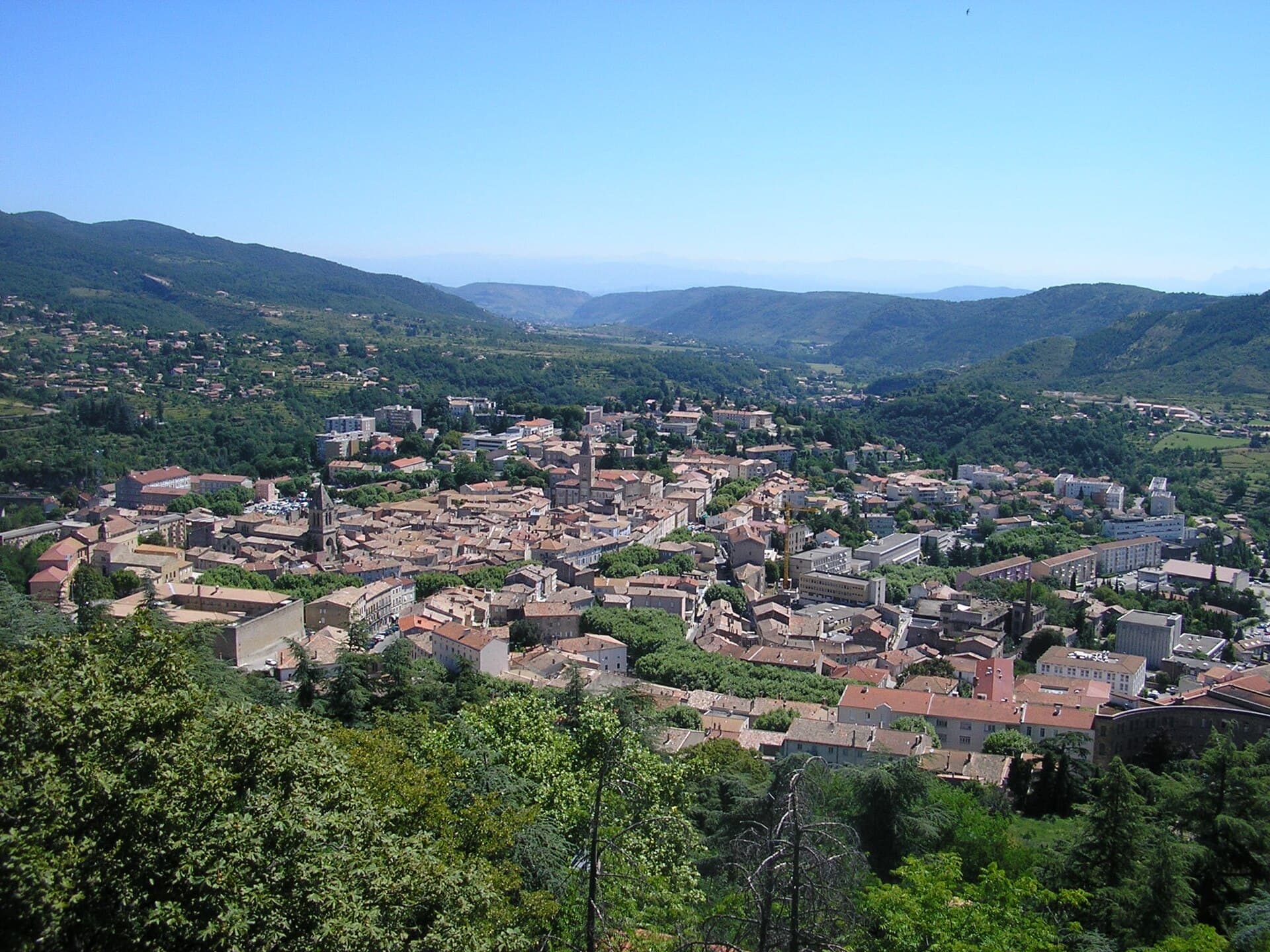 Anotine / CC BY-SA 3.0, via Wikimedia Commons
Self-guided audio walking tour of Privas — GPS route, offline playback, story-driven narration in 32 languages.
“Where history's echoes mingle with the sweet perfume of chestnuts.”
Not the postcards. The stories even locals don't know — whispered in your ear, right where they happened.
The tranquil vista from Montoulon Hill conceals a tumultuous past.
Privas is the global center for a particular sweet confection, yet its origins are tied to a surprising historical challenge.
This unassuming bridge bears a royal designation, though its narrative is far from a peaceful construction tale.
Discover every secret of Privas
Every address, every reveal in full — in your ear, right where it happened.
You pick your stops. You walk. The voice reveals what the others miss.


Your self-guided audio tour of Privas is ready — pick your landmarks, choose your language, and start the moment you arrive.
BuyLume has a built-in augmented-reality guide. Hold your phone up and its camera shows the street ahead of you, with a glowing arrow laid over the real view that always points to your next stop — no map to puzzle over, no wrong turns. Like everything in Lume, it works fully offline.
Privas, the smallest prefecture in France, rests upon a rocky outcrop within the Ouvèze valley, encircled by the dramatic gorges and rugged hills of the Ardèche department. This serene town, characterized by its stone structures and terracotta roofs, acts as a portal to the Monts d'Ardèche Regional Nature Park, offering a fusion of historical intrigue and natural splendor.
While the town itself might appear modest, its strategic placement at the base of the Coiron plateau, where three rivers – the Mezayon, Ouvèze, and Charalon – converge, has shaped its compelling narrative. Privas is particularly celebrated as the capital of candied chestnuts and chestnut cream, a sweet legacy deeply interwoven with the region's agricultural heritage.
The earliest evidence of human presence in the Privas area dates back to the 1st century CE, with the discovery of a Gallo-Roman villa at the hamlet of Le Lac. The initial settlement of Privas itself began to form between the 11th and 12th centuries around the first Saint-Thomas church, now located in Place de la République. By the 13th century, a castrum (castle) was erected, and the town was fortified with walls, indicating its increasing significance.
Privas's destiny took a dramatic turn in the 16th century with the spread of the Protestant Reformation. The town swiftly became a vital center of the Protestant movement in eastern France, earning it the moniker "le Rempart de la Réforme" (the Bulwark of the Reformation) and even "the little Rochelle." For over 70 years, Catholic mass ceased to be observed in Privas, and the Catholic church was demolished in 1570, reflecting the town's unwavering Protestant identity. Privas functioned as a place de sûreté particulière, a self-governed Protestant stronghold under figures like Jacques de Chambaud.
This defiance, however, led to severe consequences during the French Wars of Religion. In 1629, King Louis XIII and Cardinal Richelieu, commanding an army of 20,000 troops, besieged Privas, deeming it rebellious and disobedient to royal authority. Despite natural defenses provided by surrounding gorges, the town was seized after a 15-day siege, resulting in the execution of surviving defenders, imprisonment, or deportation to serve as galley slaves. The majority of the town's structures were consumed by fire or cannon, leaving Privas a desolate place for many years. It is estimated that one-fifth of the Protestant population of the Ardèche emigrated as a result of this defeat.
Privas was eventually reconstructed in the 17th and 18th centuries, with its motto, "celle que la violence a détruite, sa propre énergie l'a ressuscitée" (that which violence destroyed, its own energy resurrected), reflecting its resilience. During the French Revolution, Privas became the prefecture of the newly formed Ardèche department. Today, while few traces of the pre-1629 city remain, landmarks like the Pont Louis XIII and the Tour Diane de Poitiers offer glimpses into its turbulent past.
Begin your exploration of Privas with a walk along its historic trail, marked with 24 information boards that guide you through the town's past. The 15th-century Tour Diane de Poitiers, a Renaissance-style tower on Place de la République, offers a window into the city's appearance before the 1629 siege. Nearby, the Pont Louis XIII, a stone bridge spanning the Ouvèze River, stands as a testament to the town's resilience, rebuilt after its destruction during the siege.
Ascend to the Montoulon site, where three monumental crosses and a sculpted Pietà survey Privas, providing sweeping views of the town's rooftops and the Ardèche Mountains. For a deeper immersion into local culture, visit the Protestant Temple, constructed in the first half of the 19th century, and the Church of Saint-Thomas, built in 1884 in a Neo-Romanesque style. The Town Hall, with its prominent clocktower erected in 1937, exemplifies pre-World War II French architecture.
Beyond the town center, Privas serves as a gateway to the Parc Naturel Régional des Monts d'Ardèche, offering opportunities for hiking, canyoning, and rock climbing. Nearby villages like Mirmande and Vogüé are recognized as some of France's most beautiful and are worth exploring. Do not miss the local markets on Wednesday and Saturday mornings in the Place de l'Hôtel de Ville, where you can sample regional products, including the renowned chestnut specialties.
The most favorable time to visit Privas is during May, June, July, August, and September, when the weather is agreeable with average temperatures ranging from 21°C to 29°C (70°F to 84°F). These months are ideal for sightseeing and outdoor pursuits. While July offers the most sunshine, it can also be quite warm, with average highs around 29°C (84°F). October is the wettest month, and February is the driest. For warm-weather activities, mid-June to early September is recommended.
Privas is situated in the Ardèche department, which is distinctive in France for lacking a train station. The most straightforward way to reach Privas is by car or bus, with regular bus services available from the TGV station in nearby Valence, a journey of approximately an hour. Within the town, walking offers the best means to explore its historic core. For information on outdoor activities and rentals, the Office de Tourisme Privas-Rhône et Vallées is located at 3, Place Général de Gaulle. While generally secure, travelers should observe standard precautions, particularly concerning pickpocketing in bustling tourist areas.
Privas in Korean, in Chinese or in Hebrew — and 29 more languages, every stop narrated by a native voice. The widest language range of any self-guided audio tour.
Available in: