Czartoryski Palace and Park Complex
This grand estate once served as a lively intellectual center, earning Puławy a lofty nickname. What became of its invaluable collections?
Full story unlocks in the tour
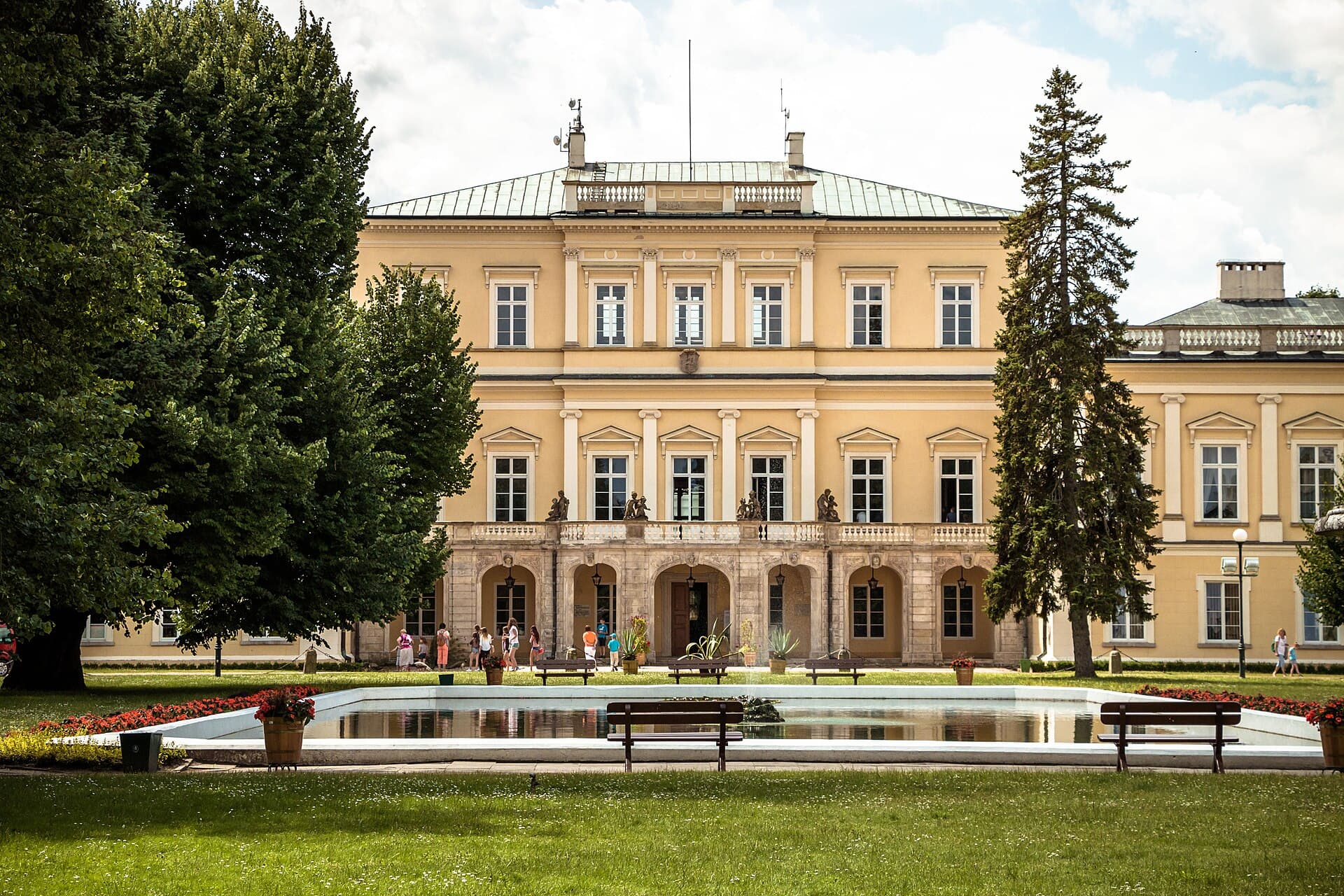 Krzysztof Kosowski / CC BY-SA 3.0 pl, via Wikimedia Commons
Self-guided audio walking tour of Puławy — GPS route, offline playback, story-driven narration in 32 languages.
“Where Polish Athens once bloomed, echoes of grandeur and resilience remain.”
Not the postcards. The stories even locals don't know — whispered in your ear, right where they happened.
This grand estate once served as a lively intellectual center, earning Puławy a lofty nickname. What became of its invaluable collections?
A seemingly ancient structure within the park holds a surprising literary connection.
Before World War II, a significant portion of Puławy's inhabitants were Jewish, fostering a thriving community life. What became of their cultural landmarks?
Discover every secret of Puławy
Every address, every reveal in full — in your ear, right where it happened.
You pick your stops. You walk. The voice reveals what the others miss.


Your self-guided audio tour of Puławy is ready — pick your landmarks, choose your language, and start the moment you arrive.
BuyLume has a built-in augmented-reality guide. Hold your phone up and its camera shows the street ahead of you, with a glowing arrow laid over the real view that always points to your next stop — no map to puzzle over, no wrong turns. Like everything in Lume, it works fully offline.
Puławy, a city where the Vistula and Kurówka Rivers meet in eastern Poland, invites visitors on a compelling journey through Polish history and culture. What began as a small settlement near a Vistula River ford blossomed into a significant cultural and political hub under the Czartoryski family in the late 18th century, earning it the moniker 'Polish Athens.'
Today, Puławy presents a harmonious blend of historical grandeur and modern scientific endeavor. It stands as a local center for science, industry, and tourism, forming part of a popular tourist triangle with nearby Nałęczów and Kazimierz Dolny. The city encourages visitors to explore its aristocratic past, delve into its scientific traditions, and appreciate its scenic riverside location.
## From Riverside Settlement to 'Polish Athens' Puławy's origins can be traced back to the 15th century as a settlement strategically positioned near a Vistula River ford. By the late 17th century, it became the rural residence of powerful noble families, initially the Lubomirskis and then the Sieniawskis. Prince Stanisław Herakliusz Lubomirski constructed a summer palace between 1676 and 1679, now recognized as the Czartoryski Palace.
## The Czartoryski Golden Age In 1731, the estate transferred to the Czartoryski family, marking the commencement of Puławy's 'Golden Age.' Under Prince Adam Kazimierz Czartoryski and his wife Izabela Czartoryska, Puławy transformed into a leading cultural and political center, frequently referenced as 'Polish Athens' or 'The Athens of the North.' Princess Izabela established Poland's first permanent museum in the Temple of the Sibyl in 1801, gathering national memorabilia to safeguard Polish identity during a period of partitions.
## Russian Rule and Rebirth This era of magnificence concluded abruptly with the November Uprising of 1830-31. Due to the Czartoryski family's backing of the rebels, the estate was confiscated by the Russian government. In 1842, the Tsarist authorities even renamed the town to New Alexandria. Despite this, Puławy embarked on a gradual modernization process, acquiring city rights in 1906.
## Wars, Occupation, and Industrial Growth Both World Wars brought considerable destruction to Puławy. During World War II, the town was seized by the Wehrmacht, and its Jewish population, which comprised a significant portion of the inhabitants, was tragically confined to a ghetto and later murdered. However, the city exhibited remarkable resilience. In the post-war period, a major turning point arrived in 1960 with the decision to construct a large chemical plant, Zakłady Azotowe Puławy. This industrial development spurred rapid growth and transformed Puławy into a significant industrial and scientific center.
Begin your exploration at the Czartoryski Palace and Park Complex, the very heart of Puławy's historical significance. The Baroque-Classicist palace, dating from the late 17th century and re-imagined around 1800, is encircled by a sprawling 30-hectare English landscape garden.
Within the park, discover the Temple of the Sibyl, a colonnaded circular structure that once housed Poland's first museum. Nearby stands the Gothic House, a neo-Gothic pavilion built upon the foundations of an earlier Baroque structure. Wander through the romantic alleys and admire the classicist park pavilions.
Beyond the palace grounds, consider a visit to the Kościół pw. Świętego Józefa (St. Joseph's Church), a Roman Catholic parish church with a history reaching back to 1676. For those drawn to the natural world, the Rezerwat Łęg na Kępie w Puławach is a nature reserve worth exploring. Puławy also serves as a Vistula River port, offering a different perspective of the city from the waterfront.
The most opportune time to visit Puławy for comfortable weather and to enjoy outdoor attractions is during the late spring (May, June) and early autumn (September). Temperatures are pleasant, and the crowds are generally more manageable than in the peak summer months of July and August. Summer offers the warmest weather, but it is also the busiest and can experience more rainfall. Winters are cold and snowy, providing a tranquil atmosphere and festive Christmas markets in nearby larger cities during December.
Puławy is readily accessible by train, with Puławy Station serving as the primary hub for arrivals and departures. The city also sits on Polish Expressway S12, making road travel convenient. For local navigation, public transportation is available. While English is spoken in major tourist areas, learning a few basic Polish phrases like 'Dzień dobry' (Good day) and 'Dziękuję' (Thank you) is always appreciated. Poland is generally a safe country, but it is always wise to take precautions with valuables. Be aware that many shops in Poland are closed on Sundays, though smaller convenience stores like Żabka often remain open. The local currency is the Polish Złoty (PLN).
Puławy in Korean, in Chinese or in Hebrew — and 29 more languages, every stop narrated by a native voice. The widest language range of any self-guided audio tour.
Available in: