Reszel Castle Dungeon
Beneath the castle's formidable towers lies a dungeon with a chilling claim to fame.
Full story unlocks in the tour
 Matthias Bethke / CC BY-SA 4.0, via Wikimedia Commons
Self-guided audio walking tour of Reszel — GPS route, offline playback, story-driven narration in 32 languages.
“Where medieval walls recount tales of bishops, battles, and Europe's last alleged witch.”
Not the postcards. The stories even locals don't know — whispered in your ear, right where they happened.
Beneath the castle's formidable towers lies a dungeon with a chilling claim to fame.
Even the castle's inviting bar has an unexpected, spectral patron.
This medieval fortress once welcomed a renowned figure of the Polish Enlightenment.
Discover every secret of Reszel
Every address, every reveal in full — in your ear, right where it happened.
You pick your stops. You walk. The voice reveals what the others miss.


Your self-guided audio tour of Reszel is ready — pick your landmarks, choose your language, and start the moment you arrive.
BuyLume has a built-in augmented-reality guide. Hold your phone up and its camera shows the street ahead of you, with a glowing arrow laid over the real view that always points to your next stop — no map to puzzle over, no wrong turns. Like everything in Lume, it works fully offline.
Above the winding Sajna River in northeastern Poland, Reszel is a small town that feels suspended in time. Its well-preserved medieval character, dominated by a striking Gothic castle and a picturesque market square, offers a captivating glimpse into centuries past. Far from the bustling tourist routes, Reszel provides a tranquil and authentic experience of the Warmia region.
Stepping onto Reszel's ancient streets, you will discover a town that has embraced its heritage, earning it the distinction of being the first Polish member of the Cittaslow movement. The red-brick architecture, gothic bridges, and remnants of defensive walls create an evocative atmosphere, inviting leisurely exploration. Whether you are drawn to its enduring history, architectural beauty, or the serene surrounding landscapes, Reszel promises a unique and memorable journey.
## From Prussian Stronghold to Polish Cornerstone Reszel's origins trace back to a settlement of the Old Prussian Bartian tribe, conquered by the Teutonic Knights in 1241. The Knights initially constructed a timber and earth watchtower, which was repeatedly destroyed and rebuilt due to persistent Prussian rebellions. In 1254, the lands around Reszel were granted to the Warmian bishop, though the Teutonic Order maintained control of the strategic stronghold until around 1300.
Construction of the formidable brick castle, the town's most iconic landmark, began between 1350 and 1401 under the initiative of Bishop John I of Meissen. This Gothic fortress served as both a defensive stronghold and an administrative center for the Warmian bishops. Over the centuries, the castle and town witnessed numerous conflicts, changing hands between Polish and Teutonic forces. Following the Polish victory at the Battle of Grunwald in 1410, King Władysław II Jagiełło briefly captured the town. Reszel later joined the anti-Teutonic Prussian Confederation in 1440, leading to its incorporation into Poland in 1454, an event that sparked the Thirteen Years' War.
By the 17th century, the castle began to lose its military significance, transitioning into a summer residence for the bishops. However, its turbulent history continued. In 1772, Reszel was annexed by Prussia during the First Partition of Poland, and by 1795, the castle was converted into a prison. The town suffered a devastating fire in 1806, which nearly destroyed the entire settlement, including parts of the castle. It was during this period that Barbara Zdunk, accused of arson and witchcraft, was imprisoned in the castle and subsequently executed in 1811, an event often cited as Europe's last witch burning.
Despite the challenges, Reszel underwent reconstruction in the 19th century, with notable contributions from master builder Karl Friedrich Schinkel to the castle chapel. Remarkably, Reszel largely escaped major damage during World War II, preserving much of its historic urban fabric. Today, the castle houses a museum, an art gallery, a hotel, and a restaurant, continuing its long and varied life as a cultural and historical cornerstone of the region.
Begin your exploration at the Bishop's Castle, a magnificent Gothic fortress that now functions as a hotel, museum, and art gallery. Climb its imposing tower for expansive views of Reszel and the surrounding Warmian landscape. Inside, explore the knight's hall and a fascinating, albeit stark, exhibition of historical torture instruments. Do not miss the castle's dungeon, a site connected to the infamous Barbara Zdunk.
Adjacent to the castle, discover the Gothic Church of Saints Peter and Paul. This monumental, three-nave church, rebuilt over centuries, features octagonal pillars supporting a striking star vault. Ascend its 52-meter tower for another excellent vantage point of the town.
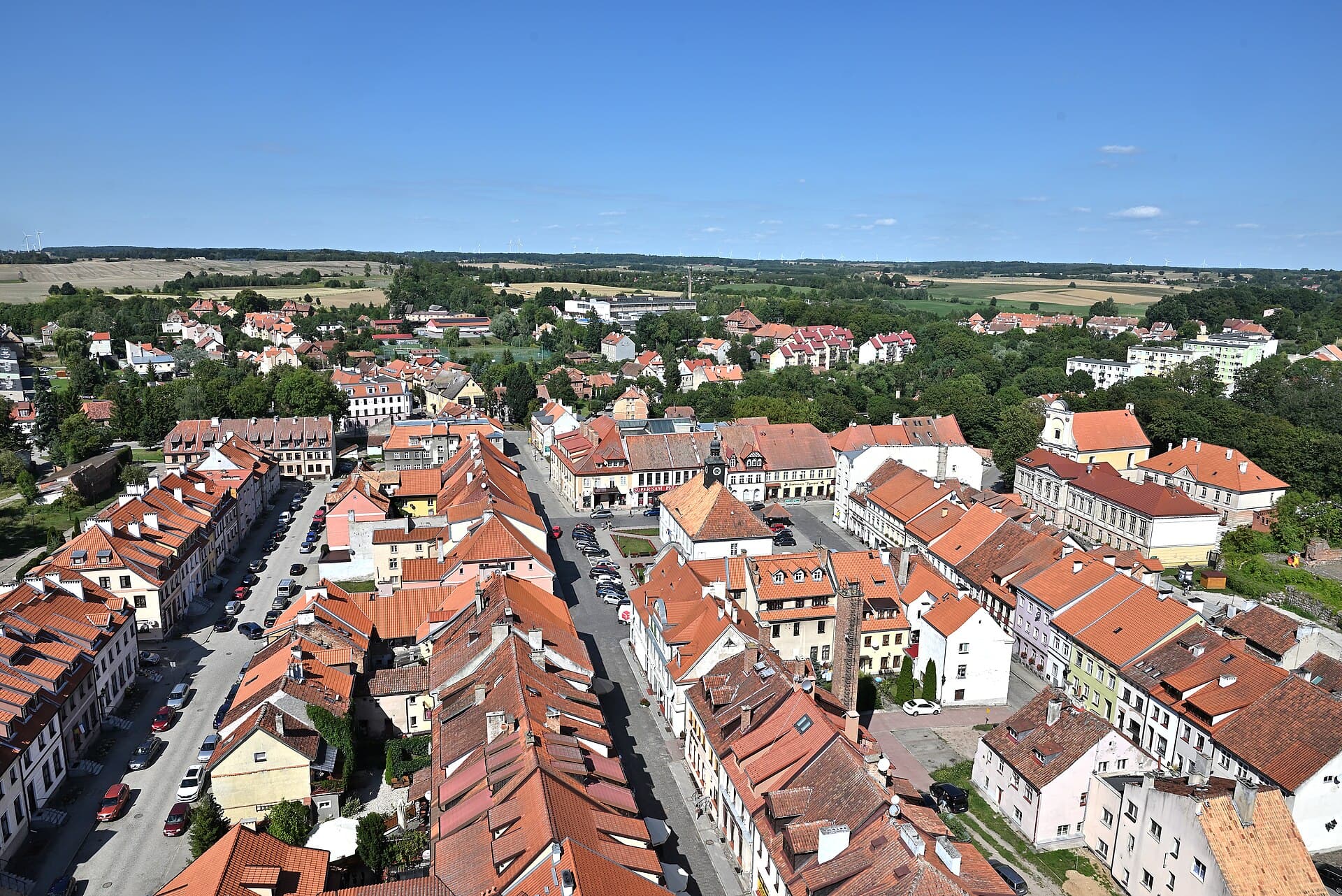
Stroll through the Market Square, the heart of Reszel's old town, surrounded by elegant, low townhouses. In the center stands the classicist Town Hall, rebuilt after the 1806 fire. Wander the narrow streets like Sienkiewicza, Wyspiańskiego, and Reymonta, which lead away from the square, revealing more of the town's preserved architectural charm.
Consider a visit to the oldest rectory in Warmia, situated between the castle and the church, its history dating back to the 14th century. For a unique experience, take the 6 km Pilgrimage Route to Święta Lipka, adorned with Baroque chapels and ancient lime trees, leading to the renowned Baroque Basilica of the Visitation of the Blessed Virgin Mary.
The ideal time to visit Reszel is during late spring (May-June) and early autumn (September-October). The weather is mild and pleasant, perfect for exploring the town's historical sites and the surrounding natural beauty without the peak summer crowds. Summer (July-August) offers warm, sunny weather and longer daylight hours, but also sees more visitors. Winter (December-February) is cold and often snowy, offering a quiet, atmospheric experience, especially around the holidays, though some attractions may have reduced hours.
Reszel is approximately a 1-hour drive (67 km) from Olsztyn, or about 30 minutes from Mrągowo. The town does not have a train station; the nearest is in Kętrzyn, from where you can arrange onward travel by taxi or bus. For visiting Reszel itself, half a day is generally sufficient, allowing time for the castle, church, and market square. The castle houses a hotel and restaurant, offering a unique opportunity to stay within its historic walls. Comfortable shoes are recommended for exploring the ancient streets and climbing the castle and church towers. While Polish is the official language, English may be spoken at major tourist attractions like the castle. The local currency is the Polish Złoty (PLN).
Reszel in Korean, in Chinese or in Hebrew — and 29 more languages, every stop narrated by a native voice. The widest language range of any self-guided audio tour.
Available in: