Piatra Secuiului (Székelykő) Mountain
Most places only experience one sunrise, but in Rimetea, the sun has a peculiar habit of appearing twice.
Full story unlocks in the tour
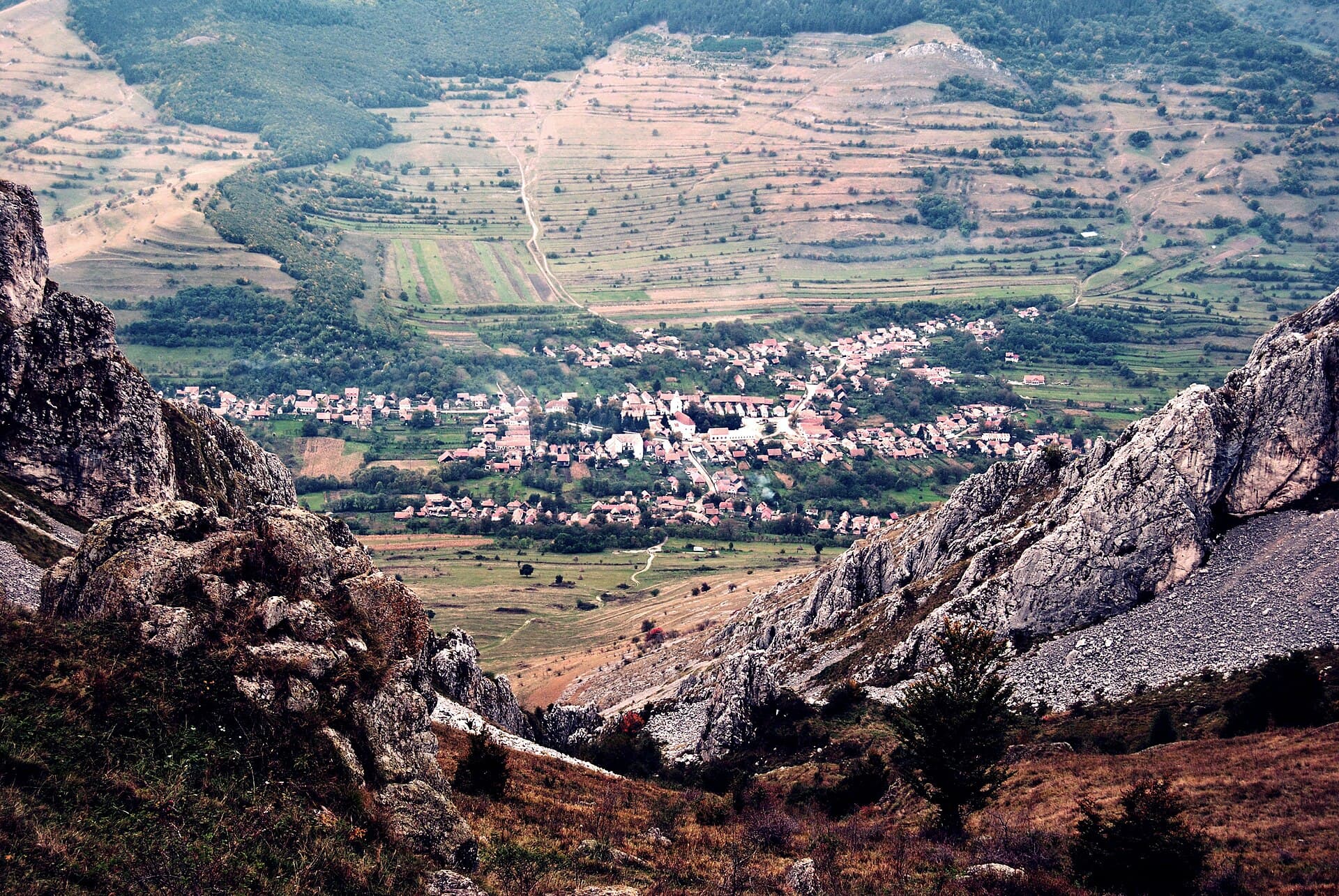 Andrea Polereczky / CC BY-SA 3.0, via Wikimedia Commons
Self-guided audio walking tour of Rimetea — GPS route, offline playback, story-driven narration in 32 languages.
“Where the sun rises twice, and time stands still in white and green.”
Not the postcards. The stories even locals don't know — whispered in your ear, right where they happened.
Most places only experience one sunrise, but in Rimetea, the sun has a peculiar habit of appearing twice.
Among Rimetea's many preserved houses, one stands as a true survivor, holding a secret about its remarkable age.
The rhythmic clang of a hammer on anvil carries an ancient secret in Rimetea, a sound that has resonated for centuries.
Discover every secret of Rimetea
Every address, every reveal in full — in your ear, right where it happened.
You pick your stops. You walk. The voice reveals what the others miss.


Your self-guided audio tour of Rimetea is ready — pick your landmarks, choose your language, and start the moment you arrive.
BuyLume has a built-in augmented-reality guide. Hold your phone up and its camera shows the street ahead of you, with a glowing arrow laid over the real view that always points to your next stop — no map to puzzle over, no wrong turns. Like everything in Lume, it works fully offline.
Within the dramatic embrace of the Apuseni Mountains in Transylvania, Rimetea (Torockó in Hungarian) is a village that appears to exist outside the relentless march of time. Its striking landscape, dominated by the imposing Piatra Secuiului (Székelykő) mountain, sets the stage for a truly singular experience. What immediately captures the eye are the approximately 130 idyllic white houses with their distinctive green shutters and flat gables, standing shoulder to shoulder like a perfectly arranged tableau. This architectural uniformity, largely preserved from the 17th to 19th centuries, earned Rimetea the prestigious Europa Nostra award for cultural heritage preservation in 1999, making it the first village in Romania to receive such an honor.
More than just a picturesque sight, Rimetea is a living testament to a rich cultural blend. While part of Romania, the village is predominantly Hungarian, with Szekler Hungarian spoken in its doorways and signs often displayed in both Romanian and Hungarian. This strong cultural identity is deeply intertwined with its history as a former iron mining and blacksmithing center, a legacy evident in its ethnographic museum and the traditional crafts still practiced today. Travelers are drawn not only by its visual charm but also by the promise of a rare natural phenomenon: the 'double sunrise,' where the sun appears to rise twice in a single morning, a captivating geographical illusion caused by the surrounding mountains.
## From Roman Roots to Mining Prosperity Rimetea's story stretches back to Roman times, with archaeological evidence suggesting activity in the area during prehistory. While a Roman presence within the valley itself is unconfirmed, the strategic flat top of Piatra Secuiului was likely inhabited due to its clear views and access to game, offering a defensive advantage. The village's Hungarian name, Torockó, is believed to have Old Slavic origins, indicating the presence of Slavic settlers before the arrival of Hungarian migrants.
## The Iron Heart of Transylvania The settlement's development became inextricably linked to the extraction and processing of iron, a natural mineral abundant in the surrounding land. By the 13th century, Rimetea was a thriving mining and blacksmiths' center, attracting German miners in the late 14th and early 15th centuries. By 1716, the village featured 16 melting furnaces and 16 hydraulic hammers, making it one of Transylvania's main iron processing hubs, forging tools for the entire region and eastern Hungary. This prosperity fostered a high standard of living and even led to legal battles by inhabitants seeking liberation from serfdom.
## Fire, Decline, and Rebirth Despite its economic growth, Rimetea faced challenges. A major fire in 1870 destroyed a significant portion of the houses, though the resilient miners managed to rebuild. However, the late 19th century brought a decline in the mining industry and a recession in craftsmanship, leading to a decrease in population. The 20th century saw industrialization further impact traditional manufacturing and mining. The village was officially renamed Rimetea in 1925, several years after Transylvania's union with Romania.
## A Model of Preservation A turning point arrived in 1996 when locals, in partnership with the Transylvania Trust Foundation, initiated a conservation project. This ambitious undertaking aimed to restore traditional houses built between the 17th and 19th centuries, emphasizing the importance of their architectural heritage without altering the original facades. The project's success was recognized in 1999 with the European Union Prize for Cultural Heritage (Europa Nostra award), and in 2000, Rimetea was designated a protected architectural and urban area by the Romanian National Register for Historical Monuments. Today, Rimetea stands as an exceptional example of a deliberately preserved traditional human settlement, a living example of rural life before the agricultural revolution.
Rimetea is a village best explored on foot, allowing you to appreciate its distinctive architecture and serene atmosphere. The main street, stretching 800 meters, is lined with the iconic white houses and green shutters that define the village's aesthetic.
Begin your exploration at the Ethnographic Museum, located in the village center. It houses a comprehensive collection of over 11,000 objects, including folk costumes, hand-painted items, and tools reflecting the historical occupations of mining, metallurgy, and woodworking. Do not miss the balcony for a panoramic view of Piatra Secuiului.
Just a short walk away is the Unitarian Church, dating from the 17th to 18th centuries. Nearby, the old watermill (Vizimalom), built in 1752, is still functional and offers a glimpse into traditional grain processing. A private tour by the owner often includes stories and insights into local history.
For those seeking outdoor adventure, the Piatra Secuiului (Székelykő) mountain is a prominent landmark. A hike to its summit offers expansive 360-degree views of Rimetea's white houses and the surrounding hay fields. The mountain also offers over 80 bolted routes for rock climbing. Another rewarding hike is the Haystack Trail to Colțești village, passing charming haystacks and leading to the ruined Colțești Fortress, built in 1296. The fortress offers a dramatic backdrop and further panoramic views.
For a truly memorable experience, consider a sunset photography session from the Calvinist cemetery. The cemetery hill, a 15-minute climb, provides the ideal vantage point as the white houses glow orange against the setting sun.
Rimetea offers distinct charms throughout the year. For warm-weather activities like hiking and exploring, the best time to visit is from late June to late August, when temperatures are comfortable, averaging highs of 73°F (23°C) in July. Spring (April to June) is also delightful, with wildflowers blooming and mild temperatures perfect for outdoor pursuits. September brings pleasant weather, with fewer rainy days and beautiful morning fogs for photographers. However, July and August can be crowded with tourists. Winters are freezing and snowy, with average lows of 18°F (-8°C) in January, making it less ideal for extensive outdoor exploration.
Rimetea is located approximately 60 km from Cluj-Napoca (about a 1-hour drive) and 38 km from Turda (a 30-minute drive). From Cluj-Napoca, you can take DN1 to Turda, then scenic DJ107M through the Apuseni Mountains. Public transport options include a morning school bus from Alba Iulia that reaches Rimetea at 7:45 AM and returns at 4 PM. Taxis from Turda station are also an option, but it is advisable to settle the fare beforehand.
The village itself is tiny, with most sights within a 10-minute walk, rendering bikes largely unnecessary due to the steep surrounding hills. Accommodation is primarily found in guesthouses. While some places may accept Hungarian Forints or Romanian Lei, it is essential to carry cash, as the closest ATM is 20km away in Aiud, and cards are generally not accepted. Remember that the Calvinist service on Sundays is held in Hungarian, and visitors are welcome, though men should remove their hats and shoulders should be covered.
Rimetea in Korean, in Chinese or in Hebrew — and 29 more languages, every stop narrated by a native voice. The widest language range of any self-guided audio tour.
Available in: