Yvon Nicolazic's House
The modest dwelling of the farmer who witnessed the apparition of Saint Anne holds a secret beyond its reconstructed walls.
Full story unlocks in the tour
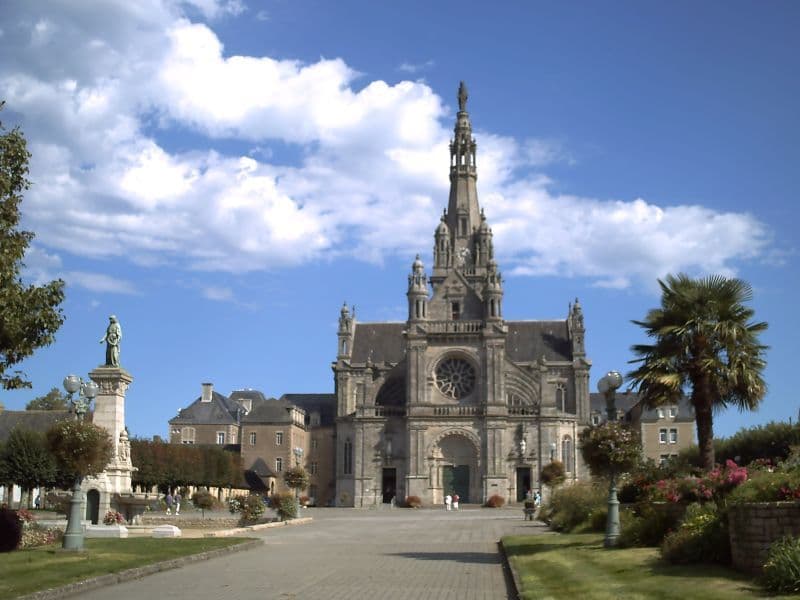 Monstruosator / CC BY-SA 3.0, via Wikimedia Commons
Self-guided audio walking tour of Sainte-Anne-d'Auray — GPS route, offline playback, story-driven narration in 32 languages.
“Where a saint's whisper shaped a region's faith.”
Not the postcards. The stories even locals don't know — whispered in your ear, right where they happened.
The modest dwelling of the farmer who witnessed the apparition of Saint Anne holds a secret beyond its reconstructed walls.
Within the grand basilica, among its many sacred objects, lies a surprising connection to a modern pontiff.
Beyond the carefully tended paths and monuments, the very earth of the sanctuary park once presented an unusual challenge to local farmers.
Discover every secret of Sainte-Anne-d'Auray
Every address, every reveal in full — in your ear, right where it happened.
You pick your stops. You walk. The voice reveals what the others miss.


Your self-guided audio tour of Sainte-Anne-d'Auray is ready — pick your landmarks, choose your language, and start the moment you arrive.
BuyLume has a built-in augmented-reality guide. Hold your phone up and its camera shows the street ahead of you, with a glowing arrow laid over the real view that always points to your next stop — no map to puzzle over, no wrong turns. Like everything in Lume, it works fully offline.
Sainte-Anne-d'Auray, a village in Brittany's Morbihan department, stands as a significant spiritual center in France, drawing hundreds of thousands of visitors each year. It is considered the sole place on Earth where Saint Anne, the grandmother of Christ, is said to have made an earthly appearance. This miraculous event in the 17th century transformed a small hamlet, then known as Keranna ('village of Anna' in Breton), into a major pilgrimage destination.
The heart of Sainte-Anne-d'Auray beats within its impressive neo-Gothic basilica, constructed between 1865 and 1872 to accommodate the ever-increasing numbers of pilgrims. The sanctuary complex extends beyond the basilica, encompassing a serene 7-hectare park, a historic cloister, and several other religious monuments. The town's enduring spiritual importance is underscored by visits from notable figures such as Napoleon III, General de Gaulle, and Pope John Paul II.
The history of Sainte-Anne-d'Auray stretches back to the 6th century, with ancient texts mentioning a chapel dedicated to Saint Anne in the hamlet of Keranna. However, this early chapel was eventually destroyed, its memory persisting primarily through local tradition. The pivotal moment in the town's history occurred in 1624 when Saint Anne is said to have appeared multiple times to a local farmer named Yvon Nicolazic. During these apparitions, Saint Anne instructed Nicolazic to rebuild the ancient chapel where she had once been revered.
Nicolazic, acting on these divine requests, uncovered a wooden statue marking the precise location for the new chapel. He constructed a chapel on this spot around 1630. News of these apparitions and the subsequent rebuilding spread rapidly throughout Brittany, attracting a growing number of pilgrims. Between 1633 and 1684, hundreds of miracles were reportedly recorded at the site. The devotion gained royal support, with Queen Anne of Austria and King Louis XIII contributing gifts, including a relic of Saint Anne brought from Jerusalem.
Despite the destruction of Nicolazic's chapel and the original statue during the French Revolution in 1793, the faithful continued to gather at the site. The increasing influx of pilgrims necessitated a larger structure. Consequently, the grand neo-Gothic Basilica of Sainte-Anne-d'Auray was constructed between 1865 and 1872, replacing Nicolazic's smaller chapel. In 1868, Pope Pius IX granted a Pontifical decree to crown the venerated image of Saint Anne, a ceremony that took place on September 30th of that year.
Sainte-Anne-d'Auray has maintained its status as a major pilgrimage site. It is the third most popular pilgrimage destination in France, after Lourdes and Lisieux. Pope John Paul II's visit in 1996 further elevated its international recognition, drawing a gathering of 500,000 people. The sanctuary continues to be a spiritual capital for Brittany, with the annual Grand Pardon of Saint Anne on July 26th attracting thousands of pilgrims for a time of prayer and celebration.
The primary attraction in Sainte-Anne-d'Auray is the Basilica of Sainte-Anne-d'Auray, a neo-Gothic edifice built between 1865 and 1872. Its soaring spire, reaching 80 meters, is crowned with a bronze statue of Saint Anne. Inside, visitors can admire stained-glass windows depicting the apparitions and the life of Saint Anne, as well as a Cavaillé-Coll organ. The basilica also houses relics of Saint Anne and Pope John Paul II, and the tomb of Yvon Nicolazic.
Adjacent to the basilica is the Carmelite Cloister, the oldest monument of the sanctuary, constructed between 1638 and 1641. This 17th-century structure, a fine example of Carmelite architecture, offers a space for quiet reflection and often hosts temporary exhibitions. The Sanctuary Park, spanning seven hectares, provides a peaceful setting for walks, featuring fountains, and a monument dedicated to fallen soldiers of World War I. Within the park, you can also find the Scala Santa, a holy staircase, and the Espace Jean-Paul II, commemorating the Pope's visit.
A short distance from the basilica is Yvon Nicolazic's house, reconstructed in traditional Breton style and furnished with period pieces, offering insight into the life of the seer. For those interested in local history and culture, the nearby town of Auray, with its appealing harbor of Saint-Goustan and medieval streets, is just 6 km away.
Sainte-Anne-d'Auray welcomes visitors throughout the year, but the ideal time to arrive often depends on individual preferences. The summer months, particularly July and August, offer warm weather and a lively atmosphere with numerous events, though crowds reach their peak. The most significant event, the Grand Pardon of Saint Anne, occurs annually around July 26th, drawing thousands of pilgrims. For a more serene experience with pleasant weather and fewer people, consider visiting in June or September. Spring also presents an ideal season, offering mild weather, blooming landscapes, and an opportunity to explore the region's heritage in a more peaceful setting. While winter is quieter and cooler, it provides a cozy atmosphere and a chance to explore without the bustling crowds.
Sainte-Anne-d'Auray is readily accessible, situated just a few kilometers from the appealing medieval town of Auray. Auray is served by the TGV, connecting it to cities like Paris, Rennes, and Vannes. For local travel, the 'Tire-bouchon' line runs to Quiberon during specific periods.
Within Sainte-Anne-d'Auray, many attractions are within walking distance of the central sanctuary. For accommodation, options range from hotels like Brit Hotel Kara Sainte Anne d'Auray and L'Auberg'ine to various holiday rentals, including family-friendly and pet-friendly choices. Dining options encompass traditional French cuisine, crêperies, and bistronomic restaurants such as L'Auberge and Le Nature. The local Tourist Office can provide further information and assistance with planning your visit.
Sainte-Anne-d'Auray in Korean, in Chinese or in Hebrew — and 29 more languages, every stop narrated by a native voice. The widest language range of any self-guided audio tour.
Available in: